

When your asthma feels under control, it’s easy to forget to check your lungs. But the truth is, your airways can start closing long before you feel wheezing or shortness of breath. That’s where peak flow monitoring comes in - a simple, daily habit that can give you a heads-up before things get serious.
What Is Peak Flow Monitoring?
Peak flow monitoring measures how fast you can blow air out of your lungs after taking a deep breath. It’s done with a small, handheld device called a peak flow meter. The number you get - your peak expiratory flow (PEF) - tells you how open your airways are right now. It’s not a guess. It’s data.
This isn’t new. Doctors have been using peak flow meters since the 1950s. But it’s only in recent years that we’ve fully understood how powerful daily tracking can be. According to the 2023 Global Initiative for Asthma (GINA) guidelines, peak flow monitoring is still a key tool - especially when spirometry isn’t available or when you need to catch changes early.
Here’s the real win: your peak flow can drop 24 to 48 hours before you even notice symptoms. If you have asthma and don’t always feel when you’re worsening - maybe because you’ve gotten used to breathing a little harder - this tool is lifesaving.
How to Track Your Peak Flow Daily
Tracking isn’t just about blowing into a device. It’s about doing it the same way, every day, so your numbers mean something.
- Take your reading twice a day - once in the morning, once at night. Best times? Between 7 and 9 a.m. and 6 and 8 p.m.
- Use the same meter every single time. Different brands give different readings. Switching meters ruins your trend line.
- Stand up straight, take a deep breath, seal your lips around the mouthpiece, and blow out as hard and fast as you can. One big, forceful puff.
- Do it three times. Write down the highest number. Don’t average them. The highest is your real effort.
- Record it. Use a paper diary, a notes app, or a calendar. Consistency matters more than the tool you use.
Don’t skip days. Even if you feel fine. That’s how you build a baseline. If you’re new to this, track for two to three weeks when your asthma is stable. That’s how you find your personal best.
Finding Your Personal Best
Your personal best isn’t the number on the chart that comes with the meter. It’s not what your doctor says you “should” be able to do. It’s the highest number you’ve consistently reached when your asthma is under control.
For most people, that means taking readings twice daily for two to three weeks. During that time, avoid triggers, take your meds as prescribed, and don’t change your routine. The highest number you hit during that period? That’s your personal best.
And it’s not set in stone. If you’re a child, your personal best changes as you grow. Even adults might need to update it every six to twelve months - especially if your asthma control has shifted.
Here’s something most people don’t realize: your personal best might be lower than the “normal” range for your age or height. That’s okay. What matters is what’s normal for you.
The Green, Yellow, Red Zone System
Now that you know your personal best, it’s time to understand what your numbers mean. The standard system uses three color zones based on percentages of your personal best.
- Green Zone (80-100%): You’re in good control. No symptoms. No extra meds needed. Keep doing what you’re doing.
- Yellow Zone (50-79%): Warning signs. Your airways are narrowing. You might feel fine, but your lungs are telling a different story. This is when you follow your asthma action plan - maybe increase your preventer inhaler or add a short-acting rescue inhaler.
- Red Zone (below 50%): Medical alert. Your airways are severely restricted. You need to take your rescue inhaler right away and call your doctor or go to urgent care. Don’t wait.
Some people notice a drop of 20-30% from their personal best as an early warning. That’s the signal to check your peak flow more often and be ready to act. A drop of 20% might mean an asthma flare-up is coming - even if you’re not coughing or wheezing yet.
Who Needs to Track Daily?
Not everyone needs to check twice a day. It depends on your asthma severity.
- If you have severe or unstable asthma, track twice daily, every day. Keep a diary. You need the data to spot patterns before things spiral.
- If you have moderate asthma, twice daily is still recommended, especially if you’ve had recent flare-ups.
- If your asthma is mild and well-controlled, you might only need to check two to three times a week - or just when you feel something’s off.
But here’s the catch: if you’ve ever been hospitalized for asthma or needed a breathing machine, you should be tracking daily. Always. That’s not optional. It’s your early warning system.
Why Your Meter Matters
Not all peak flow meters are the same. A cheap one bought online might not match the one your doctor uses. That’s why you must use the same one every time.
Also, keep it clean. Wash the mouthpiece with warm, soapy water once a week. Let it dry completely. A dirty meter can give false low readings.
Bring your meter to every appointment. Your doctor should check it. Sometimes, a meter gets worn out. Or you’ve been using it wrong without realizing it.
What If Your Numbers Don’t Match How You Feel?
This happens. Sometimes your peak flow is in the green zone but you feel awful. Other times, your numbers are in the red but you feel fine.
If your numbers are off and you feel worse than your readings suggest - trust your body. Call your doctor. Your symptoms matter just as much as the number.
But if your numbers are low and you feel fine? That’s the whole point. Your lungs are warning you before you feel it. That’s why you track. Don’t ignore it just because you’re not coughing.

When to Call for Help
Here’s the bottom line:
- Go to urgent care or call your doctor if your peak flow drops below 50% of your personal best - even if you feel okay.
- If you’ve used your rescue inhaler more than usual in 24 hours and your peak flow hasn’t improved, get help.
- If you’re in the red zone and your rescue inhaler doesn’t help within 15-20 minutes, don’t wait. Go to the emergency room.
Most asthma deaths happen because people waited too long. Peak flow monitoring gives you the power to act before it’s too late.
What About Children?
Children need peak flow monitoring too - especially if they’ve had severe attacks or hospital visits. But their numbers change as they grow. Recheck their personal best every six to twelve months.
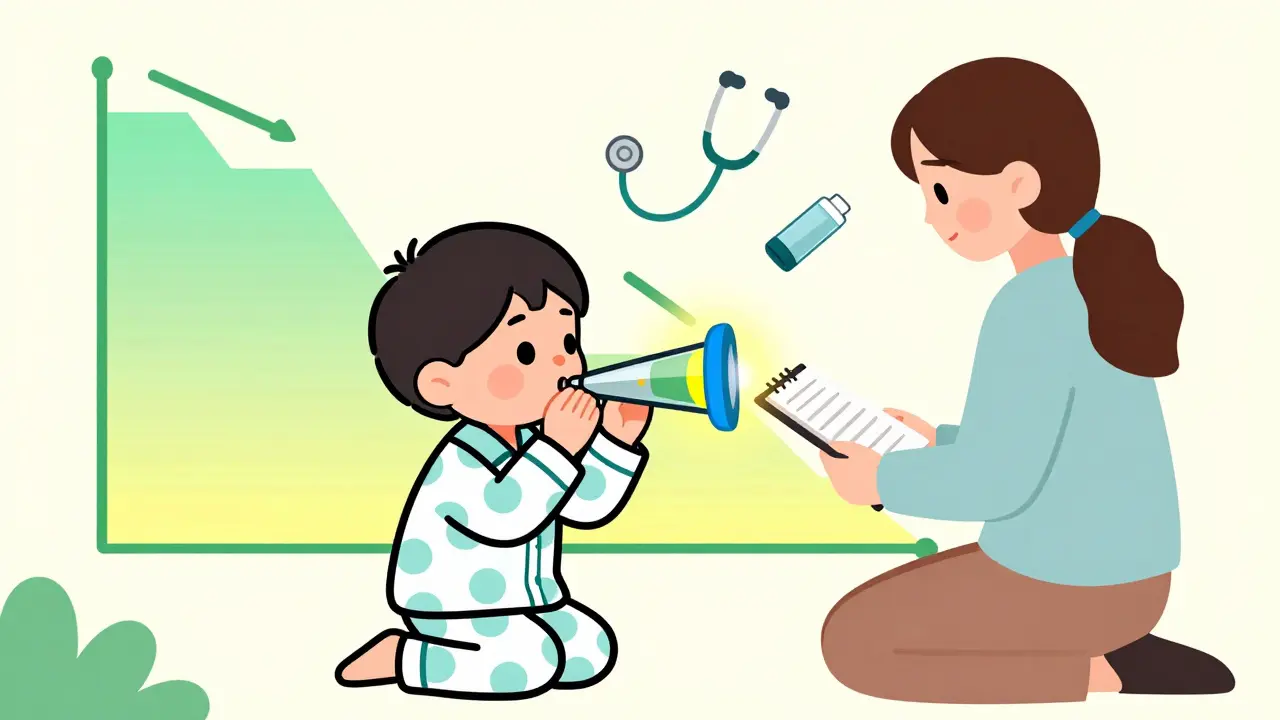
Make it part of their routine. Let them pick their own meter (some come in fun colors). Track together. Use stickers on a chart. Make it positive. When kids understand their lungs, they’re more likely to take control as they get older.
Final Thoughts
Peak flow monitoring isn’t about perfection. It’s about awareness. You don’t need to be a scientist. You just need to be consistent.
It’s not a replacement for your inhaler. It’s not a replacement for your doctor. But it’s the one tool that gives you a real-time look inside your lungs - before you feel the storm coming.
If you’ve been told you have asthma and you’re not tracking your peak flow, you’re flying blind. Start today. Use the same meter. Record every number. Know your zones. And when that number drops - don’t wait. Act.
How often should I check my peak flow if I have asthma?
If you have moderate, severe, or unstable asthma, check your peak flow twice a day - once in the morning and once at night. If your asthma is mild and well-controlled, you may only need to check two to three times a week. Always check more often if you feel symptoms coming on or if your numbers drop.
What is a normal peak flow number?
There’s no single "normal" number. Your personal best - the highest reading you achieve over two to three weeks when your asthma is under control - is your baseline. This number is unique to you and may be higher or lower than standard charts suggest. Always use your own personal best to judge your zones.
Can I use any peak flow meter?
No. Different meters give different readings. Always use the same one. Switching brands or models can make your trends unreliable. Bring your meter to every doctor visit so they can check its accuracy and calibrate your action plan.
What should I do if my peak flow is in the yellow zone?
If your peak flow drops to 50-79% of your personal best, follow your asthma action plan. This usually means taking your rescue inhaler, checking your peak flow more often, and possibly increasing your daily preventer inhaler. Don’t wait for symptoms to get worse. Early action prevents full flare-ups.
Why does my peak flow drop in the morning?
It’s normal for peak flow to be lower in the morning due to natural circadian changes in lung function. That’s why it’s important to measure at the same time every day - typically right after waking up. If your morning number is consistently lower than your evening one, that’s expected. But if it’s dropping below your usual morning range, that’s a red flag.
Do I need a peak flow meter if I use a spacer and inhaler?
Yes. Inhalers and spacers help deliver medicine, but they don’t tell you how open your airways are. Peak flow monitoring gives you objective data on lung function - something your inhaler can’t do. Even if you feel fine, your lungs might be narrowing. The meter catches it before you do.
Can peak flow monitoring replace spirometry?
No. Spirometry is more accurate and gives more detailed information about lung function. But peak flow monitoring is practical for daily use at home. It’s especially useful when spirometry isn’t available or when you need to track changes between doctor visits. Think of it as your daily check-in - spirometry is your yearly health review.
8 Comments

Winni Victor
December 27 2025
Ugh, another ‘track your numbers’ lecture. Like I don’t already know my body better than some plastic tube with a slider. I’ve had asthma since I was 5 and I’ve survived 30 years without a ‘personal best’ chart. If I’m not wheezing, I’m fine. This feels like medical gaslighting dressed up as empowerment.

Lindsay Hensel
December 28 2025
Thank you for this clear, compassionate guide. I’ve watched my daughter struggle with asthma since she was two, and the fear of silent deterioration has kept me awake at night. Your explanation of the zones, especially the emphasis on personal baselines, has given us both a sense of agency. We’ve started using a colorful chart with stickers-she now asks to check her flow every morning. It’s not just medicine. It’s a ritual of care.

Gary Hartung
December 29 2025
I'm sorry, but this article reads like a pharmaceutical brochure disguised as patient education. Peak flow meters? Really? In 2024? We have wearable spirometers, AI-driven respiratory analytics, even smartphone apps that analyze breath patterns via microphone. And you're telling people to blow into a $12 plastic device from 1997? This is like using a slide rule to calculate rocket trajectories. The author clearly hasn't read the latest Lancet papers on digital phenotyping in chronic respiratory disease.

Ben Harris
December 29 2025
I’ve been doing this for years and nobody ever told me to stand up straight or use the same meter. I just blow into whatever’s handy and hope for the best. My doctor never even asked if I was using the same one. I mean come on. Also I use a red one and my cousin uses a blue one and we compare numbers and I’m always higher so I guess mine is better. Who even cares about personal bests anyway

Jason Jasper
December 31 2025
I used to skip days. Then I missed a drop during a pollen surge and ended up in the ER. Now I log it every morning before coffee. Doesn’t feel like a chore anymore. Just… quiet data. Like checking the weather before stepping out. I don’t need to shout about it. Just know.

Justin James
December 31 2025
Have you ever wondered why peak flow meters are so cheap and widely available? Because they’re not meant to save lives. They’re meant to make you feel like you’re in control while the real problem-the air pollution, the mold in your apartment, the corporate lobbying that keeps inhalers at $300 a puff-goes ignored. Your personal best? It’s a distraction. Your lungs are telling you the system is broken. But instead of fighting for clean air, you’re told to blow harder into a plastic tube. This isn’t empowerment. It’s victim-blaming with a digital interface.

Rick Kimberly
January 1 2026
Thank you for the meticulous detail on establishing a personal baseline. I would only add that for pediatric patients, it is imperative to correlate peak flow trends with symptom diaries and environmental logs. In our clinic, we’ve observed that a 15% drop in morning readings-when coupled with increased nighttime awakenings-is a more reliable predictor of impending exacerbation than the absolute value alone. Consistency, as you note, is paramount; however, contextual interpretation elevates the tool from mere measurement to meaningful clinical insight.
Write a comment
Popular Posts


Nifedipine and Insomnia: Tips for Better Sleep
27 Mar 2025



Mussin Machhour
December 26 2025
Just started tracking my peak flow last week after my ER visit last winter. Holy crap, my numbers were dropping 30% two days before I even felt tightness. I thought I was fine-turns out my lungs were screaming and I was too busy scrolling TikTok to notice. Now I log it every morning like brushing my teeth. Best decision I made since quitting soda.