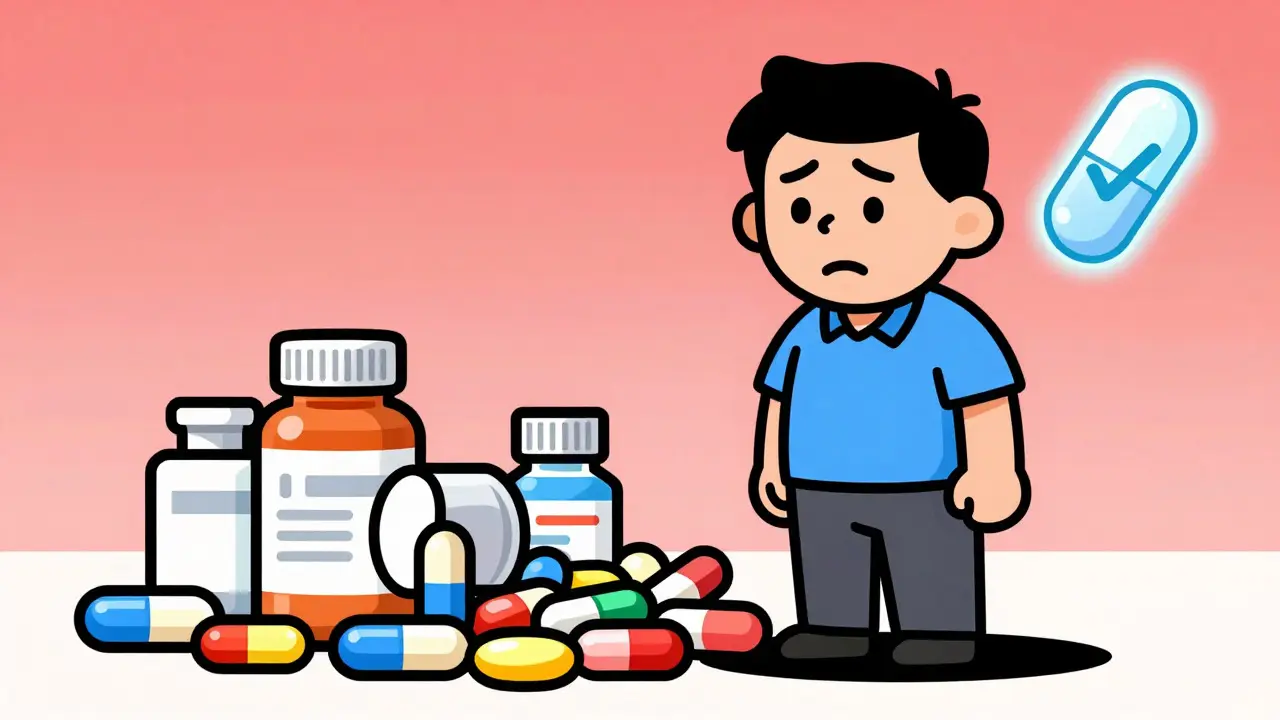
Imagine taking three different pills every morning for your blood pressure, cholesterol, and heart health. Now imagine doing that for the next ten years. It sounds exhausting, doesn't it? For millions of people with chronic conditions, this is daily reality. But there is a simpler way that many doctors are prescribing today: fixed-dose combination drugs, often called FDCs.
An FDC is exactly what it sounds like: two or more active medications packed into a single tablet or capsule. Instead of swallowing separate pills for each condition, you take one. This isn’t just about convenience; it’s a strategic medical approach designed to improve how well treatments work and keep patients sticking to their regimens. But why do they exist? Are they always better? And when might they actually cause problems?
What Exactly Is a Fixed-Dose Combination Drug?
To understand FDCs, we first need to look at how traditional medications work. Usually, if you have high blood pressure and high cholesterol, your doctor prescribes two distinct pills. One lowers blood pressure (like an ACE inhibitor), and the other manages lipids (like a statin). You buy them separately, fill two prescriptions, and manage two different schedules.
In contrast, a fixed-dose combination contains both active ingredients in one solid dosage form. The key word here is "fixed." The ratio of Drug A to Drug B is set during manufacturing and cannot be changed by the pharmacist or the patient. If the standard dose is 10mg of Drug A and 5mg of Drug B, that is exactly what you get, every time.
Fixed-Dose Combination (FDC) is a pharmaceutical product containing two or more active ingredients combined at fixed dosages within a single dosage form such as a tablet or capsule. These products are designed to simplify treatment regimens while leveraging synergistic effects between components.
This structure creates a specific type of relationship between the drugs. In pharmacology, we call this a "synergistic" effect when the combined result is greater than the sum of individual parts. For example, combining certain antibiotics can kill bacteria faster than either drug alone. However, not all combinations are synergistic. Some are simply bundled together to make life easier for the patient.
Why Do FDCs Exist? The Core Reasons
You might wonder why pharmaceutical companies and regulators bother creating these complex pills instead of just letting us take separate ones. There are three main drivers behind the rise of FDCs: adherence, efficacy, and safety.
1. Improving Medication Adherence
Adherence refers to how well a patient follows their prescribed treatment plan. It is a massive problem in healthcare. Studies show that non-adherence costs the U.S. healthcare system billions annually because patients stop working effectively. When a patient has to take five different pills at different times, mistakes happen. Pills get forgotten, doses are doubled by accident, or the routine becomes too burdensome to maintain. By reducing the "pill burden"-the total number of pills taken per day-FDCs significantly increase the likelihood that a patient will stay on track. If you only have to remember one pill, you are much less likely to miss it.
2. Enhancing Therapeutic Efficacy
Sometimes, diseases are too complex for one drug to handle alone. Take HIV/AIDS, for instance. The virus mutates rapidly, so attacking it from multiple angles is necessary. Early antiretroviral therapies required patients to swallow handfuls of pills daily. Today, most HIV patients take a single tablet containing three different antiviral agents. This combination attacks the virus at different stages of its lifecycle, making it far harder for the virus to survive and develop resistance. This is a classic example of where the combination is medically superior to any single component.
3. Reducing Side Effects
Counterintuitively, adding a second drug can sometimes reduce side effects. Consider levodopa, a primary treatment for Parkinson’s disease. Levodopa helps replace dopamine in the brain, but it also causes nausea when metabolized in the gut. By combining it with carbidopa-a drug that blocks that specific metabolism pathway-the body absorbs more levodopa into the brain and experiences fewer nauseating side effects. Here, the second ingredient acts as a shield for the first.
The Regulatory Hurdle: Proving Worth
Creating an FDC isn’t as simple as crushing two pills together. Regulators like the U.S. Food and Drug Administration (FDA) and the European Medicines Agency (EMA) have strict rules. The central question they ask is: "Does each component contribute to the claimed effect?"
If a company wants to approve an FDC, they must prove that the combination offers a benefit over taking the drugs separately. This benefit could be clinical (better outcomes), safety-related (fewer side effects), or practical (improved adherence). Without this proof, the FDA may reject the application. This is known as the "combination rule."
For new combinations involving entirely new chemical entities, the process is rigorous, requiring full Phase 1, 2, and 3 clinical trials. However, for combinations using already-approved drugs (often called "mono:mono" combinations), developers can use a streamlined pathway known as 505(b)(2). This allows them to rely on existing data for the individual drugs while focusing new studies on the interaction and fixed-ratio justification. Even then, about half of these applications still require significant new clinical data to satisfy regulators.

Advantages vs. Disadvantages: A Balanced View
While FDCs offer clear benefits, they are not a perfect solution for everyone. Understanding the trade-offs is crucial for both patients and providers.
| Feature | Fixed-Dose Combination (FDC) | Separate Medications |
|---|---|---|
| Pill Burden | Low (Single pill) | High (Multiple pills) |
| Dosing Flexibility | Rigid (Fixed ratio) | Flexible (Adjust individually) |
| Cost | Often higher upfront cost | Can be cheaper with generics |
| Adherence | Generally improved | Prone to errors/omission |
| Side Effect Management | Harder to isolate culprit drug | Easier to identify and adjust |
The biggest disadvantage of FDCs is the lack of flexibility. Because the doses are fixed, you cannot adjust one component without changing the other. Imagine a patient whose blood pressure is controlled but whose cholesterol remains high. With separate pills, the doctor could increase the statin dose while keeping the blood pressure med stable. With an FDC, increasing the statin means automatically increasing the blood pressure medication, potentially causing hypotension (dangerously low blood pressure). This "all-or-nothing" dosing can be problematic for patients with varying needs.
Another concern is cost. While FDCs save time, they are often branded products with higher prices than generic separate pills. Insurance coverage varies, and some payers view FDCs skeptically, seeing them as marketing strategies to extend patent life rather than genuine medical innovations. This can lead to higher out-of-pocket costs for patients.
Common Examples of Rational FDCs
Not all FDCs are created equal. Health organizations like the World Health Organization (WHO) distinguish between "rational" and "irrational" combinations. Rational FDCs have strong scientific backing for their synergy and safety profile. Here are some widely used examples:
- Antibiotics: Sulfamethoxazole + Trimethoprim (Bactrim/Septra). These two drugs block different steps in bacterial folate synthesis, creating a powerful blockade that prevents bacteria from repairing themselves.
- Tuberculosis Treatment: Rifampicin + Isoniazid. TB requires long-term treatment, and adherence is critical to prevent drug-resistant strains. Combining these first-line drugs ensures patients take both simultaneously.
- HIV Therapy: Tenofovir + Emtricitabine + Rilpivirine (Complera). This triple-combination pill simplifies a once-complex regimen into a single daily dose, drastically improving quality of life.
- Parkinson’s Disease: Levodopa + Carbidopa. As mentioned earlier, carbidopa reduces the side effects of levodopa, allowing for lower effective doses and better symptom control.
- Hypertension: Amlodipine + Valsartan. These target different pathways in blood pressure regulation (calcium channels and angiotensin receptors), providing complementary effects.
Irrational FDCs, on the other hand, combine drugs without clear synergistic benefit, often leading to unnecessary exposure to side effects. The WHO actively monitors and updates its Model List of Essential Medicines to promote rational FDCs and discourage irrational ones.

Who Should Be Cautious?
FDCs are excellent tools, but they aren't for everyone. Patients with kidney or liver issues may metabolize drugs differently, making fixed ratios risky. Elderly patients, who often take multiple medications, are particularly vulnerable to drug-drug interactions. If a patient develops an allergy to one component of an FDC, they must stop the entire combination, even if the other drug was working perfectly.
Additionally, pharmacokinetics-the way the body absorbs, distributes, and eliminates drugs-must align. If one drug lasts 12 hours and the other lasts 24 hours, putting them in one pill might mean one wears off too early or the other builds up to toxic levels. Regulators check this closely, but real-world biology can vary.
The Future of Combination Therapies
The trend toward FDCs is growing, especially in areas like oncology and neurodegenerative diseases. Cancer treatments increasingly rely on hitting tumors from multiple biological angles, and adherence is critical for success. Similarly, Alzheimer’s research is exploring combinations that target amyloid plaques and tau tangles simultaneously.
However, the bar for approval is rising. Payers and regulators now demand robust real-world evidence showing that FDCs truly improve outcomes beyond mere convenience. The focus is shifting from "can we combine these?" to "should we combine these?" This ensures that future FDCs deliver genuine value to patients rather than just serving corporate lifecycle management strategies.
Are fixed-dose combination drugs safer than taking pills separately?
Safety depends on the specific combination. Rational FDCs are designed to minimize side effects through synergy (e.g., levodopa/carbidopa). However, because you cannot adjust doses individually, there is a risk of overmedication if your body’s needs change. Always consult your doctor to ensure the fixed ratio matches your current health status.
Can I split a fixed-dose combination pill?
Generally, no. Splitting an FDC disrupts the precise ratio of active ingredients, potentially leading to underdosing one component and overdosing the other. Unless the pill is specifically scored and approved for splitting by the manufacturer, it should be swallowed whole.
Why are FDCs often more expensive than generic separate pills?
Many FDCs are branded products protected by patents, preventing immediate generic competition. Additionally, the development and regulatory approval process for combinations can be costly. While separate generic pills are usually cheaper, insurance plans often cover FDCs due to their proven adherence benefits.
How do doctors decide if an FDC is right for me?
Doctors consider your medical history, current medication list, kidney/liver function, and ability to adhere to complex regimens. If you struggle to remember multiple pills or have stable conditions requiring standard doses, an FDC may be ideal. If your doses frequently change, separate medications offer more flexibility.
What happens if I experience a side effect from an FDC?
Identifying which drug caused the side effect can be challenging since both are in one pill. Your doctor may switch you back to separate medications to isolate the culprit. Never stop taking an FDC abruptly without medical advice, as this can lead to withdrawal or disease rebound.