
Most people think obesity is just about eating too much and moving too little. But if that were true, losing weight would be simple. The real problem? Your body’s internal systems have been rewired. This isn’t laziness or lack of willpower-it’s biology gone off track. The science behind why you can’t seem to control hunger, why diets stop working, and why weight keeps coming back is called obesity pathophysiology. And it’s not just about calories. It’s about broken signals in your brain and body.
How Your Brain Controls Hunger (And Why It Fails)
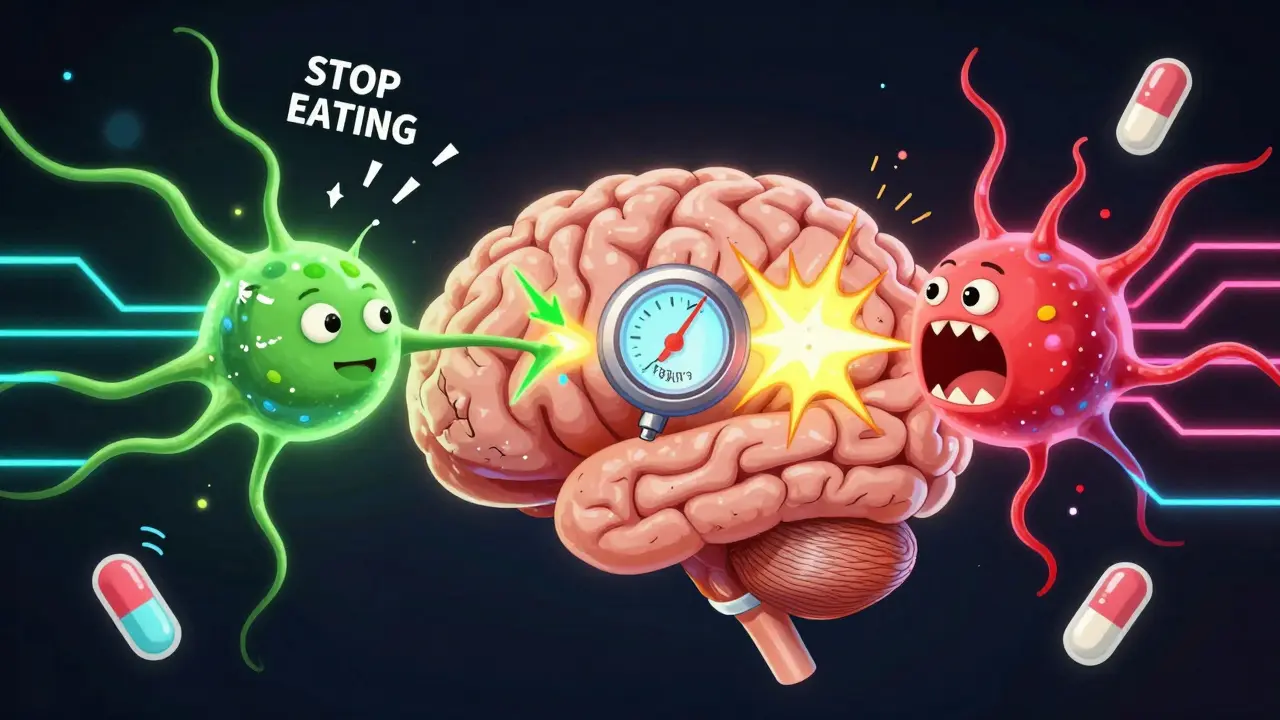
Deep inside your hypothalamus, a tiny cluster of neurons acts like a thermostat for your body weight. Two groups of cells are in constant battle: one tells you to stop eating, the other screams for more food. The first group, called POMC neurons, releases a chemical called alpha-MSH. When it hits the right receptors, you feel full. Studies show this can cut food intake by 25% to 40%. The other group, NPY and AgRP neurons, does the opposite. Activate them, even briefly, and you’ll eat 300% to 500% more than normal. That’s not a craving-it’s a biological override. These neurons don’t work alone. They listen to hormones from your fat, gut, and pancreas. Leptin, made by fat cells, should tell your brain: "You’ve got enough stored. Stop eating." In lean people, leptin levels sit between 5 and 15 ng/mL. In obesity, they spike to 30-60 ng/mL. But here’s the catch: your brain stops listening. This is called leptin resistance. It’s not that you don’t have enough leptin. You have way too much-and your brain ignores it. That’s why starving yourself doesn’t work long-term. Your brain thinks you’re starving, even when you’re overweight. Then there’s ghrelin, the hunger hormone. It rises before meals, signaling your brain to eat. In healthy people, it drops after eating. In obesity, it doesn’t drop enough. Even after a big meal, ghrelin stays high, keeping the hunger signal active. Add to that the fact that processed, sugary foods blunt ghrelin’s normal drop, and you’ve got a perfect storm for overeating.The Metabolic Breakdown: When Your Body Stops Burning Fat
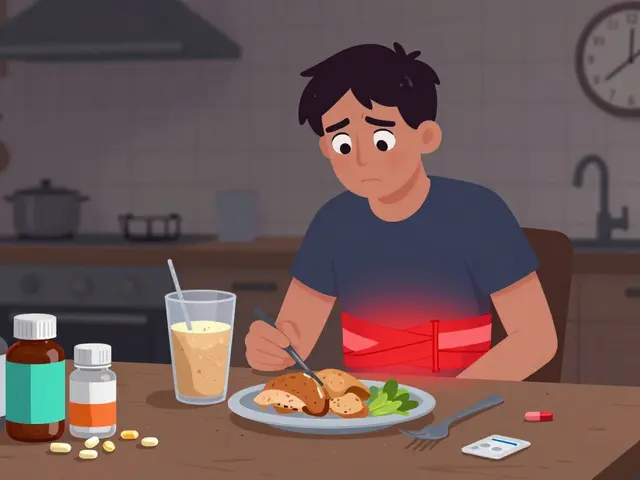
Your body doesn’t just store fat-it burns it too. But in obesity, the systems that turn fat into energy get damaged. One key player is the PI3K/AKT pathway. This is how leptin and insulin talk to your brain to reduce appetite. When this pathway works, it cuts food intake by 30% to 50%. But in obesity, chronic inflammation turns on JNK, a stress signal that blocks this pathway. Your brain can’t hear the signals anymore. Brown fat, the kind that burns calories to make heat, also shuts down. In lean people, brown fat stays active, helping to burn off extra energy. In obesity, it becomes dormant. Even worse, the body starts storing fat in places it shouldn’t-liver, muscles, around organs. This isn’t just cosmetic. Visceral fat releases inflammatory chemicals that make insulin resistance worse, which in turn makes your brain less sensitive to leptin. It’s a loop: more fat → more inflammation → worse signaling → more fat. Insulin, meant to help cells take in glucose, becomes less effective. In response, your pancreas pumps out more insulin. Fasting levels jump from 5-15 μU/mL to 50-100 μU/mL after meals. High insulin tells your body to store fat, not burn it. And it suppresses fat breakdown. So even if you eat less, your body refuses to tap into stored energy.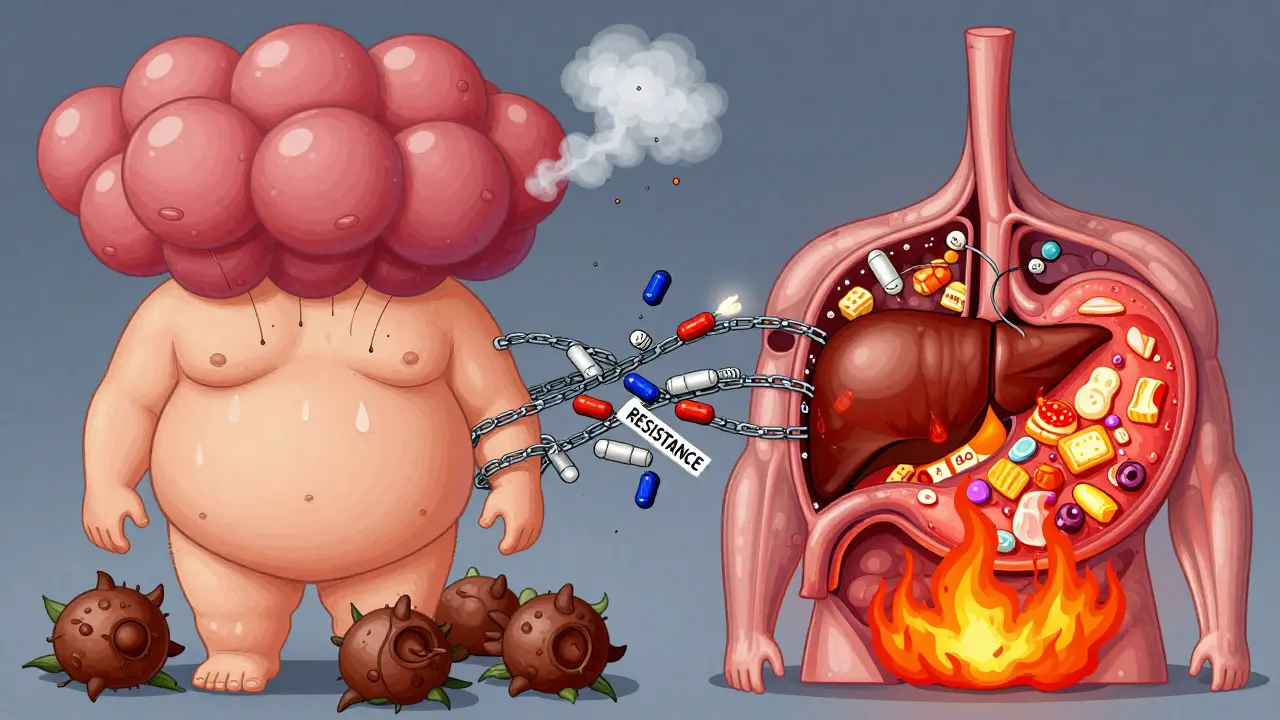
Why Diets Fail: The Hormonal Trap
When you lose weight, your body fights back. Leptin levels drop sharply. Ghrelin rises. Your metabolism slows down by 15% to 20%-even if you’re still eating the same amount. This isn’t your fault. It’s evolution. Your body thinks you’re in famine. It’s designed to hold onto fat, not lose it. This is why most people regain weight within a year. The brain doesn’t reset. The hunger signals stay loud. The fullness signals stay quiet. And the metabolic rate stays low. Even people who’ve lost 50 pounds still have the hormone profile of someone who’s obese. That’s why long-term weight loss isn’t about discipline-it’s about fixing the biology.What About Other Hormones?
It’s not just leptin and ghrelin. Other players matter too. Pancreatic polypeptide (PP), released after meals, slows digestion and reduces appetite. But in 60% of people with diet-induced obesity, PP levels are too low. That means they don’t feel full after eating. In Prader-Willi syndrome, a genetic disorder with extreme hunger, PP is nearly absent. Estrogen also plays a role. After menopause, women often gain weight around the belly-not because they eat more, but because estrogen loss reduces energy expenditure by 30% and increases food intake by 12% to 15%. Studies on mice without estrogen receptors show exactly this: they eat more and burn less. Orexin, a brain chemical that keeps you awake and alert, also affects appetite. In obesity, orexin levels drop by 40%. That might sound good-less hunger, right? But low orexin is linked to fatigue, low activity, and poor sleep. And here’s the twist: people with night-eating syndrome have high orexin at night, which explains why they wake up craving food. Narcolepsy patients, who have disrupted orexin, are two to three times more likely to be obese.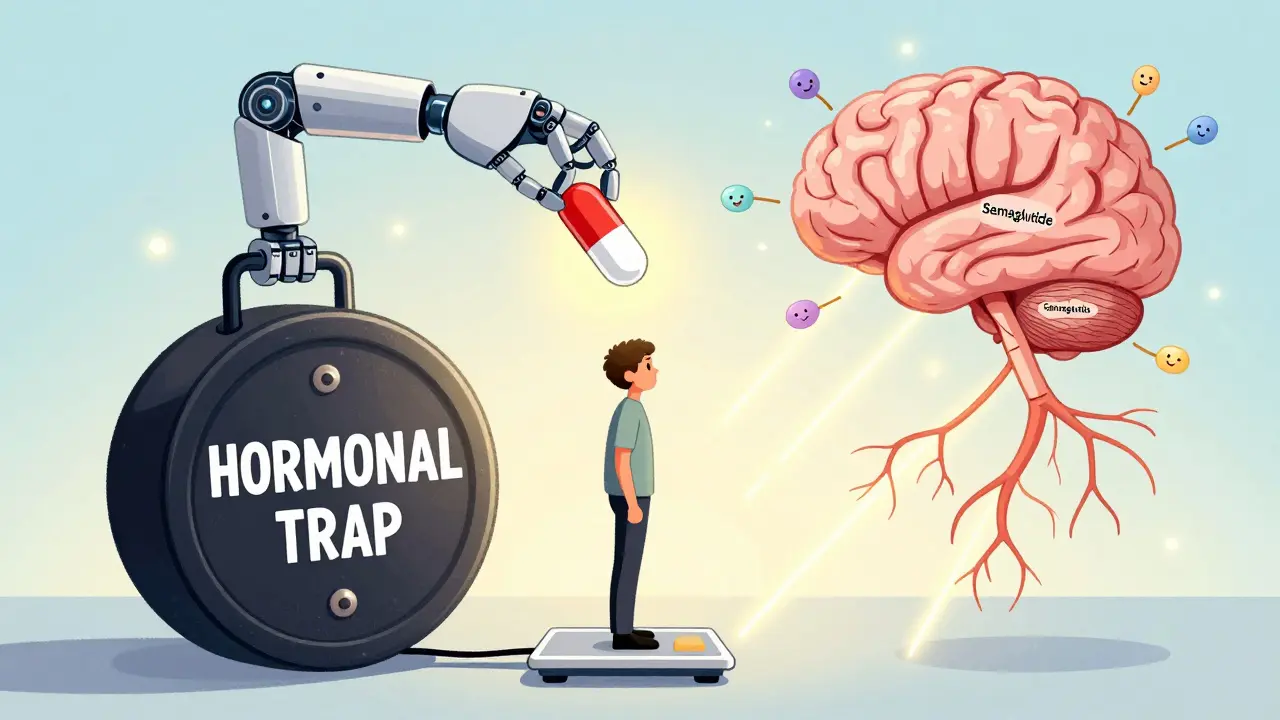
New Treatments: Targeting the Root Cause
Drugs are finally starting to work because they’re not just suppressing appetite-they’re fixing broken signals. Setmelanotide, a drug that activates the MC4R receptor (the same one alpha-MSH hits), helps people with rare genetic forms of obesity lose 15% to 25% of their body weight. It’s not a magic pill, but it proves that fixing the brain’s hunger circuitry works. Semaglutide (Wegovy, Ozempic) works differently. It mimics GLP-1, a gut hormone that tells your brain you’re full, slows stomach emptying, and reduces cravings. In trials, people lost an average of 15% of their weight. But here’s the key: it doesn’t just reduce food intake. It also improves insulin sensitivity and reduces liver fat. It’s hitting multiple broken systems at once. The biggest breakthrough came in 2022. Scientists found a new group of neurons right next to the hunger and fullness cells. When they turned these neurons on, eating stopped within two minutes. No hunger. No cravings. Just silence. This opens the door to entirely new therapies-ones that don’t just dull appetite but shut off the signal entirely.What This Means for You
If you’ve struggled with weight, know this: it’s not you. It’s your biology. The same hormones that once helped your ancestors survive famines now keep you stuck in a cycle of hunger and fat storage. The solution isn’t more willpower. It’s understanding the system and working with it. Diets that cut calories too drastically make things worse. They drop leptin, spike ghrelin, and slow metabolism. Instead, focus on foods that naturally boost fullness signals: protein, fiber, healthy fats. Avoid ultra-processed foods that hijack your hunger hormones. Exercise helps-not just to burn calories, but to improve insulin sensitivity and reduce inflammation. Even moderate movement can make your brain more responsive to leptin over time. And if you’re considering medication, understand it’s not a cheat code. It’s a tool to reset your biology. Just like insulin for diabetes, these drugs help your body function the way it should. The future of obesity treatment isn’t about pills alone. It’s about combining drugs that target appetite with those that boost metabolism, and pairing them with lifestyle changes that support-not fight-your biology. The science is here. The tools are getting better. And for the first time, we’re not blaming the person. We’re fixing the system.12 Comments

Jennifer Phelps
January 13 2026
Leptin resistance is wild when you think about it your body has more than enough fuel but still acts like it's about to starve like a glitch in the system

Alice Elanora Shepherd
January 15 2026
This is one of the clearest explanations I’ve ever read-thank you. The way you describe the hypothalamus as a thermostat, and how leptin resistance creates a false famine signal, is exactly right. It’s not willpower. It’s neuroendocrine dysfunction. And the fact that even after 50 lbs of weight loss, the hormonal profile remains obese? That’s devastating-and scientifically valid. I’ve seen patients cry when they learn this. They’ve been blamed for years. It’s not laziness. It’s biology. We need more public education on this.
Also: protein and fiber are non-negotiable. Not because they’re ‘diet foods,’ but because they activate POMC neurons naturally. No pills needed.
And please, stop calling it ‘obesity’ like it’s a moral failing. It’s a metabolic disorder. Like diabetes. We don’t shame diabetics for needing insulin. Why do we shame people for needing GLP-1 agonists?

Amanda Eichstaedt
January 16 2026
They say ‘eat less, move more’ like it’s a magic spell. But if your brain is literally wired to think you’re starving while you’re overweight, then ‘eat less’ is like telling someone with a broken leg to just walk faster.
And the part about brown fat shutting down? That’s why I’m always cold. I thought it was just my AC being too strong. Turns out my body’s not burning calories to stay warm anymore. It’s just… conserving. Like a savings account with a lock on it.
Also, I’m 43, post-menopause, and I gained 20 lbs without changing my eating habits. Estrogen loss = 30% drop in energy expenditure? That’s not a coincidence. That’s a biological reset. And nobody warned me.

Daniel Pate
January 17 2026
Let’s be honest: the pharmaceutical industry didn’t wake up one day and say ‘how can we help people lose weight?’ They saw a market. Semaglutide works because it hijacks a natural pathway-but it’s expensive, and it’s not a cure. It’s a lifelong dependency. And the real problem? We’re treating the symptom with a drug instead of fixing the food environment. Ultra-processed foods are engineered to override satiety signals. That’s not an accident. That’s corporate design. The science here is valid-but the solution isn’t just pills. It’s regulation. It’s banning hyper-palatable junk from being marketed as ‘food.’
And yes, exercise helps-but not because it burns calories. It reduces inflammation. It restores leptin sensitivity. It’s medicine, not punishment.

Monica Puglia
January 19 2026
OMG I’ve been saying this for years 😭
It’s not that I don’t want to lose weight-it’s that my body fights me like I’m a threat to its survival.
And now I know why I wake up at 2am craving chips. It’s not ‘weakness.’ It’s orexin misfiring.
Thank you for validating what my body’s been screaming.
Also-setmelanotide sounds like sci-fi but I’m low-key praying it gets approved for more people. 💪❤️

Windie Wilson
January 20 2026
Oh wow. So now we’re blaming fat people’s hormones instead of their bad choices? Brilliant. Next you’ll tell me my dog eats my couch because his ‘neurotransmitters are misaligned.’
Meanwhile, my cousin lost 80 lbs on a 1,200-calorie diet and ran 5K every day. So yeah. Willpower exists. And if you can’t do it, maybe you’re just not trying hard enough.
Also, ‘leptin resistance’? Sounds like a buzzword invented by Big Pharma to sell $1,000/month shots.
Just eat less. Move more. Simple. Done.

Alex Fortwengler
January 21 2026
They’re lying to you. This isn’t biology-it’s a cover-up. The real reason diets fail? The government and food industry are pumping out fake hormones in the water supply. You think leptin resistance is natural? Nah. It’s glyphosate. It’s fluoridated tap water. It’s the 5G towers messing with your hypothalamus. I’ve read 17 papers from Eastern Europe that prove this. You think they want you to know? No. They want you buying Wegovy so they can charge you $1,200 a month. And the ‘new neurons’? They’re not real. It’s a distraction. Wake up.
Also, I lost 60 lbs in 3 months on a diet of raw eggs and Himalayan salt. Don’t believe the lie.

Sonal Guha
January 21 2026
This is just woke science. You're saying people can't control their appetite so we should give them drugs? That's what they did in the Soviet Union with the vodka rationing. You think your body is a broken machine? No. It's a test. Weak people fail. Strong people win. You don't need science. You need discipline. And if you can't do it, then you're just lazy. End of story. Also, your citations are from American journals. We know how biased they are.

steve ker
January 23 2026
So what? I'm not paying for your biology. Just stop eating so much. Done.

Rebekah Cobbson
January 23 2026
I’ve been on this journey for 10 years. I’ve been told I’m lazy. I’ve been shamed in doctor’s offices. I’ve been told ‘just eat salad.’ But this? This is the first time anyone explained why my body behaves this way without blaming me.
Thank you. Truly.
And if you’re reading this and you’ve struggled-you’re not broken. You’re not failing. You’re just working with a system that was never meant to survive in this world.
Be kind to yourself. Progress isn’t linear. Healing isn’t fast. But you’re not alone.

Audu ikhlas
January 24 2026
USA always make everything complicated. In Nigeria we just eat less and work hard. No pills no science. Just discipline. Your body is not broken. You are weak. You eat too much sugar. You sit too much. Stop blaming hormones. Blame yourself. We don't have these problems in Africa. We have real problems like hunger. You are spoiled. Fix yourself.
Write a comment
Popular Posts


Christina Widodo
January 12 2026
So this is why my 12-week keto plan failed spectacularly-not because I cheated, but because my brain was screaming for food like I was in a post-apocalyptic wasteland. Biology is brutal.
And now I feel less guilty about eating the whole pizza.
Thank you for this.