
Ototoxicity Risk Assessment Tool
Use this tool to evaluate common risk factors associated with aminoglycoside-induced ear damage. Disclaimer: This is an educational tool, not a medical diagnosis. Always consult your physician.
Recommended Precautions:
Imagine waking up from a severe infection recovery only to realize the world has gone quiet, or that the floor feels like it's tilting beneath your feet. This is the harsh reality for many people who undergo treatment with aminoglycoside ototoxicity is a condition where potent antibiotics cause irreversible damage to the inner ear, leading to permanent hearing loss and balance issues. While these drugs are lifesavers for treating multidrug-resistant infections, they come with a heavy price for some. In fact, clinical data suggests that between 20% and 47% of patients experience some level of hearing loss after using these medications. But why does a drug meant to fight bacteria also attack your ears, and can it be stopped?
How These Antibiotics Damage Your Hearing
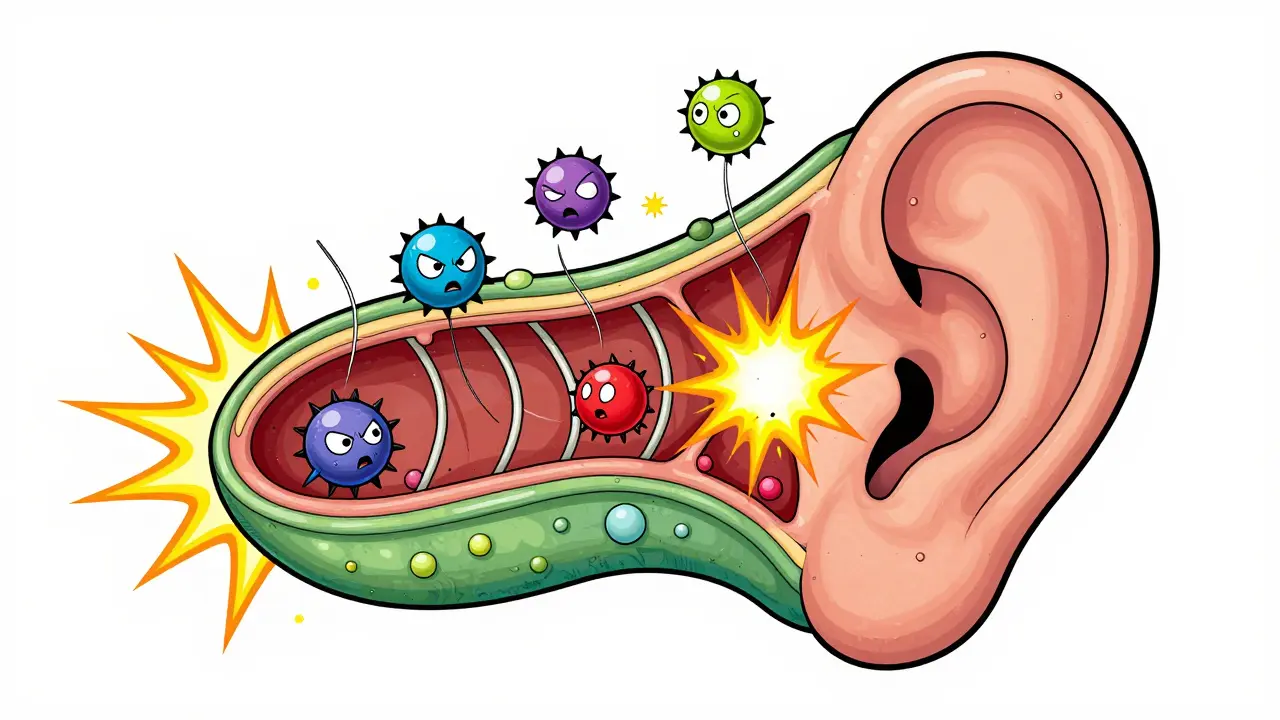
To understand the damage, we have to look at how Aminoglycosides are a class of potent antibiotics used to treat serious Gram-negative bacterial infections enter the system. These drugs usually cross the blood-labyrinth barrier via the stria vascularis or enter topically through the round window. Once inside the inner ear, they don't just kill bacteria; they trigger a destructive chemical chain reaction.
The process starts when the drugs overactivate NMDAR receptors (polyamine-like N-methyl-D-aspartate receptors). This overstimulation produces nitric oxide, which acts like a toxin to your cells. This leads to the formation of oxidative free radicals, eventually triggering programmed cell death. Unlike some other toxins, aminoglycosides cause both apoptosis (cell suicide) and necrosis (uncontrolled cell death), effectively wiping out the hair cells in the cochlea. Because these hair cells don't grow back, the resulting aminoglycoside ototoxicity is permanent.
The Difference Between Hearing Loss and Balance Issues
Not everyone experiences the same side effects. The damage usually happens in two distinct areas: the cochlea (responsible for hearing) and the vestibular system (responsible for balance).
- Cochlear Damage: This typically starts in the basal, high-frequency region. You might first notice that high-pitched sounds, like a whistle or a bird chirping, disappear. If you already have high-frequency hearing loss before treatment, you're actually 3.2 times more likely to lose lower-frequency hearing as well.
- Vestibular Damage: About 15-30% of patients suffer from vestibular dysfunction. This isn't just a bit of dizziness; it can be total bilateral vestibular loss. In one case at Johns Hopkins Hospital, a patient treated for urosepsis with gentamicin lost their balance entirely and required 14 months of intensive rehabilitation just to walk normally again.
| Feature | Aminoglycoside-Induced | Cisplatin-Induced | |
|---|---|---|---|
| Primary Target | High-frequency hair cells & Vestibular system | High-frequency hair cells | |
| Vestibular Impact | Significant / Common | Minimal / Rare | |
| Cell Death Method | Apoptosis and Necrosis | Primarily Apoptosis | |
| Frequency Pattern | Starts at high-frequency basal end | Severe loss at lower frequencies in some cases |
Who Is Most at Risk?
Why does one person walk away fine while another loses their hearing? A huge part of the answer is hidden in your DNA. Specifically, mutations in the mitochondrial DNA-like the A1555G and C1494T mutations in the 12S rRNA gene-make some people genetically hypersensitive to these drugs. These mutations mess with mitochondrial protein synthesis, making the inner ear cells far more vulnerable to the antibiotic's toxicity.
Environmental factors also play a role. If you've been exposed to loud noise recently, you're in more danger. Research shows that loud sound exposure up to two months before taking the drug can increase ototoxicity by as much as 52%. Even a "safe" low dose of the antibiotic can become toxic if combined with noise exposure. Furthermore, if you have a systemic infection causing inflammation, your blood-labyrinth barrier becomes "leaky," increasing the amount of the drug that reaches the inner ear by about 63%.

How Doctors Monitor and Prevent Damage
Since the damage is irreversible, the only real solution is early detection and prevention. Standard hearing tests (0.25-8 kHz) often miss the early signs. Instead, specialists use high-frequency audiometry (9-16 kHz), which can catch the damage 5 to 7 days sooner than standard tests. The American Speech-Language-Hearing Association suggests getting a baseline test within 24 hours of starting treatment and monitoring every 48 to 72 hours.
Another critical tool is Therapeutic Drug Monitoring (TDM). By tracking the peak and trough levels of the drug in your blood, doctors can keep the dose effective against bacteria but below the threshold of ear toxicity. This practice alone can reduce the risk of ototoxicity by 28%. For those with a family history of hearing loss, genetic screening tools like the OtoSCOPE® can identify vulnerability with over 94% sensitivity, allowing doctors to choose a different antibiotic altogether.
The Future of Ear Protection
We are moving toward a world of "personalized medicine" where your genetic profile determines your prescription. The FDA recently gave Fast Track designation to a new otoprotectant called ORC-13661. In Phase II trials, this compound helped preserve 82% of hair cells when used alongside amikacin. Additionally, gene therapy research is targeting those specific mitochondrial mutations, with preclinical trials showing a 67% reduction in toxicity.
However, there is a global gap in care. While high-income countries have these monitoring protocols in many hospitals, only about 18% of hospitals in low- and middle-income countries do the same. Because 80% of aminoglycoside use happens in these resource-limited settings, the need for simpler, cheaper screening methods is urgent.
Can aminoglycoside-induced hearing loss be reversed?
Unfortunately, no. Because these antibiotics destroy the sensory hair cells in the cochlea, and these cells do not regenerate in humans, the resulting sensorineural hearing loss is permanent. Management focuses on hearing aids, cochlear implants, and vestibular rehabilitation.
What are the first signs that I am experiencing ototoxicity?
The earliest signs are often a loss of high-frequency sounds (like the sound of a digital beep or a high-pitched voice) and the onset of tinnitus (ringing in the ears). If the vestibular system is affected, you may experience vertigo, a spinning sensation, or a general loss of balance.
Which aminoglycosides are the most common?
Common examples include Gentamicin, Amikacin, Neomycin, Tobramycin, and Kanamycin. Each has a slightly different toxicity profile, but all carry the risk of damaging the inner ear.
Does the method of administration (IV vs. Topical) matter?
Yes. Systemic administration (like IV) must cross the blood-labyrinth barrier, whereas topical administration (like ear drops) bypasses this barrier via the round window. Both can be ototoxic, but the pathway and speed of accumulation may differ.
How can I protect myself if I must take these antibiotics?
Ensure your doctor performs a baseline audiogram and regular monitoring during treatment. Ask about therapeutic drug monitoring (TDM) to keep blood levels in a safe range. Most importantly, avoid exposure to loud noises during and immediately after your treatment course.
Popular Posts