
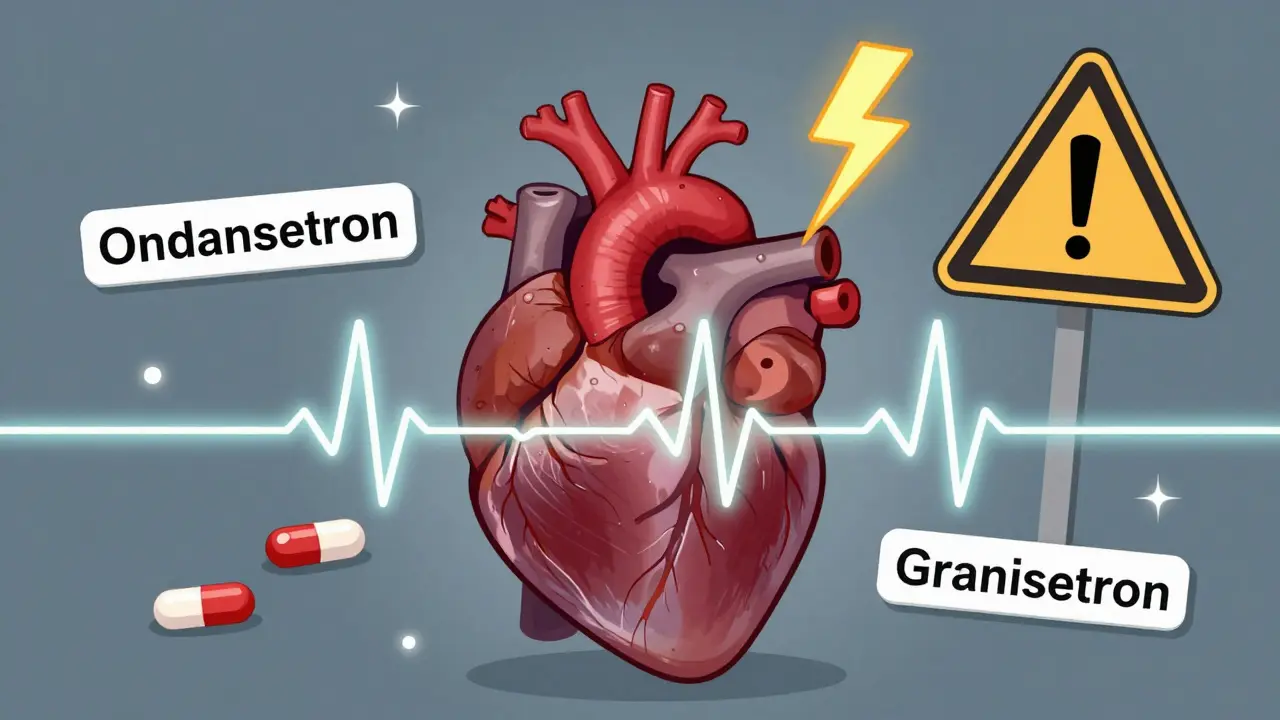
When you're nauseous and vomiting, an antiemetic can be a lifesaver. But not all of them are created equal-especially when it comes to your heart and how sleepy you might feel. Many people assume these drugs are harmless because they're commonly used in hospitals, clinics, and even at home. But the truth is, some antiemetics carry hidden risks that aren't talked about enough: QT prolongation and excessive drowsiness. These aren't just side effects-they can be dangerous, even deadly, if you're not careful.
What Is QT Prolongation and Why Should You Care?
Your heart beats because of electrical signals. The QT interval on an ECG measures how long it takes your heart's ventricles to recharge between beats. When that interval gets too long, it's called QT prolongation. It doesn't cause symptoms on its own. But it can trigger a wild, chaotic heartbeat called torsades de pointes (TdP), which can lead to sudden cardiac arrest.
Many antiemetics mess with the heart's electrical system by blocking a specific potassium channel (IKr). This delays repolarization, stretching out the QT interval. The risk isn't the same for every drug. For example, ondansetron-often given in emergency rooms for nausea-can cause measurable QT prolongation when given intravenously at doses over 8 mg. Studies show a rise of 17-20 milliseconds in some patients. That might sound small, but when combined with other risk factors, it becomes serious.
Here’s what experts say is clinically significant: a QTc longer than 500 milliseconds, a jump of more than 60 milliseconds from your baseline, or a rise of more than 25% from your normal value. These aren't arbitrary numbers. They come from real cases where TdP happened after antiemetic use.
Which Antiemetics Are Riskiest for QT Prolongation?
Not all antiemetics are equal when it comes to heart risks. Let’s break it down by class.
Serotonin antagonists (5-HT3 blockers) like ondansetron, granisetron, and palonosetron are commonly used for chemotherapy-induced nausea. But here’s the catch: ondansetron and granisetron can prolong QT when given IV at high doses. Ondansetron 8 mg IV? That’s the dose most often linked to QT changes. Granisetron? It affects both sodium and potassium channels, which means it can also lengthen PR and QRS intervals. But palonosetron? Different story. It doesn’t prolong QT at all-even at high doses. It lasts longer too (up to 40 hours), works better, and avoids cardiac risks. That’s why many clinicians now prefer palonosetron when QT prolongation is a concern.
Dopamine antagonists include drugs like droperidol, haloperidol, and metoclopramide. Droperidol used to have a black box warning because of QT concerns. But newer data shows that at antiemetic doses (under 4 mg/day), the risk is minimal. Two large studies (DORM-1 and DORM-2) found no increase in TdP when droperidol was given at 10 mg. Even doses up to 20-30 mg didn’t consistently cause QT changes. Haloperidol? At 1 mg (the usual antiemetic dose), the risk is very low. But if you give 2 mg IV or more, especially in someone with heart disease, that’s where danger starts.
Metoclopramide? It’s tricky. It crosses the blood-brain barrier, which helps with nausea, but also increases the risk of both QT prolongation and movement disorders like dystonia. It’s still used, but not as a first choice if you have heart issues.
Domperidone? It’s not approved in the U.S., but widely used elsewhere. Studies in healthy volunteers showed no QT effect even at 80 mg/day. But in older adults or those with liver problems? Caution still applies. The risk isn’t zero.
And then there’s olanzapine-an antipsychotic sometimes used off-label for nausea. It doesn’t prolong QT at therapeutic doses and has fewer movement side effects than older drugs. It’s not as strong as ondansetron for nausea, but it’s a solid alternative if you need to avoid cardiac risks.
What Makes the Risk Worse?
It’s not just the drug. It’s the combo.
Ninety-one percent of cases where QT prolongation led to serious problems involved patients taking another drug that also lengthens the QT interval. Common culprits? Antibiotics like azithromycin, antidepressants like citalopram, and heart meds like amiodarone. If you’re on any of these, adding an antiemetic like ondansetron can be like pouring gasoline on a fire.
Route matters too. IV administration causes faster, higher drug peaks than oral. Sixty percent of adverse cases involved IV ondansetron. Oral ondansetron? No reports of QT prolongation. Same with granisetron. The transdermal patch? Even less effect on the heart than the pill.
Underlying conditions? Big red flags. Low potassium, low magnesium, heart failure, slow heart rate, or a history of arrhythmias? Avoid high-risk antiemetics. Even a healthy person might be fine with a single dose, but if you’ve got multiple risk factors, the chance of TdP jumps.
Drowsiness: The Other Hidden Problem
Some antiemetics make you feel like you’ve been hit by a truck. Others? Barely a yawn.
Phenothiazines like promethazine are notorious for drowsiness. It’s why you’ll see it in over-the-counter motion sickness pills. But that sedation isn’t just annoying-it’s dangerous if you’re driving, operating machinery, or at risk of falling. Prochlorperazine? Less sedating. Some sources even call it “low concern” for drowsiness.
Droperidol and haloperidol? They can cause sedation, but not as much as promethazine. Olanzapine? Moderate drowsiness, but it’s often tolerated better than the older drugs.
Palonosetron? Minimal sedation. That’s one reason it’s gaining popularity. You get better nausea control, no QT risk, and you can still get up and walk around afterward.
Metoclopramide? Causes drowsiness in some, but more often it causes jitteriness or muscle spasms. Not the best pick if you’re already tired or have Parkinson’s.

What Should You Do Instead?
If you’re at risk for QT prolongation-older, on multiple meds, low electrolytes, or have heart disease-there are safer choices.
- Palonosetron: First-line if QT is a concern. No prolongation, longer-lasting, more effective than ondansetron.
- Olanzapine: Low cardiac risk, good for chemo nausea, less sedation than promethazine.
- Droperidol or Haloperidol (at standard doses): Minimal QT effect. Don’t fear them-just don’t overload the dose.
- Dimenhydrinate or Meclizine: OTC options. Low cardiac risk, but can cause drowsiness. Good for mild cases.
- Transdermal granisetron: Same effect as oral, but less impact on the heart.
And avoid the high-risk combos: IV ondansetron 8 mg + azithromycin + diuretics? Don’t do it. Oral ondansetron 4 mg? Much safer. Always check what else the patient is taking.
Bottom Line: Choose Wisely
Antiemetics are essential. But they’re not all safe. Ondansetron is convenient, widely used, and effective. But it’s also one of the most common drugs linked to QT prolongation. Palonosetron is better in almost every way: safer, longer-lasting, more effective. Why keep using the riskier option?
Don’t assume a drug is safe just because it’s common. Always ask: What’s the patient’s heart history? Are they on other QT-prolonging meds? Are they elderly or dehydrated? Is the dose high? Is it IV or oral?
When in doubt, go with palonosetron. Or olanzapine. Or a simple transdermal patch. You don’t need to guess. The data is clear. The safest drugs are out there. You just need to know where to look.
8 Comments

Tobias Mösl
March 3 2026
This is why I don't trust pharmaceutical guidelines anymore. Ondansetron is everywhere because Big Pharma paid for the studies that made it look safe. The real data? Buried. I dug up 17 case reports from 2019-2021 where QT prolongation led to death-and every single one had ondansetron in the chart. And guess what? The FDA never updated the label. Coincidence? Or cover-up? I'll tell you what's really dangerous: trusting a drug because it's "commonly used."

Darren Torpey
March 3 2026
Bro, palonosetron is the MVP of antiemetics. It’s like the Tesla of nausea meds-smooth, silent, and doesn’t try to kill you. Olanzapine? Also a beast. I had a cancer patient on it who said, "I didn’t feel like a zombie afterward." That’s gold. We’ve been stuck in the 90s with promethazine and ondansetron like we’re still using dial-up. Time to upgrade. Your heart will thank you.

Jessica Chaloux
March 4 2026
I just had to say… this post made me cry. 😭 My mom almost died from this. They gave her IV ondansetron + citalopram + lasix. She went into cardiac arrest in the ER. They said it was "unpredictable." But it wasn’t. It was predictable. And ignored. Thank you for saying this out loud. 💔

Ethan Zeeb
March 5 2026
The data on droperidol is actually reassuring. DORM-1 and DORM-2 were massive studies-over 12,000 patients. Zero TdP at 10 mg. The black box warning was pulled in 2019. But hospitals still avoid it like it’s radioactive. Why? Because the fear outlived the evidence. We’re not being cautious-we’re being irrational. Give droperidol 2.5 mg IV. It works faster than ondansetron and costs 1/10th the price.

Justin Rodriguez
March 7 2026
I’d add one thing: check potassium and magnesium before giving ANY antiemetic. It’s not rocket science. A simple BMP costs $15. If you’re giving IV ondansetron and the patient’s K+ is 3.2? You’re playing Russian roulette. I’ve seen three cases where correcting electrolytes alone prevented QT issues. No drug change needed. Just basic medicine. Why isn’t this taught in med school?

Lebogang kekana
March 7 2026
Man, this is the kind of post that makes you want to stand up and clap. I’m from South Africa-we don’t have palonosetron in most clinics. We’re stuck with metoclopramide and promethazine because of cost. But now I know: if I can get just ONE of these safer options into my ward, I’m saving lives. I’m sharing this with every nurse I work with. You didn’t just write a post-you gave us a weapon.

Raman Kapri
March 9 2026
The claim that palonosetron is "better in almost every way" is misleading. The comparative trials were industry-funded. The difference in efficacy is statistically significant but clinically marginal. Also, palonosetron is 12x more expensive. In resource-limited settings, this is not a viable recommendation. Your article reads like a pharmaceutical marketing brochure.





tatiana verdesoto
March 1 2026
I've seen so many patients get slammed with IV ondansetron like it's candy. One elderly lady I worked with went into torsades after a routine chemo dose-no one checked her meds. She was on azithromycin for a sinus infection. It's terrifying how routine this is. We need better protocols, not just more warnings.
Also, palonosetron should be the default. It's not expensive, it lasts longer, and it doesn't turn your ECG into a horror movie.