
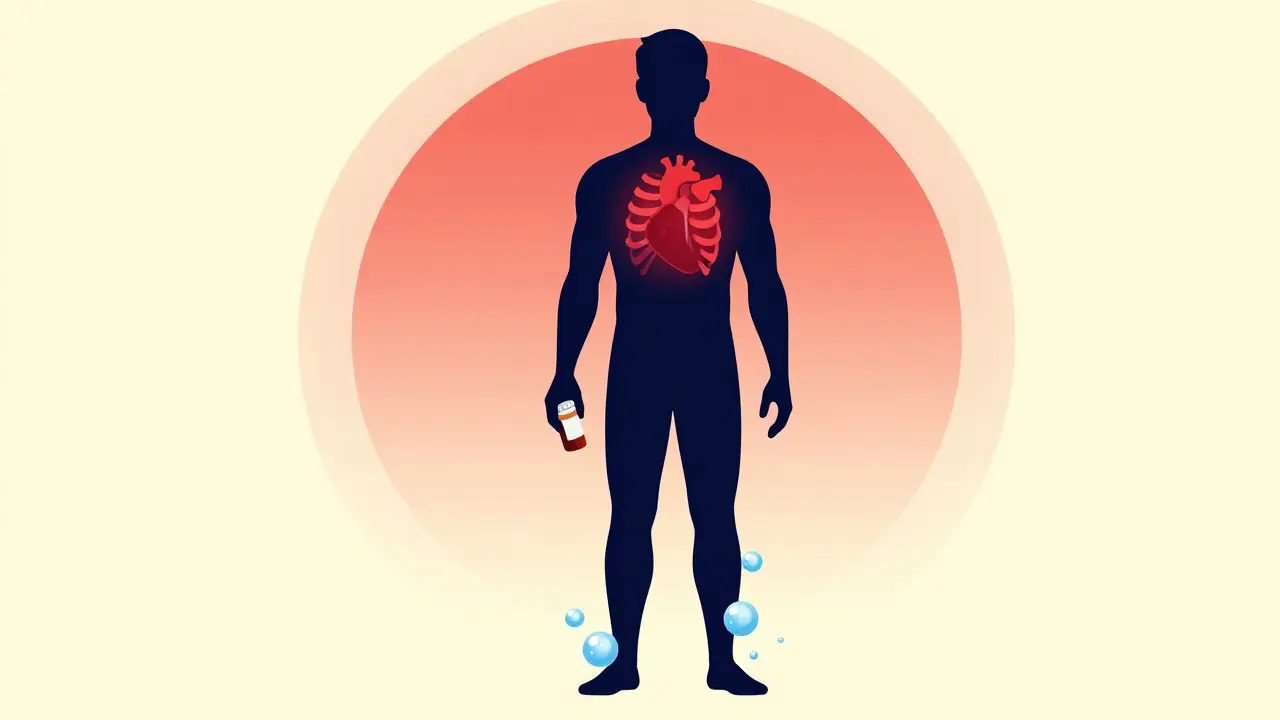
TZD Heart Risk Assessment Tool
Medication & Health Information
Your Risk Assessment
Complete the form and click "Assess My Risk Level" to see your personalized evaluation.
Key Warning Signs
- URGENTRapid weight gain > 10 lbs
- MONITORFluid retention signs
- GOODNo symptoms present
Understanding the Hidden Heart Risks in Diabetes Meds
If you manage type 2 diabetes, you know that balancing blood sugar is crucial for your health. However, some medications come with trade-offs that affect more than just your glucose levels. Thiazolidinediones, often shortened to TZDs, are powerful oral insulin-sensitizing agents that help control diabetes, but they carry a specific warning regarding your cardiovascular system. You might wonder if this means avoiding them entirely. The answer isn't a simple yes or no, but it requires a close eye on potential side effects, particularly concerning fluid buildup.
The concern here centers on fluid retention that leads to worsening congestive heart failure. While these drugs work well to lower blood sugar, approximately 5% to 15% of people using them develop noticeable fluid retention. This isn't just minor puffiness; it represents a measurable increase in blood volume. For someone already struggling with heart issues, this extra load can push the heart past its breaking point. We need to look at exactly how this happens, who is most at risk, and what you can do to stay safe while taking these essential medications.
How Thiazolidinediones Work in Your Body
To understand the risks, you first need to see how the medicine works to fix your blood sugar. Rosiglitazone is a specific thiazolidinedione drug, commonly known by the brand name Avandia. It sits alongside Pioglitazone, another member of this drug family sold as Actos. Both belong to a class called peroxisome proliferator-activated receptor-γ (PPAR-γ) agonists. These drugs activate receptors found in fat cells, blood vessels, and kidneys to improve how your body uses insulin.
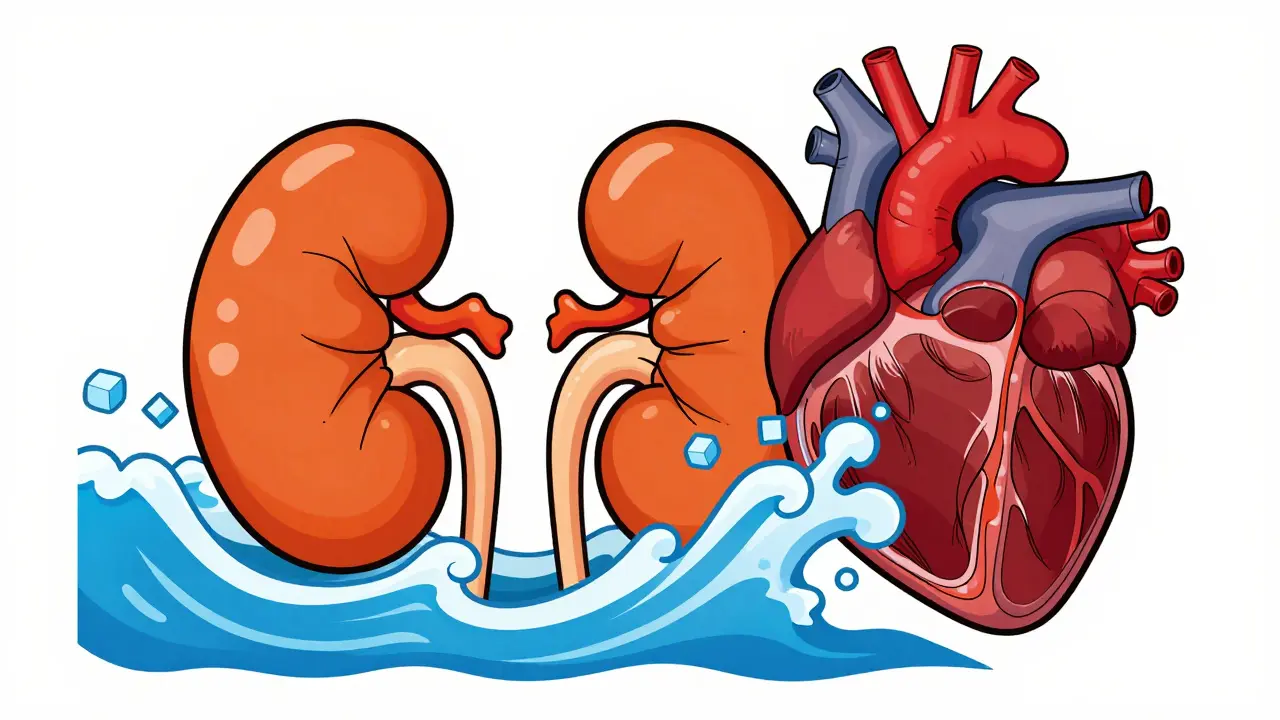
This mechanism is highly effective for lowering hemoglobin A1c levels, a measure of long-term blood sugar control. The problem arises because activating these PPAR-γ receptors doesn't stop at insulin sensitivity. It triggers changes in how your kidneys handle salt and water. When the receptors fire up in the renal system, they encourage your tubules to hold onto sodium rather than flushing it out. Water follows salt, naturally increasing your plasma volume. Studies, including research published in PPAR Research in 2008, noted a 6-7% rise in blood volume even in healthy volunteers. Imagine carrying an extra five liters of water every time you walk around; your heart has to pump harder just to move that extra weight.
The Connection Between Edema and Heart Strain
You might notice your shoes fitting tighter or your rings sliding less easily before anything else happens. This peripheral edema occurs in about 7% of patients using TZDs alone, but the risk jumps to roughly 15% when you combine the drug with insulin. That combination creates a synergistic effect where fluid builds up faster. In some cases, this shifts from visible leg swelling to pulmonary edema, where fluid fills the lungs, making breathing difficult.
Why does this happen? It comes down to sodium handling. Reviews, such as one by Bełtowski, Rachańczyk, and Włodarczyk in 2013, suggest the mechanism involves increased tubular sodium reabsorption in the kidney. Specifically, research indicates activation of serum and glucocorticoid-regulated kinase-1 (SGK-1), which stimulates channels that pull sodium back into the blood stream. Other pathways might involve non-ENaC sodium channels or inhibiting chloride transport. It is a complex physiological chain reaction that starts with a pill and ends with strain on the heart muscle.
| Symptom | Typical Presentation | Risk Factor with TZDs |
|---|---|---|
| Weight Gain | Sudden jump of 10 lbs or more | High due to plasma expansion |
| Peripheral Edema | Swelling in ankles and feet | Presents in 7-15% of users |
| Jugular Venous Distension | Visible neck vein swelling | Seen in severe fluid overload |
| Breathlessness | Difficulty breathing lying flat | Sign of pulmonary edema |
Who Should Avoid These Medications?
Safety depends heavily on your starting point. If you already have heart problems, adding a medication that retains fluid is a major decision. New York Heart Association (NYHA) classification determines your risk level. This scale grades heart failure severity from Class I (no symptoms) to Class IV (symptoms at rest). Current guidelines strictly contraindicate TZD use in patients with NYHA Class III or IV heart failure. For those with Class I or II, where symptoms occur only with strenuous activity or exercise, use is permitted but requires strict monitoring.
Data paints a worrying picture of real-world practice. A large analysis of over 424,000 adults in the Diabetes Collaborative Registry revealed that nearly half of patients currently taking these drugs showed evidence of heart failure despite the warnings. About 23.7% had a formal diagnosis, 7.7% had severely reduced ejection fraction, and nearly 30% were already on loop diuretics to manage fluid. This suggests that many clinicians are prescribing these drugs to patients who may already be too vulnerable for them. It highlights a gap between the theoretical safety guidelines and daily prescribing habits.

Managing Risks Through Careful Monitoring
If you are prescribed a TZD, vigilance is your best defense. The FDA label includes a black box warning-the strongest alert available-to signal these risks to prescribers. Doctors should monitor your weight weekly during the initial phase. If you see a rapid weight gain, say 10 pounds over a few days, report it immediately. Unlike normal diet-induced weight gain, this fluid gain happens quickly and signals that your body is hoarding water.
Loop diuretics, which are commonly used to drain fluid, sometimes fail to reverse TZD-induced retention effectively. However, stopping the TZD usually resolves the issue completely. If you find yourself needing stronger diuretics or showing signs of jugular venous distension, your doctor might switch your treatment plan. Remember, while these drugs reduce the risk of hypoglycemia compared to insulin, the potential for exacerbating heart failure makes them unsuitable for everyone.
Current Guidelines and Market Status
Regulatory bodies have adjusted access to these drugs over the years. Following a 2007 meta-analysis suggesting rosiglitazone could increase heart attack risk, the FDA restricted access in 2010. Restrictions were partially lifted later after trials like the RECORD study showed no significant overall cardiovascular risk when used correctly. Today, pioglitazone remains widely available, costing roughly $300 for a month's supply, while rosiglitazone access is often limited through special programs. The American Diabetes Association advises caution, recommending avoidance in those with established heart failure and close observation for those at borderline risk.
In summary, TZDs offer strong glycemic control but demand respect for their fluid-retaining properties. Understanding your heart function before starting treatment is critical, and regular check-ins ensure you aren't trading one chronic condition for another. By weighing the benefits against the documented risks, patients and providers can make safer choices together.
Can I take thiazolidinediones if I have mild heart disease?
It depends on the severity. If your heart failure is classified as NYHA Class I or II, meaning stable with symptoms only under stress, doctors may allow cautious use with frequent monitoring. If you have Class III or IV, these drugs are contraindicated.
How quickly does fluid retention start appearing?
Signs can appear early in treatment, often within weeks. It is recommended to weigh yourself weekly at home. If you gain 10 pounds suddenly, contact your provider immediately.
Is rosiglitazone banned?
It is not fully banned but remains under restricted distribution in many regions due to past cardiovascular concerns. Pioglitazone is generally more widely accessible in standard pharmacies.
Does using insulin with TZDs increase risk?
Yes, combining insulin with thiazolidinediones significantly increases the rate of fluid retention, rising from about 7% as monotherapy to approximately 15% when used together.
What are the alternative treatments for diabetes?
Other options include metformin, SGLT2 inhibitors, and GLP-1 receptor agonists. Many of newer alternatives actually offer heart benefits rather than risks, so discuss options with your endocrinologist.
9 Comments

emma ruth rodriguez
April 1 2026
The medical community; which often overlooks the nuance; regarding sodium reabsorption kinetics must be applauded for highlighting this risk profile; particularly when considering the renal implications observed in longitudinal studies; furthermore; patients should remain vigilant about weight fluctuations; ensuring regular monitoring occurs; without fail; as safety protocols dictate.

Rick Jackson
April 2 2026
i think that point about vigilance is valid but we also need to trust our doctors when they prescribe these treatments based on individual cases

Ruth Wambui
April 3 2026
these big pharma giants are hiding the fact that this fluid buildup is just their way of keeping us hooked on diuretics forever so the wallet stays bloated along with the ankles what a delicious little scheme of control masquerading as healthcare

Carolyn Kask
April 4 2026
oh sure let us blame the americans for everything instead of admitting your local diet is probably worse than taking a pill i know plenty of folks here who stay healthy without caving to your doomsday predictions

Katie Riston
April 4 2026
when one considers the fundamental nature of how cells interact with insulin it becomes clear that forcing them to absorb glucose comes with a tax paid by the kidneys. we often forget that biology is a system of trade-offs where gaining control over sugar means losing control over water balance. history has shown us repeatedly that intervention carries unintended consequences down the road. people tend to view the kidney as a filter rather than a dynamic regulator. this oversight is tragic in its simplicity. imagine carrying extra weight everywhere you go without feeling it. imagine you walk into a room and cannot feel your legs moving properly until you fall over. the heart is a pump but pumps have limits. we push them beyond those limits daily with stress. poor diet adds fuel to the fire. medication side effects are merely accelerants added to a volatile environment. the ethical question remains whether we are trading life years for quality of living without proper consent. perhaps there is wisdom in listening to older methods of management. though modern convenience tempts us away. i wonder if we are ignoring the wisdom of the body signaling distress through edema before anything catastrophic happens. ultimately we must respect the warning signs rather than dismiss them as mere inconvenience. the heart does not negotiate with neglect or arrogance during these trials.

Jonathan Sanders
April 5 2026
god another lecture on physiology like anyone actually reads past the first two paragraphs i am drowning in information about water retention while my own life feels completely dry and meaningless thanks for the update on how my heart could give out it really adds to the joy of existing today

Beccy Smart
April 6 2026
just don't take the bad stuff 🚫💊

sanatan kaushik
April 6 2026
stop making excuses for drugs that make you sick i tell you simple truth if your legs swell go see doctor stop eating this poison nobody cares about the study just care about your family



Angel Ahumada
March 31 2026
the body is a vessel designed for decay yet we attempt to prop it up with chemical crutches that merely shift the burden elsewhere instead of curing the root cause of metabolic imbalance i find the way society treats these medications fascinating because it ignores the larger philosophy of health maintenance