Waking up with a sharp ache in your shoulder that makes it hard to reach for a coffee cup or sleep on your side is more than just an annoyance; it’s a signal that something in your joint complex needs attention. Whether you are dealing with rotator cuff tendinitis or the inflammation known as subacromial bursitis, the path to relief usually starts with understanding exactly what is happening inside your shoulder. You don’t need to guess if you need surgery or just some rest. Most cases respond well to structured care, but knowing the difference between a minor strain and a tear can save you months of frustration.
Understanding the Shoulder Mechanics
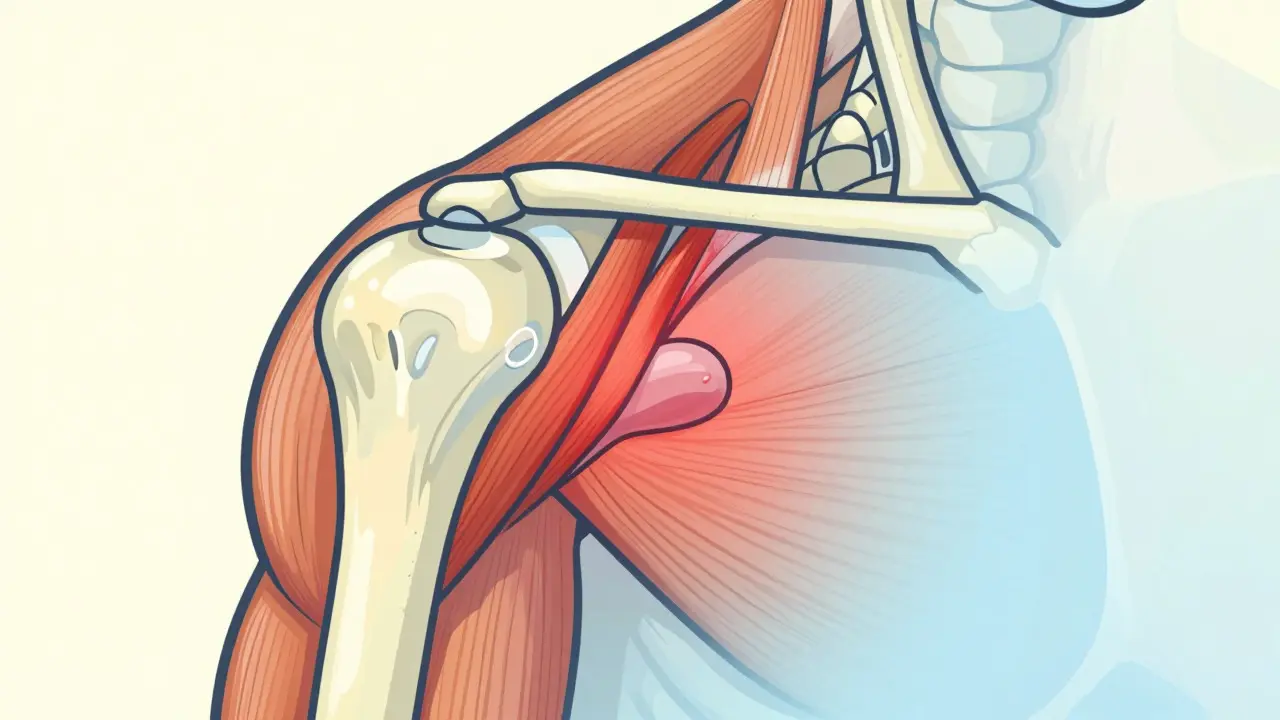
Your shoulder is a ball-and-socket joint stabilized by four muscles collectively called the rotator cuff: the supraspinatus, infraspinatus, teres minor, and subscapularis. These muscles work together to keep the arm bone (humerus) centered in the socket while allowing overhead motion. When these tendons get irritated or torn, stability drops, and pain follows. Right next to these tendons sits the subacromial bursa, a small fluid-filled sac that acts like a cushion to reduce friction between the tendons and the acromion bone (the roof of the shoulder). When this bursa gets inflamed, it swells to three or four times its normal size, creating a mechanical pinch every time you lift your arm. This combination of tendon irritation and bursal swelling is often referred to as impingement syndrome, a term first systematically described in the 1970s by Dr. Charles Neer.
The pain pattern is distinct. Many people describe a "painful arc" where lifting the arm between 60 and 120 degrees triggers discomfort. Nighttime pain is also common, particularly when lying on the affected side. If you have noticed these specific symptoms, especially after repetitive overhead work or a sudden injury, you are likely dealing with one of these two interrelated conditions.
Diagnosis: How Doctors Identify the Problem
Getting an accurate diagnosis is crucial because treatment depends on whether the issue is primarily inflammatory (bursitis) or structural (tear). A physical examination often reveals weakness in specific movements, such as external rotation or abduction. However, imaging provides the definitive answer. Ultrasound is frequently used as a first-line tool because it is dynamic and cost-effective. An abnormal finding on ultrasound includes bursal thickening exceeding 2 mm. For more detailed views, especially to assess the integrity of the rotator cuff tendons, an MRI is often ordered. On a T2-weighted MRI, inflammation shows up as high signal intensity, while tears appear as gaps in the tendon tissue.
It is worth noting that partial tears and full-thickness tears require different approaches. While both cause pain, a complete tear in someone over 60 has a lower healing rate with conservative management alone compared to partial tears. This distinction influences whether a doctor recommends immediate surgical consultation or a trial of physical therapy.
Conservative Treatment: The First Line of Defense
For most patients, surgery is not the first step. In fact, about 80% of rotator cuff tendinitis and bursitis cases respond favorably to non-surgical management when protocols are followed strictly. The initial phase focuses on reducing inflammation and protecting the joint. This typically involves relative rest for 2 to 4 weeks, avoiding activities that provoke pain, particularly overhead positions. Ice application is a simple but effective tool; applying ice packs for 15 to 20 minutes, three to four times daily, helps manage acute swelling. Nonsteroidal anti-inflammatory drugs (NSAIDs), such as ibuprofen, are commonly recommended to control pain and inflammation during this period.
If symptoms persist after four to six weeks, corticosteroid injections may be considered. These injections, usually containing triamcinolone acetonide mixed with lidocaine, are administered into the subacromial space under ultrasound guidance to ensure accuracy. Clinical data suggests that 65% to 75% of patients experience significant pain relief lasting from 4 to 12 weeks. However, these injections should be limited to two or three per year, with at least a three-month interval between them, to minimize the risk of tendon weakening.
Rehabilitation Protocols That Work
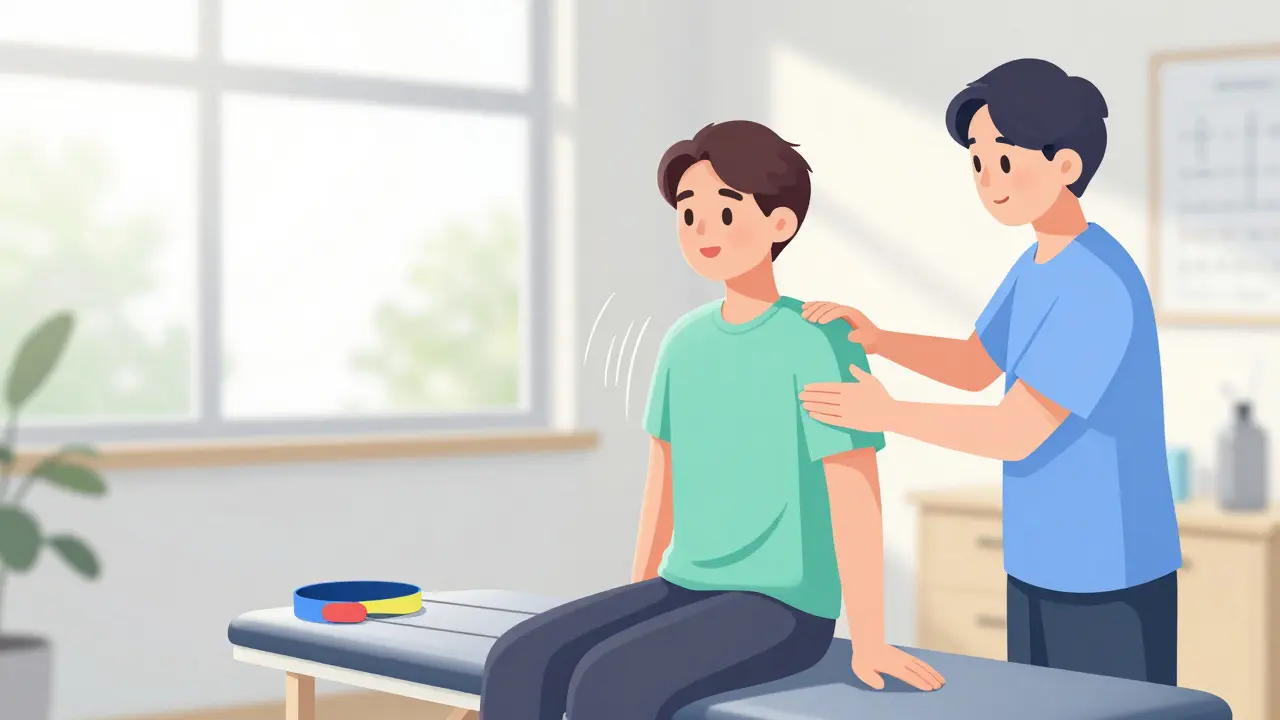
Physical therapy is the cornerstone of long-term recovery. It is not just about stretching; it is about restoring proper mechanics and strength. A standard protocol progresses through specific phases:
- Pain Control and Early Mobilization: Within the first few days, gentle pendulum exercises help maintain circulation without straining the joint. Patients are encouraged to perform these for 5 to 10 minutes, three times daily.
- Range of Motion Restoration: Around two to three weeks, active-assisted range-of-motion exercises begin. This might involve using a cane or pulley system to gently move the arm through its full range, preventing stiffness.
- Strength Building: At four to six weeks, resisted strengthening is introduced. Using resistance bands (like TheraBand) at 30% to 50% of maximum effort allows the muscles to rebuild capacity without overload. Typical sets include 15 to 20 repetitions.
- Scapular Stabilization: Often overlooked, scapular health is vital. Exercises that squeeze the shoulder blades together (retraction) improve the positioning of the shoulder blade, which directly affects how the rotator cuff functions. Studies show that focusing on scapular stability can lead to faster pain resolution than isolating the rotator cuff muscles alone.
Adherence is key. Patients who use smartphone apps with exercise reminders complete significantly more of their prescribed routines, leading to faster functional recovery. Consistency over eight to twelve weeks is typical before seeing measurable, lasting improvement.
When Surgery Becomes Necessary
Surgery is reserved for cases unresponsive to three to six months of comprehensive non-operative care or for large, full-thickness tears in younger, active patients. The most common procedure is arthroscopic subacromial decompression. This minimally invasive technique uses small portals (3-4 mm) to remove the inflamed bursa (bursectomy) and shave down any bone spurs on the acromion (acromioplasty) to create more space for the tendons. The average operative time is 45 to 60 minutes.
While surgery offers a structural fix, it is not a magic bullet. For isolated bursitis without significant structural damage, studies show only modest improvement over intensive physical therapy alone. Therefore, the decision to operate weighs the severity of the pathology against the risks and recovery timeline. Surgical recovery involves restrictions for several months, whereas conservative management, while slower, preserves native anatomy and carries a very low complication rate.
| Factor | Conservative Management | Surgical Intervention |
|---|---|---|
| Typical Duration | 3-6 months | 4-6 months (with restrictions) |
| Success Rate | ~80% for tendinitis/bursitis | High for structural repairs |
| Risk Profile | Minimal (<0.5% serious complications) | Anesthetic/surgical risks |
| Cost Range (USD) | $1,500 - $3,000 | $15,000 - $20,000 |
| Best For | Inflammation, partial tears, older adults | Full-thickness tears, failed conservative care |

Practical Tips for Faster Recovery
Managing shoulder pain at home requires strategy. Sleep disturbance is a major complaint, with nearly 80% of patients reporting difficulty sleeping initially. Sleeping with a pillow under the affected arm can provide support and reduce pressure on the bursa. During the day, monitor your pain levels using a 0-10 scale. The goal during exercise is to stay below a level 5; if pain spikes higher, you are likely doing too much, too soon. Avoid the "weekend warrior" trap-returning to sports prematurely is a leading cause of recurrent symptoms. Listen to your body, and remember that progress is often slow and steady rather than linear.
Frequently Asked Questions
How long does it take to recover from rotator cuff tendinitis?
Most patients see significant improvement within 8 to 12 weeks of consistent physical therapy and activity modification. Full return to heavy overhead activities may take up to 3 to 6 months depending on the severity of the initial injury.
Is bursitis the same as a rotator cuff tear?
No, they are different but often coexist. Bursitis is inflammation of the fluid-filled sac, while a tear is damage to the muscle-tendon unit itself. Bursitis can occur without a tear, but chronic impingement from a tear can lead to secondary bursitis.
Do I need surgery for shoulder bursitis?
Rarely. Surgery for isolated bursitis shows only modest benefits over intensive physical therapy. It is usually reserved for cases where structural issues like bone spurs are causing persistent impingement despite months of conservative care.
What exercises are safe for a painful shoulder?
Pendulum swings, scapular retraction (shrugging shoulders back), and gentle passive range-of-motion exercises are generally safe early on. Avoid overhead lifting and heavy resisted rotations until cleared by a physiotherapist.
Can I cure rotator cuff pain with just ice and rest?
Ice and rest help manage acute symptoms, but they do not address underlying weakness or mechanical issues. Without progressive strengthening and mobility work, the condition is likely to recur once normal activities resume.