
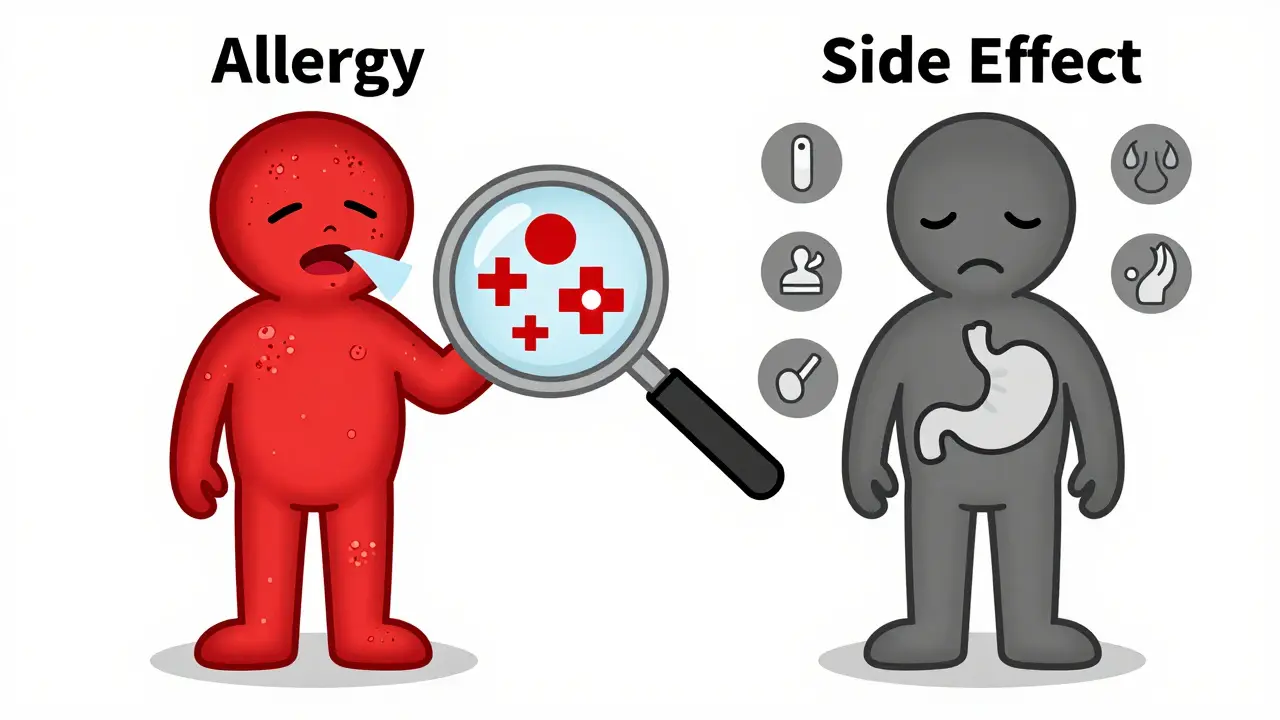
It’s common to hear someone say, "I’m allergic to penicillin," or "I can’t take ibuprofen-it gives me a stomachache." But not all bad reactions to medication are allergies. In fact, most aren’t. If you’ve ever been told you have a drug allergy based on nausea, dizziness, or a mild rash, you might be carrying around a label that’s not just wrong-it’s dangerous. Mislabeling a side effect as an allergy can limit your treatment options, cost you more money, and even put your life at risk in emergencies. So how do you tell the difference?
What’s Really Happening in Your Body?
A true drug allergy means your immune system has mistakenly identified a medication as a threat. It produces antibodies-usually IgE-that attack the drug, triggering inflammation. This can lead to hives, swelling, trouble breathing, or even anaphylaxis. These reactions are unpredictable, can get worse with each exposure, and require complete avoidance of the drug.
On the other hand, a side effect is just how the drug works. It’s not your immune system. It’s pharmacology. For example, aspirin can irritate your stomach lining. That’s not an allergy-it’s a known effect of how aspirin blocks certain enzymes. Same with nausea from antibiotics or dizziness from blood pressure meds. These are predictable, dose-dependent, and often go away if you lower the dose or stop the drug.
Here’s the key: allergies involve your immune system. Side effects don’t. That’s the line.
Timing Matters: When Did the Reaction Happen?
When you notice symptoms can tell you a lot.
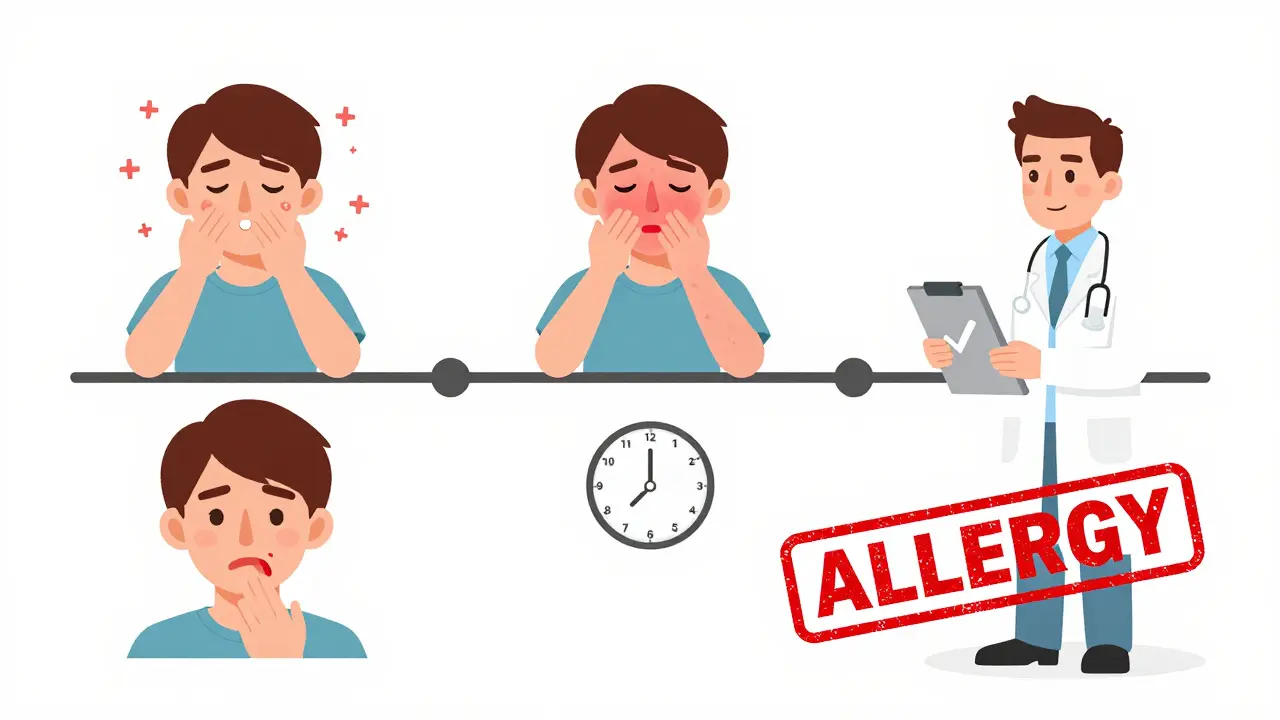
- Immediate reactions (within minutes to 1 hour): If you break out in hives, your throat swells, or you start wheezing within an hour of taking a pill, that’s a red flag for an IgE-mediated allergy. These are the most dangerous and require urgent care.
- Delayed reactions (days to weeks): A rash that shows up 7 to 14 days after starting a drug-especially if it’s widespread and itchy-could be a T-cell mediated allergy. Severe forms like DRESS (Drug Reaction with Eosinophilia and Systemic Symptoms) or Stevens-Johnson Syndrome can develop 2 to 6 weeks later. These are rare but life-threatening.
- Side effects: Nausea, headache, or dizziness usually happen soon after taking the drug, but they don’t get worse with repeated doses. They often improve over time or go away if you stop taking it.
According to the Mayo Clinic, 80-90% of true drug allergies show up as skin reactions. But 40-50% of all reported adverse reactions are gastrointestinal-like nausea or diarrhea. That’s almost always a side effect, not an allergy.
Pattern Recognition: One Symptom or Many?
Side effects usually stick to one system. If you only get a headache after taking a certain drug, it’s likely a side effect. But if you get a rash and swollen lips and trouble breathing? That’s multiple systems involved-and that’s classic for a true allergy.
A 2023 analysis of 10,000 patient records found that 87% of confirmed drug allergies involved at least two organ systems. Only 22% of side effects did. So if you’re wondering whether it’s an allergy, ask: "Did more than one thing go wrong?" If yes, it’s worth investigating.
Common Misunderstandings
Let’s clear up a few myths.
- "I got sick to my stomach after amoxicillin-I’m allergic." That’s not an allergy. Gastrointestinal upset is the #1 side effect of antibiotics. The American Journal of Medicine found that 68% of people who think they’re allergic to penicillin actually just had nausea or diarrhea.
- "I had a rash once, so I can never take it again." A mild, non-itchy rash can be a viral reaction, especially in kids on antibiotics during a cold. It’s not always drug-related.
- "I had a reaction years ago, so I’m still allergic." Up to 95% of people who were labeled penicillin-allergic decades ago can safely take it today. Allergies can fade. That’s why testing matters.
Here’s the hard truth: 7% of Americans say they’re allergic to penicillin. But when tested properly, only about 1% actually have a true IgE-mediated allergy. That means tens of millions are avoiding a safe, cheap, effective antibiotic because they were misinformed.
What Should You Do?
If you think you have a drug allergy, don’t just assume. Don’t avoid the drug forever. Talk to your doctor or an allergist. Here’s what you can do:
- Write down the details: What drug? When did you take it? What happened? How long did it last? Was it just one symptom or more?
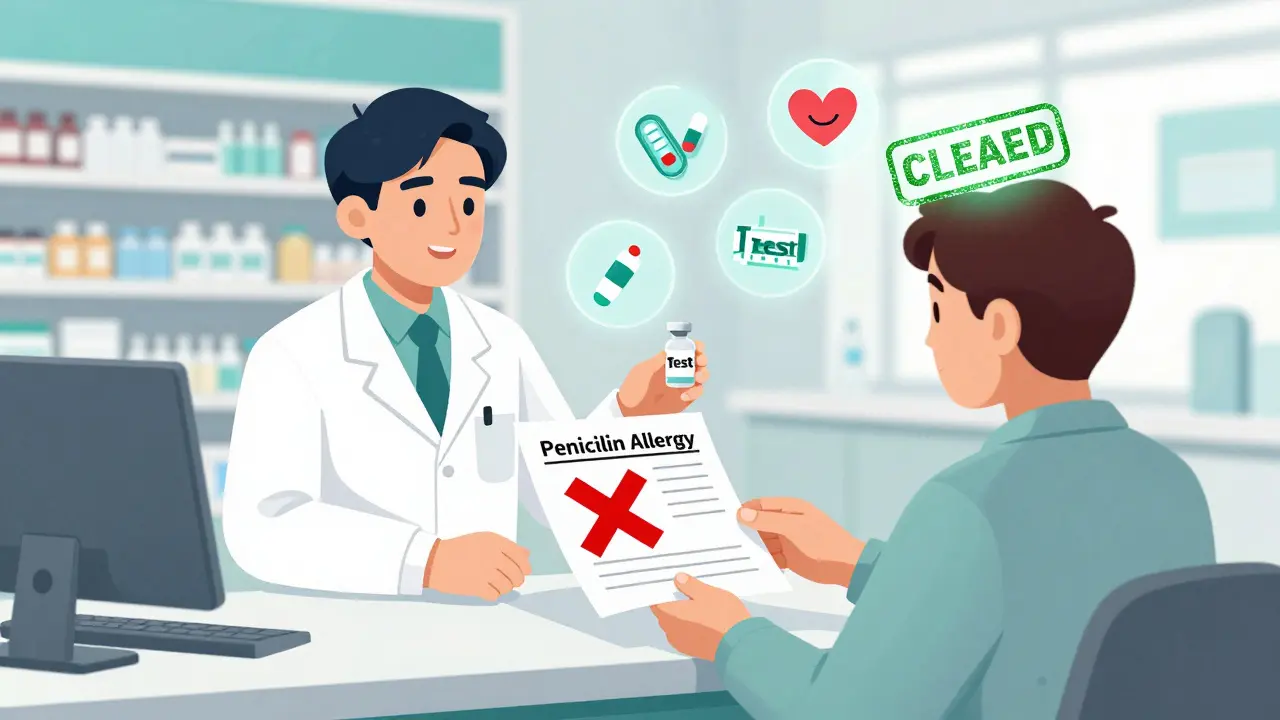
- Ask about testing: For penicillin and some other drugs, skin tests and blood tests (like the Penicillin ImmunoCAP test) are 97% accurate. A simple scratch test can confirm or rule out an allergy in minutes.
- Consider a drug challenge: If you’re low-risk, an allergist might give you a tiny dose under supervision. If nothing happens, you’re not allergic. This is safe and common.
- Update your records: If you’re cleared, ask your doctor to remove the allergy label from your chart. Many hospitals now have pharmacist-led programs to do this.
One patient I spoke with (from Bristol, like me) had avoided all penicillin-based antibiotics for 12 years after a mild rash as a child. When she finally got tested, she was cleared. Her doctor was able to prescribe a targeted antibiotic for a recurring infection-and she recovered faster, with fewer side effects and lower costs.
Why This Matters More Than You Think
Getting this wrong isn’t just inconvenient. It’s costly and dangerous.
When doctors can’t use penicillin, they turn to broader-spectrum antibiotics. These are more expensive, harder on your gut, and contribute to antibiotic resistance. The CDC estimates that incorrect penicillin labels cost the U.S. healthcare system over $1 billion a year. Patients with mislabeled allergies also have a 69% higher risk of C. diff infection and stay in the hospital 30% longer.
And here’s the scary part: if you’re having a serious infection and your chart says "penicillin allergy," a doctor might skip the best treatment entirely. That could mean the difference between a quick recovery and a life-threatening complication.
What’s Changing in 2026?
The medical world is catching up. The FDA now requires drug labels to clearly separate "side effects" from "allergies." Electronic health records must distinguish between the two by January 2025. Hospitals across the U.S. and U.K. are rolling out allergy assessment programs, with some reporting over 90% success in safely removing false labels.
New tools are emerging too. The Penicillin ImmunoCAP test, approved in 2023, gives doctors a clear yes-or-no answer. And by 2026, more clinics will use decision-support software that flags suspicious allergy labels and prompts testing.
But none of this matters if you don’t question your own label. If you’ve ever said, "I’m allergic to this," pause and ask: "Was it really an allergy-or just a side effect?"
14 Comments

Allison Priole
March 22 2026
omg yes i had this exact thing happen!! i thought i was allergic to ibuprofen because i got a rash once when i was sick with mono-turns out it was the virus, not the drug. my doctor just laughed and said "you’re not allergic to painkillers, you’re allergic to being sick." now i take it like candy and my headaches are gone. why do we all just assume the worst? 🤦♀️

Sandy Wells
March 22 2026
The real issue here is that patients are too lazy to learn the difference between pharmacology and immunology. Doctors don’t have time to educate every person who says "I’m allergic" after one bad experience. It’s not rocket science. Stop being dramatic and read the damn pamphlet.
Also the FDA should just remove all non-IgE reactions from labels entirely. Too much noise.

Timothy Olcott
March 23 2026
AMERICA NEEDS TO STOP BEING SO COWARDLY ABOUT MEDS. I’VE TAKEN 3 DIFFERENT ANTIBIOTICS IN THE LAST YEAR AND I’M STILL STANDING. IF YOU CAN’T HANDLE A LITTLE NAUSEA THEN YOU SHOULD BE ON A DIET OF WATER AND CRACKERS. #AMERICANHEALTHCAREISABOMB #STOPTHEFUD

Desiree LaPointe
March 24 2026
How charming. Another feel-good narrative where we pretend people are too stupid to know the difference between a rash and anaphylaxis. The truth? Most patients don’t want to be educated-they want to be validated. The label "allergy" gives them agency. The label "side effect" makes them feel weak. So we let them keep their delusions because it’s easier than making them face reality.
And yes, this is why we’re in the middle of an antibiotic resistance crisis. We’ve turned medicine into a therapy session.

matthew runcie
March 24 2026
I appreciate this breakdown. I had a mild rash after amoxicillin as a kid-no swelling, no breathing issues, just a few spots. My mom made me avoid all penicillin for 20 years. I finally got tested last year. Zero reaction. Now I’m on a better antibiotic for my sinus infection. Simple fix. Why didn’t anyone suggest testing sooner?

trudale hampton
March 24 2026
My cousin got mislabeled as penicillin-allergic after a stomachache in 1998. She ended up on clindamycin for a tooth infection and got C. diff. Spent 3 weeks in the hospital. Now she’s fine, but the damage was done. This isn’t just about convenience-it’s about survival. We need to stop treating medical labels like tattoos.
Also, kudos to the hospitals doing testing programs. More of that please.

Solomon Kindie
March 26 2026
The immune system is not a switch it is a spectrum and we are reducing complex biology to binary labels because it makes doctors lives easier and patients feel safe in their ignorance
we are not evolving we are just rebranding fear as caution

Nicole James
March 26 2026
Have you considered that this whole "misdiagnosed allergy" narrative is pushed by Big Pharma? Think about it-when you remove penicillin labels, you open the door for newer, more expensive antibiotics. Who benefits? Not you. Not me. The system. The FDA? They’re just puppets. The 90% success rate? Probably faked. They want you to believe you’re safe so you keep taking their drugs.
And don’t get me started on the Penicillin ImmunoCAP test. It’s not 97% accurate-it’s 97% profitable.

Casey Tenney
March 27 2026
If you say you're allergic to a drug and you’ve never been tested, you’re not brave. You’re reckless. Your ignorance could kill someone. Get tested. Or shut up.

Bryan Woody
March 27 2026
Let’s be real-this whole thing is a symptom of a broken system. Doctors don’t have time to explain pharmacology. Nurses don’t have time to document properly. Patients are handed a one-page discharge slip and told "don’t take this again."
Meanwhile, I’ve seen people avoid life-saving drugs for decades because of a single stomachache. I had a patient who refused cipro because she thought it "gave her anxiety"-turns out it was just caffeine withdrawal. We tested her. She’s fine now. She cried. Not because she was allergic. Because she realized she’d been living in fear for 15 years.
Testing isn’t a luxury. It’s a right.

Chris Dwyer
March 29 2026
I work in a rural clinic. We’ve started doing quick penicillin scratch tests in the office. It takes 10 minutes. Cost? $40. Result? People walk out with a new lease on life. One guy avoided all antibiotics for 30 years because he threw up once after a tonsillectomy. Now he’s on his third course of penicillin since we cleared him. He says it’s the first time he’s felt healthy since the 80s.
We’re not just fixing labels-we’re fixing lives.

Jackie Tucker
March 29 2026
How quaint. You treat this like a medical issue. But it’s not. It’s a psychological one. People cling to these labels because they give them a narrative: "I’m special. I’m fragile. I’m different."
Removing the label doesn’t just change their treatment-it shatters their identity. That’s why most won’t test. Not because they’re ignorant. Because they’re terrified of being ordinary.
And honestly? That’s more tragic than any side effect.

shannon kozee
March 31 2026
I got tested after 22 years of avoiding penicillin. Turned out I was fine. My doctor said, "You probably had a virus. That’s what happens when kids get amoxicillin during a cold." I wish I’d known that sooner. Simple. Clear. No drama. Just science.
Write a comment
Popular Posts
Nishan Basnet
March 22 2026
Finally, someone put this into perspective. I’ve been telling my mom for years that her "penicillin allergy" was just stomach upset from the antibiotic. She refused to believe it until she got tested last year-turns out she’s fine. Now she’s on a targeted treatment for her recurrent UTIs, and her bills dropped by 60%. Why do we let fear override science?