
Insulin Time Zone Adjustment Calculator
Calculate Your Insulin Adjustment
Get personalized guidance for adjusting your insulin when traveling across time zones
Your Adjustment Recommendations
Enter your travel details to see personalized recommendations
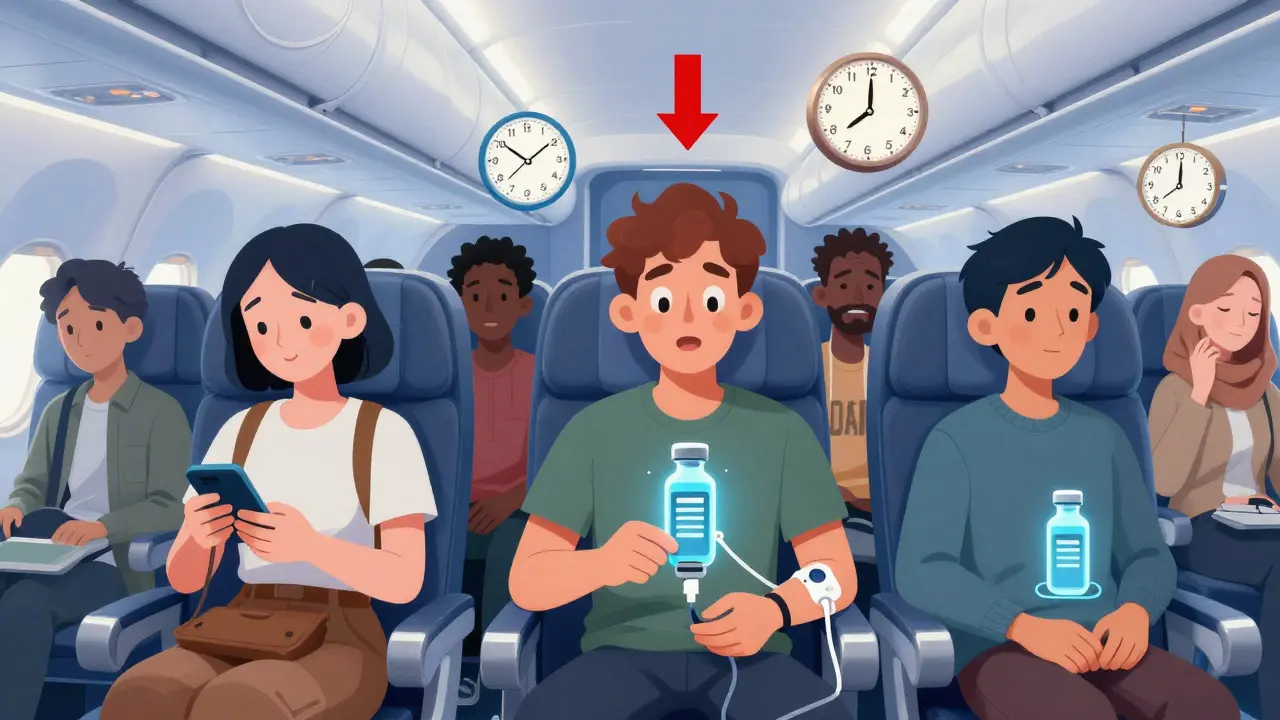
When you’re flying across time zones with diabetes, your body doesn’t get a warning before your insulin schedule gets thrown off. One day you’re taking your evening dose at 9 p.m. in London. The next, you’re landing in Tokyo at 7 a.m. local time - and your body still thinks it’s 1 a.m. That mismatch can send your blood sugar skyrocketing or crashing, and in the air, there’s no pharmacy nearby. This isn’t just inconvenient. It’s dangerous. About 7 million insulin-dependent travelers cross three or more time zones every year. Most of them don’t know how to adjust their doses safely. And too often, the result is hypoglycemia, hyperglycemia, or worse - a medical emergency mid-flight.
Why Time Zones Mess With Your Insulin
Your insulin doesn’t care about time zones. But your body does. Your metabolism, your hunger cues, your liver’s glucose release - all of it runs on a 24-hour clock. When you jump across time zones, that clock gets out of sync. Traveling east (like from New York to Paris) shortens your day. You lose hours. That means your body needs less insulin because you’re not active as long. Traveling west (like from Los Angeles to London) stretches your day. You gain hours. That means you might need extra insulin to cover the longer stretch between meals. The problem gets worse in flight. Cabin pressure and dry air make your body absorb insulin faster - up to 20% faster, according to the Aerospace Medical Association. Dehydration makes it worse. And if you skip meals because you’re tired or the food service is delayed? That’s when your blood sugar drops hard. One Reddit user, u/Type1Traveler, hit a blood sugar of 42 mg/dL on a flight from Tokyo to Chicago after skipping dinner because he thought he was “on home time.” He needed glucagon.Eastbound Travel: Shorter Days, Less Insulin
If you’re flying east - say, from the UK to Japan - you’re losing time. Your day gets shorter. Your body doesn’t need as much insulin overnight. The standard advice? Reduce your basal insulin dose by 20-33% on the day you travel. For example, if you normally take 20 units of long-acting insulin at bedtime, take 14-16 units instead. Don’t cut it all at once. Go slow. For those on rapid-acting insulin (like NovoLog or Humalog), skip the usual pre-dinner shot if you’re eating earlier than normal. But don’t skip meals. Eat something light - a banana, a handful of nuts - even if it’s not your usual mealtime. Your body still needs fuel. A 2020 study in Diabetes Technology & Therapeutics found that travelers who reduced their evening basal dose by one-third had 38% fewer episodes of nighttime low blood sugar. That’s not a small win. It’s a lifesaver.Westbound Travel: Longer Days, Extra Insulin
Going west? You’re gaining hours. That means you might need an extra meal - and an extra insulin dose. For example, if you’re flying from New York to Hawaii, you’re adding five hours to your day. You’ll likely eat dinner later than normal. Your body will still be processing food from lunch. So, take your usual dinner insulin dose, then add a small correction dose 4-6 hours later - about half of your typical meal insulin. Let’s say you normally take 8 units of rapid-acting insulin with dinner. After landing in Hawaii, eat dinner at 9 p.m. local time (which feels like 4 a.m. to your body). Then, at 1 a.m. local time, take 4 units more. That extra dose prevents the spike that comes from delayed digestion. The Cleveland Clinic Journal of Medicine recommends this approach for travelers crossing five or more time zones.Pump Users: Don’t Just Flip the Switch
If you use an insulin pump, you might think, “I’ll just change the time setting when I land.” But that’s risky. Changing the pump time all at once can cause a sudden spike or drop in insulin delivery. Instead, adjust gradually. - For changes under 2 hours: Change the pump time immediately. No problem. - For changes over 2 hours: Adjust the pump time by 2 hours per day until it matches local time. UCLA Health’s 2022 study of 127 pump users found that those who adjusted slowly had 27% fewer low blood sugar events than those who changed the time all at once. And if your pump has GPS (like the t:slim X2 with Control-IQ), it can auto-adjust. But don’t rely on it. Always double-check your settings.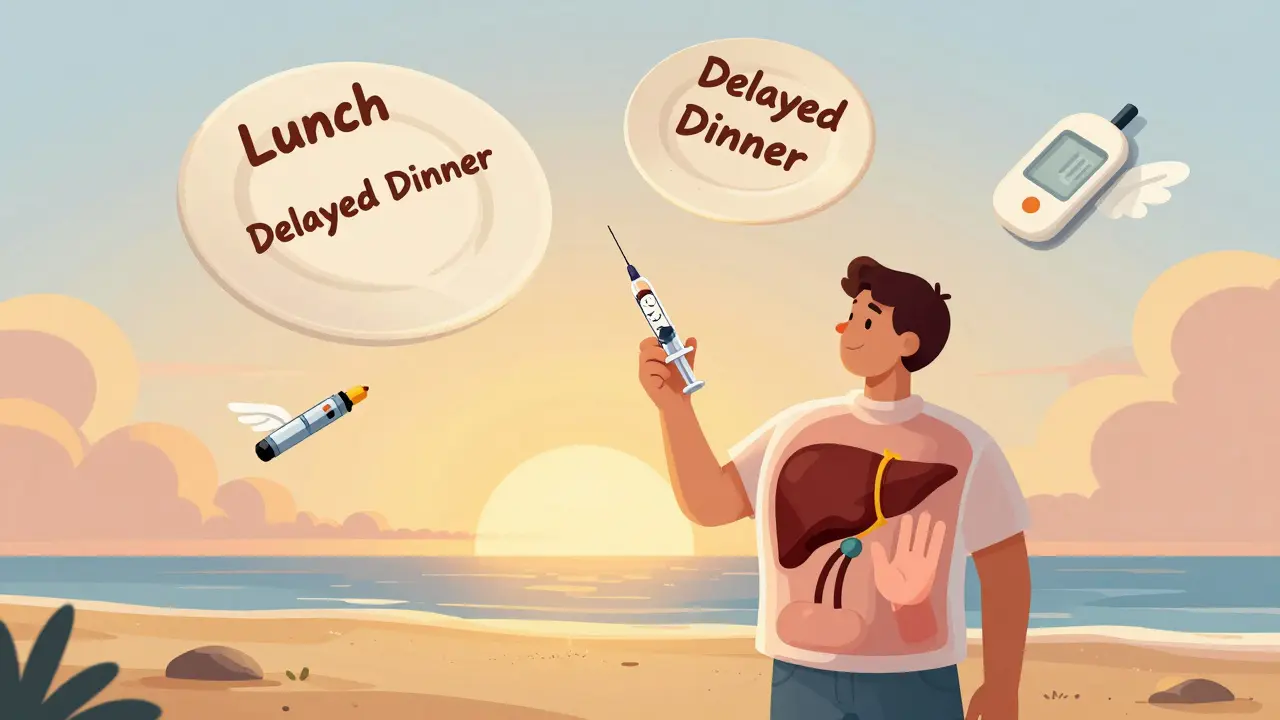
What About Basal-Bolus Regimens?
If you take long-acting insulin once a day (like Lantus or Levemir) and rapid-acting insulin with meals, here’s how to handle it:- Traveling east: Take your morning basal dose as usual. Skip your evening basal dose. Take your usual rapid-acting insulin with meals, but reduce the dose by 20% if you’re eating earlier.
- Traveling west: Take your morning basal dose as usual. When you reach your destination, take your usual evening basal dose at local dinner time. Then, take half your usual basal dose 12 hours later (that’s your “bridge” dose). This covers the gap while you adjust.
Temperature, Storage, and TSA Rules
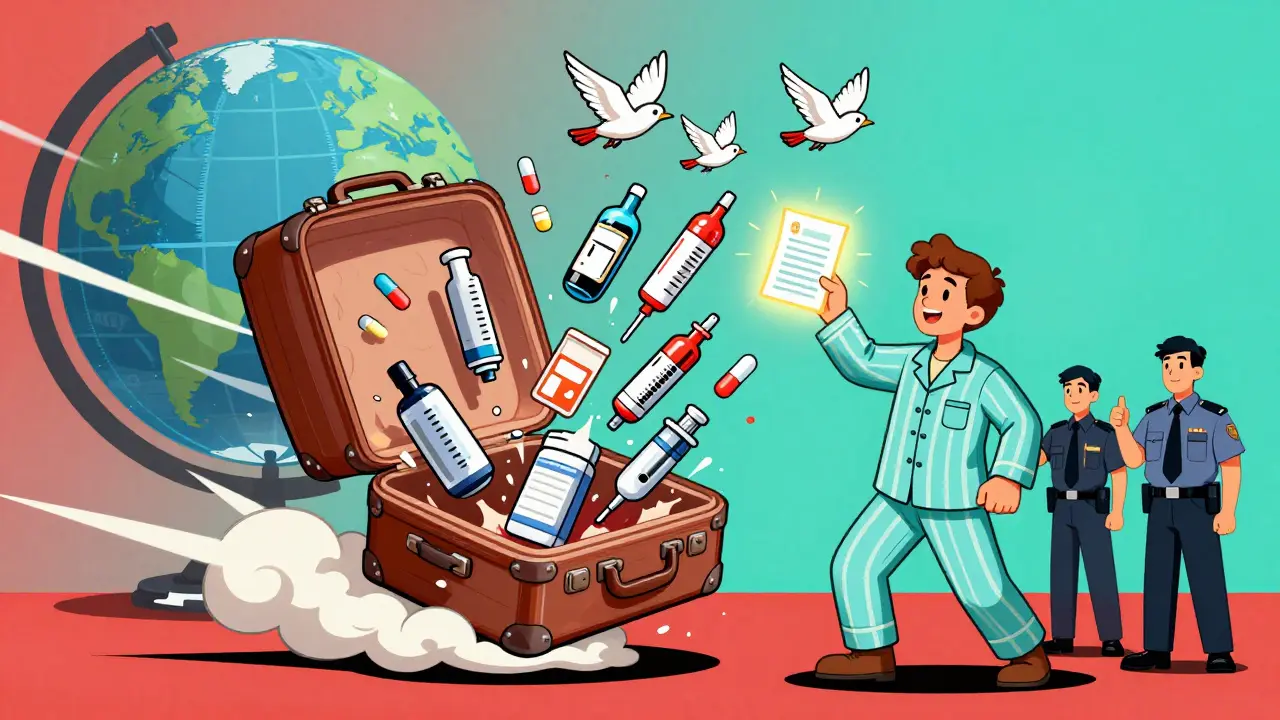
Insulin doesn’t like heat. If your bag sits in the sun on the tarmac, or your hotel room hits 90°F, your insulin loses potency. A 2022 study found insulin exposed to temperatures above 86°F for over 24 hours loses 15% of its strength per day. That means your dose might not work. Always carry insulin in your carry-on. Use a cooling wallet if you’re flying in a hot climate. And never check it in luggage. TSA allows insulin and supplies in carry-on bags - no liquid limits. But bring a doctor’s letter. According to the American Diabetes Association, travelers with documentation had 89% fewer delays at security. A simple note saying “I am a person with diabetes and require insulin and supplies” is enough.Pre-Trip Planning: Do This 4 Weeks Before You Go
Don’t wait until you’re at the airport. Talk to your diabetes care team at least four weeks before you leave. They can help you build a personalized plan. Here’s what you need:- Know your destination time zone and how many hours you’ll gain or lose.
- Calculate your new insulin schedule. Write it down. Put it in your phone and on paper.
- Bring 30% extra insulin and supplies. Always. Glucagon too.
- Test your blood sugar more often - every 2-4 hours during travel.
- Set alarms on your phone for meals and insulin doses.
What Experts Say
Dr. David Edelman from Duke University says: “Don’t chase perfect time alignment. Chase routine.” That means eat at the same time every day, even if it’s 3 a.m. in your new time zone. Your body prefers consistency over precision. Dr. Howard Wolpert from Joslin Diabetes Center advises: “Keep your blood sugar a little higher than normal on travel day - aim for 140-180 mg/dL.” That gives you a safety buffer. In a multicenter trial, this strategy cut severe lows by 41%. And if you’re flying long-haul? The Aerospace Medical Association says: “Reduce your insulin dose by 10-15% during the flight.” Dehydration + cabin pressure = faster insulin absorption. You don’t need to overcorrect. Just be cautious.What Works in Real Life
On the Diabetes Daily forum, user “GlobeTrottingGina” flew from London to Los Angeles. She took 5 units of NPH and 10 units of regular insulin 5 hours after her last European meal. No highs. No lows. She says: “I didn’t try to match the clock. I matched my hunger.” Another traveler, from Reddit, said: “I brought extra insulin, tested every hour, and ate snacks even when I wasn’t hungry. I didn’t get a single low.” The pattern is clear: plan ahead, test often, eat regularly, carry extra. Don’t overthink it.What’s Coming Next
Technology is catching up. Insulin pumps with GPS are auto-adjusting. Smart pens from Ypsomed (coming in 2025) will calculate your dose based on your flight path. The European Association for the Study of Diabetes now recommends continuous glucose monitors (CGMs) for all travelers crossing three or more time zones. CGMs cut severe lows by 58%. By 2030, personalized algorithms based on your sleep patterns and insulin sensitivity could become standard. But for now, the best tool you have is your own awareness.Do I need to adjust my insulin if I’m only crossing one time zone?
Usually not. If you’re crossing one or two time zones, your body can adjust naturally. Stick to your usual schedule. Test your blood sugar more often, especially if you’re eating at odd hours. No major changes needed.
Can I skip my insulin dose if I’m not eating on the plane?
Never skip your basal insulin - even if you’re not eating. Basal insulin keeps your blood sugar stable overnight. But you can reduce your rapid-acting insulin if you’re not eating a full meal. Always eat something light: crackers, fruit, or nuts. Skipping food entirely can cause a dangerous low.
What if I have a low blood sugar during the flight?
Treat it like you would at home: 15 grams of fast-acting sugar (glucose tabs, juice, candy). Wait 15 minutes, then retest. If you’re alone, ask a flight attendant - they’re trained to help. Always carry glucagon if you’re at risk for severe lows. And never fly without telling someone you’re diabetic.
Should I use a CGM when traveling?
Yes - especially if you’re crossing three or more time zones. Real-time glucose data lets you see trends before they become emergencies. A 2024 study showed CGMs reduce severe hypoglycemia by 58% during travel. If you don’t have one, test your blood sugar every 2-4 hours.
Is it safe to fly with insulin in checked luggage?
No. Insulin can lose potency if exposed to extreme heat or cold. Always carry it in your carry-on. TSA allows insulin and supplies without liquid restrictions. Bring a doctor’s note to avoid delays. Never risk your insulin in the cargo hold.
14 Comments

Matt Alexander
March 4 2026
Simple advice: if you're flying east, reduce basal. If west, add a bridge dose. Always carry snacks. Never skip basal. Test every few hours. Bring extra. That's it. No need to overcomplicate it. Your body just needs consistency, not perfection.

Gretchen Rivas
March 5 2026
I’ve done this 12 times. The biggest mistake? Thinking I could skip testing because I was ‘fine.’ Never again. CGM saved me on my Tokyo trip. I saw my glucose creeping up at 2 a.m. local time and took 2 units-prevented a 300+ spike. Also, ice packs in carry-on. Always.

Mike Dubes
March 5 2026
Man I love this post. I'm a pump user and used to just flip the time when I landed. Big mistake. I went low on a flight from LA to Sydney because my pump delivered a whole extra hour's worth of insulin. Now I adjust 2 hours a day. Took 3 days to sync up but zero lows. Also-snacks in every pocket. Even the coat. You never know when you'll need a granola bar.

Helen Brown
March 7 2026
Did you know the FAA has been hiding data on insulin degradation in cargo holds? They say it's safe but I’ve seen three people lose their insulin in checked bags. The FDA doesn’t test it under real flight conditions. And don’t get me started on how airlines lie about temperature control. This isn’t just about diabetes-it’s about corporate negligence. Always carry your own cooler. Always.

John Cyrus
March 9 2026
Anyone who says you need to reduce insulin eastbound is giving dangerous advice. Basal insulin is basal for a reason. You don’t reduce it because you’re tired. You reduce it because your liver output drops. And that’s not always true. If you’re a Type 1 and you’re cutting your basal because you read a blog, you’re playing Russian roulette with your pancreas. My HbA1c is 5.2 because I don’t listen to internet advice. I listen to my endo.

John Smith
March 9 2026
Y’all are overthinking this. I flew from NYC to Bali. 14 hours. I ate pizza at 8 a.m. local time because I was hungry. Took my usual dinner insulin. Didn’t test for 8 hours. Got a 210. Took 3 units. Ate mangoes. Slept. Woke up at 135. Done. Diabetes is not a math test. It’s a life. Eat when you’re hungry. Move when you can. Stay calm. You’ll be fine.

Richard Elric5111
March 11 2026
One must interrogate the ontological implications of insulin temporality. The body, as a phenomenological entity, is not merely a biological machine subject to circadian rhythms but a site of existential dislocation when subjected to the violent rupture of time zones. The insulin molecule, in its chemical purity, remains indifferent to human constructs of hours and minutes. Yet, our lived experience demands synchronization. This tension-between the inert and the embodied-is the true diagnosis. We do not merely adjust doses; we negotiate the metaphysics of metabolic identity. The CGM, then, is not a tool, but a witness to our existential recalibration.

Sharon Lammas
March 12 2026
I’ve been living with Type 1 for 32 years. I travel constantly. The most important thing isn’t the math. It’s the habit. I write everything down. I set three alarms. I pack twice as much as I think I need. I tell one person on the flight. I don’t rely on technology. I rely on routine. That’s what keeps me alive. Not the latest study. Not the smart pen. Just discipline.

marjorie arsenault
March 13 2026
You got this. I know it feels overwhelming. I’ve been there-panicked on a flight, not sure if I took my dose. Start small. One trip. One adjustment. Test more. Eat a snack. Carry glucose. You don’t need to be perfect. You just need to be prepared. And you’re not alone. Millions of us do this. You’re stronger than you think.

Deborah Dennis
March 15 2026
...And yet, still, people ignore the 20% faster absorption rate? Really? You’re going to fly across 5 time zones and just ‘trust your gut’? That’s not bravery-it’s negligence. And now you’re putting flight crews at risk too. Someone’s going to pass out. And then? Then the airline will blame YOU. Not the insulin. Not the cabin pressure. YOU. Because you didn’t follow the guidelines. So, please. For everyone’s sake. Read the article. Again.

Shivam Pawa
March 16 2026
Basal adjustment varies by insulin type. Lantus has different pharmacokinetics than Levemir. For eastbound travel, 20% reduction works for long-acting analogs but not for NPH. NPH peaks at 8 hours-so if you're crossing 10 hours, you need to split the dose. Also, CGM correlation with plasma glucose is not 1:1 at high altitudes. Calibration error increases 12%. Always confirm with fingerstick before correction.

Diane Croft
March 17 2026
This is why I love the diabetes community. We turn fear into strategy. We turn chaos into control. You don’t need to be a scientist. You just need to be prepared. Bring snacks. Test. Carry extra. Tell someone. You’ve got this. And if you mess up? You learn. You adapt. You keep going. That’s what makes us unstoppable.

Jeff Card
March 18 2026
I read this after my last trip from Boston to Berlin. I followed the 33% basal reduction, ate a banana at 1 a.m. local time, and didn’t test for 6 hours. My CGM screamed at me at 4 a.m. I was at 58. Took 15g glucose. Slept. Woke up at 110. I thought I was doing everything right. But I forgot one thing: dehydration. I didn’t drink enough water. That’s what made me drop. Now I drink 1 liter per flight. Always. It’s not about insulin. It’s about fluids.
Write a comment
Popular Posts




How Pets Help People Recover from Illness
6 Oct 2025

Dean Jones
March 4 2026
The science here is solid, but what really struck me was how little we talk about the psychological toll of managing diabetes while traveling. It's not just about math and timing-it's about fighting a constant internal battle against fatigue, disorientation, and the quiet panic that creeps in when your body doesn't recognize the time. You're not just adjusting insulin-you're retraining your entire nervous system. And no algorithm, no smart pen, no CGM can fully replace the mental discipline it takes to eat when you're exhausted, test when you're in a foreign airport bathroom at 3 a.m., and trust your body enough to not panic when the numbers don't match your expectations. This isn't a checklist. It's a daily act of courage.