

Missing a dose. Forgetting which pills to take. Double-dosing by accident. These aren’t just minor slip-ups-they’re serious risks that can send you back to the hospital. In the U.S., medication adherence problems cost over $300 billion a year in avoidable care. And yet, most people still rely on paper lists and memory to stay on track. That’s not enough. But you don’t need fancy tech to get it right. Here’s how to track your meds properly-with or without apps.
Why Medication Adherence Matters More Than You Think
It’s not just about taking your pills. It’s about taking them at the right time, in the right amount, and for the full course. One study found that patients with high blood pressure who missed just 20% of their doses were 50% more likely to have a stroke. For diabetes, skipping insulin or metformin can lead to nerve damage, kidney failure, or amputations. Even something as simple as antibiotics-if you stop early because you feel better-can create drug-resistant superbugs.
Doctors can’t fix what they can’t see. If you say you took your pills but didn’t, your treatment plan stays wrong. That’s why tracking isn’t optional-it’s part of your care.
Paper Medication Lists: The Starting Point
Before you buy a smart pillbox or download an app, start with a simple paper list. Write down every medication you take: name, dose, time of day, and reason. Include over-the-counter drugs and supplements. Use a notebook or print a template from your pharmacy. Keep it in your wallet or taped to your bathroom mirror.
Now, add a daily log. Each time you take a pill, put a checkmark or X next to it. Don’t wait until the end of the day. Do it right after you swallow it. If you miss a dose, write why: "Forgot," "Too sick," "Out of pills." This isn’t about guilt-it’s about patterns.
Studies show people who use paper logs improve adherence by 20-30%. That’s huge. But here’s the catch: paper logs are only as good as the person writing them. One study found nearly half of patients faked their logs to look better. That’s why paper alone isn’t enough for chronic conditions.
How Accurate Are Different Tracking Methods?
Not all tracking is created equal. Here’s what actually works:
- Self-reported logs (paper or phone): Only 27% accurate. People forget, misremember, or lie-even unintentionally.
- Pill counts: Around 60% accurate. Your doctor counts your pills at appointments. Works if you’re honest, but doesn’t tell you when you took them.
- Electronic monitoring caps (MEMS): 97% accurate. These caps record every time you open your pill bottle. Used in clinics and trials. Expensive, but gold standard.
- Smart pillboxes (like Tenovi): 94% accurate. They beep, flash lights, and send alerts to your phone or doctor. Real-time data. No guessing.
- Video observation (VDOT): 98.5% accurate. You film yourself taking the pill. Works for high-risk meds like tuberculosis drugs, but takes 17 minutes per dose.
The bottom line? If you’re on long-term meds for heart disease, diabetes, or mental health, don’t rely on memory or paper alone. Use something that records actual behavior.
Smart Pillboxes: The Best Middle Ground
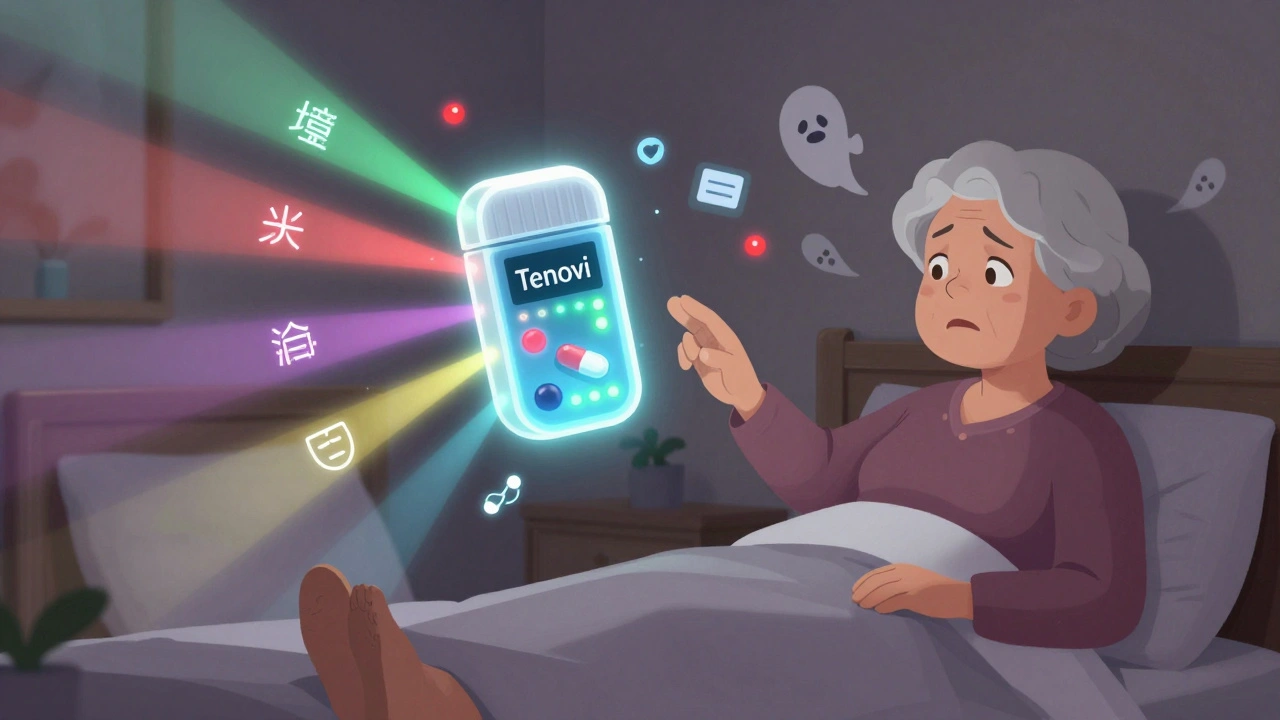
You don’t need a hospital-grade system. A $50 smart pillbox like Tenovi changes everything. It holds up to 28 doses. Each compartment opens only at the right time. A red light glows when it’s time to take your pill. Green light means you’ve taken it. If you skip it, your phone gets a text. Your doctor can see it too-if you allow it.
Real people use this. One 72-year-old in Bristol told her pharmacist she’d been taking her warfarin daily. Her pillbox showed she missed 11 doses in three weeks. She didn’t even realize. Once she saw the data, she set alarms on her phone and started keeping her pillbox next to her coffee maker. Her INR levels stabilized within a month.
Pros: No phone needed for basic use. Battery lasts 6 months. Works offline. Easy for older adults.
Cons: Needs Wi-Fi or cellular to sync with providers. Can be expensive if not covered by insurance. Rural areas sometimes lose signal.
When Apps Work-and When They Don’t
Apps like Medisafe, MyTherapy, or Mango Health are popular. They send reminders, let you log doses, and even track side effects. But they’re only useful if you open them every day. A 2023 study found that 61% of users stopped using their app after 30 days.
Why? Too many steps. You have to open the app. Tap the button. Maybe answer a question. If you’re tired, confused, or in a rush, you skip it. That’s why apps work best for younger, tech-savvy users or as a supplement-not a replacement-for physical tracking tools.
Tip: Use an app if you already check your phone 10 times a day. Skip it if you only use your phone to call people.
What Doctors and Pharmacies Are Doing Now
Hospitals aren’t waiting. Since 2022, Medicare requires adherence data to reimburse clinics for chronic care management. That means your doctor is now asking for proof you’re taking your meds.
Many use systems like AARDEX’s MEMS caps or Tenovi’s devices. At Cleveland Clinic, patients with heart failure get a free smart pillbox, linked to their electronic health record. Nurses get alerts if doses are missed. Pharmacists call within 24 hours. Result? Adherence jumped from 76% to 89%.
But here’s the problem: 38% of Medicare patients over 75 can’t use smartphones or apps. That’s not a tech failure-it’s a design failure. If your system doesn’t work for the elderly, it’s not equitable.
How to Choose What’s Right for You
Ask yourself these three questions:
- How many pills do you take daily? If it’s more than 3, you need a system that separates doses by time.
- Do you forget easily? If yes, you need alarms, lights, or someone to check in.
- Who helps you? If a family member or caregiver manages your meds, choose something they can monitor remotely.
Here’s a simple guide:
| Scenario | Best Option | Why |
|---|---|---|
| Take 1-2 pills once a day | Simple paper log + phone alarm | Low cost, low tech, works fine |
| Take 4+ pills at different times | Smart pillbox (e.g., Tenovi) | Prevents mix-ups, sends alerts, tracks usage |
| High-risk meds (blood thinners, psychiatric drugs) | Smart pillbox + pharmacy check-ins | Reduces dangerous errors |
| Living alone, no support | Smart pillbox with emergency alert feature | Can call for help if doses missed for 2+ days |
| Over 75, not tech-friendly | Paper log + caregiver check-ins | Simple, reliable, human connection matters |
Common Mistakes (and How to Avoid Them)
Even with tools, people mess up. Here’s what goes wrong-and how to fix it:
- "I don’t need to track-I remember." Memory is unreliable. Even if you think you’re good, you’re not. Start logging anyway.
- "My doctor never asks." They should. But if they don’t, bring your log anyway. It shows you care.
- "I only miss a few doses." One missed dose a week = 52 missed doses a year. That’s enough to make your meds ineffective.
- "I use an app but never open it." Delete it. Use a physical pillbox instead.
- "I refill my pills too early." That’s how you end up with double doses. Write down your refill date. Set a phone reminder.
What’s Next? The Future of Adherence
Soon, your smartwatch might know you took your pill-not because you tapped a button, but because your heart rate, blood pressure, or even sweat changed after ingestion. The FDA just approved the first AI system that predicts when you’re likely to skip a dose-72 hours before it happens.
But technology alone won’t fix this. The real breakthrough is when your pharmacist calls you because your pillbox shows you haven’t opened it in three days. When your daughter gets a text: "Mom missed her 8 a.m. pill. Can you check?" When your doctor adjusts your dose because they see you always skip your 3 p.m. pill on weekends.
Adherence isn’t about compliance. It’s about connection.
Start Today: Your 5-Minute Action Plan
You don’t need to overhaul your life. Just do this:
- Write down every medication you take-name, dose, time, reason. Keep it in your wallet.
- Put a checkmark next to each pill after you take it. Do it right away.
- If you take more than three pills a day, get a simple pill organizer with compartments for morning, afternoon, evening, night.
- Set one phone alarm for your hardest-to-remember pill. Don’t use multiple alarms-they become noise.
- Bring your log to your next appointment. Say: "I want to make sure I’m taking these right. Can we look at this together?"
That’s it. No apps. No gadgets. Just honesty and consistency. That’s how you beat non-adherence.
What’s the most accurate way to track medication adherence?
The most accurate method is electronic monitoring with MEMS caps or IoT-enabled smart pillboxes like Tenovi, which record actual bottle openings or dose dispensing with 94-97% accuracy. These are far more reliable than self-reported logs, which are only about 27% accurate. For clinical use, video directly observed therapy (VDOT) is the gold standard at 98.5% accuracy, but it’s not practical for daily use.
Can I use a regular pill organizer without a smart feature?
Yes, a basic pill organizer with separate compartments for different times of day is still very useful. It prevents mix-ups and makes it easier to see if you’ve taken your dose. Pair it with a daily checklist or calendar to mark off doses. While it won’t send alerts or share data with your doctor, it’s a huge improvement over keeping all pills in one bottle.
Why do people lie on their medication logs?
Many patients fear judgment from doctors or worry they’ll be told to stop their meds. Others feel guilty or ashamed. Some simply forget they’re supposed to be honest. A 2020 study found 42% of patients intentionally falsified their logs. The key is to create a non-judgmental space where tracking is about help-not blame. Use tools that show data objectively, not emotionally.
Are smartphone apps effective for elderly patients?
Generally, no. Studies show over 60% of adults over 70 stop using medication apps within a month. Complex interfaces, small buttons, and forgotten passwords make them frustrating. For older adults, simple physical tools-like a pillbox with lights and alarms-are more effective. If an app is used, it should be managed by a caregiver or family member who can receive alerts.
Can my doctor see my medication log without me sharing it?
Only if you’re using a system connected to your electronic health record (EHR), like Tenovi or AARDEX’s platform, and you’ve given permission. Paper logs or personal phone apps are private unless you show them. No doctor can access your personal tracking data without your consent. Always ask how your data is stored and who can see it.
What if I can’t afford a smart pillbox?
Many pharmacies, community health centers, and Medicare Advantage plans offer free or low-cost smart pillboxes to patients with chronic conditions. Ask your pharmacist or care coordinator. Even if you can’t get one, a simple $10 pill organizer with a daily checklist and alarm reminders on your phone will dramatically improve adherence. Cost shouldn’t be a barrier to better health.
How often should I update my medication list?
Update it every time your doctor changes your prescription-whether adding, stopping, or changing the dose. Also review it every three months, even if nothing changed. Sometimes you forget about an old supplement, or your pharmacy gives you a new brand name. Keep your list current. Bring it to every appointment.
10 Comments

Zoe Bray
December 4 2025
While the article presents a compelling case for objective adherence monitoring, it is imperative to acknowledge the limitations of consumer-grade IoT devices in the context of clinical-grade data integrity. MEMS caps, as referenced, remain the sole modality validated under FDA 510(k) guidelines for longitudinal pharmacokinetic compliance tracking. The conflation of proprietary consumer hardware (e.g., Tenovi) with gold-standard electronic monitoring systems risks misinforming clinical decision-making in vulnerable populations.

Shubham Pandey
December 4 2025
paper works. stop overcomplicating.

Chris Wallace
December 5 2025
I’ve been on blood thinners for six years now, and I used to rely on my phone calendar. It didn’t work. I’d get distracted, or the alarm would go off and I’d just hit snooze, thinking ‘I’ll do it later.’ Then my sister got me a dumb pillbox with four compartments and a big red light. No app. No Wi-Fi. Just lights. I didn’t even know I was skipping doses until I saw the empty slots. I still use it every day. I don’t need a smartwatch to tell me to take my medicine-I just need something that won’t let me forget. Sometimes the simplest things are the ones that keep you alive.

Girish Padia
December 5 2025
people lie on logs because they’re lazy. if you can’t even be honest with yourself about taking pills, how are you gonna live? no one cares if you feel guilty-your body doesn’t care. you’re just gambling with your life. get a box. take your pills. stop making excuses.

John Webber
December 5 2025
why do they make these pill boxes so expensive?? i asked my dr and he said medicaid wont cover it. so now i just use a ziploc bag with all my pills in it. i guess i’m just supposed to hope i dont die? lol. also my pharmacist said i should get a smart box but i dont even know how to use my phone to send a text. what’s the point of all this tech if it just leaves people like me behind?

Sandi Allen
December 5 2025
EVERYTHING IS BEING TRACKED!! MEMS caps? SMART BOXES? WHO’S REALLY ACCESSING THIS DATA?? I’M SURE THE GOVERNMENT IS USING THIS TO FLAG ‘NON-COMPLIANT’ PATIENTS FOR INSURANCE DENIALS!! AND WHAT ABOUT PRIVACY?? THEY’RE BUILDING A DATABASE OF EVERYONE WHO FORGETS THEIR MEDS!! THIS ISN’T HEALTHCARE-IT’S SURVEILLANCE!! THEY WANT TO CONTROL US THROUGH OUR PILLS!!

Elizabeth Farrell
December 7 2025
I’ve watched my mom struggle with her meds for years-she’d forget, she’d get overwhelmed, she’d feel ashamed when she missed one. I used to nag her, which only made it worse. Then I got her a simple pillbox with a light that glows at 8 a.m. and 8 p.m. No phone. No buttons. Just a little red light. I started checking in with her every Sunday over tea-not to audit her, just to ask how her week was. She started telling me things she never did before. The box didn’t fix her. The connection did. Sometimes the most powerful tool isn’t the gadget-it’s someone who shows up and says, ‘I see you trying.’

Saket Modi
December 9 2025
ugh i hate this whole ‘track your pills’ thing. why is everything so high maintenance now? i just want to take my meds and forget about it. why do i need a box that texts my doctor?? i’m not a lab rat. also my cat knocked over my pill organizer yesterday and i just threw it out. i’m done.
😩
william tao
December 11 2025
Let me be blunt: this article is dangerously oversimplified. The notion that a $50 plastic box constitutes a ‘middle ground’ is a catastrophic misrepresentation of clinical adherence science. The failure to emphasize the regulatory status of MEMS technology, the absence of cost-benefit analysis for rural populations, and the implicit endorsement of commercial products over systemic healthcare reform renders this guide not merely inadequate-it is ethically irresponsible. Adherence is not a product problem. It is a social determinants problem.
Write a comment
Popular Posts


Anthony Breakspear
December 3 2025
Man, I used to think I was good with my meds ‘til I got one of those Tenovi boxes last year. Turned out I was missing like 3 doses a week and didn’t even know it. Now I keep it next to my coffee pot-same spot as my toothbrush. No more guesswork. My cardiologist actually said he’s never seen someone improve so fast just by using a dumb box that beeps. Turns out tech doesn’t have to be fancy to save your life.