Did you know that the U.S. healthcare system saved $408 billion on generic and biosimilar medicines in 2022 alone? Yet, many patients still pay full price for brand-name drugs because they don't know how to ask the right questions at the pharmacy counter. You might be holding a prescription for a medication that has an identical, much cheaper alternative sitting on the shelf, but your insurance plan or pharmacist might not automatically switch it for you. Understanding the difference between standard generic drugs and authorized generics is the key to unlocking those savings.
This guide breaks down exactly what to say to your doctor and pharmacist to ensure you are getting the best deal without sacrificing quality. We will look at the real-world numbers, the tricky rebate structures that can hide savings, and the specific scripts you can use to negotiate your out-of-pocket costs.
The Bottom Line: Why This Matters for Your Wallet
Generic medications are not just "cheap versions" of brand-name drugs; they are legally required to be therapeutically equivalent. According to the Association for Accessible Medicines (AAM), generics fill 90% of all prescriptions in the U.S., yet they account for only 17.5% of total prescription spending. That massive gap represents money staying in your pocket. On average, a generic prescription results in a copay of $6.16, compared to $56.12 for a brand-name drug. However, these averages can be misleading if your specific medication falls into a complex pricing tier or if your insurance handles different types of generics differently.
The primary goal here is simple: identify if a lower-cost option exists and force your insurance or cash-pay strategy to recognize it. Whether you are dealing with a chronic condition like hypertension or a one-off antibiotic course, the principle remains the same. The more competition in the market, the lower the price. The Congressional Budget Office estimates that each additional generic competitor reduces prices by another 10-15%. So, asking about options isn't just nitpicking; it's leveraging market dynamics to your advantage.
Understanding the Two Types of Generics
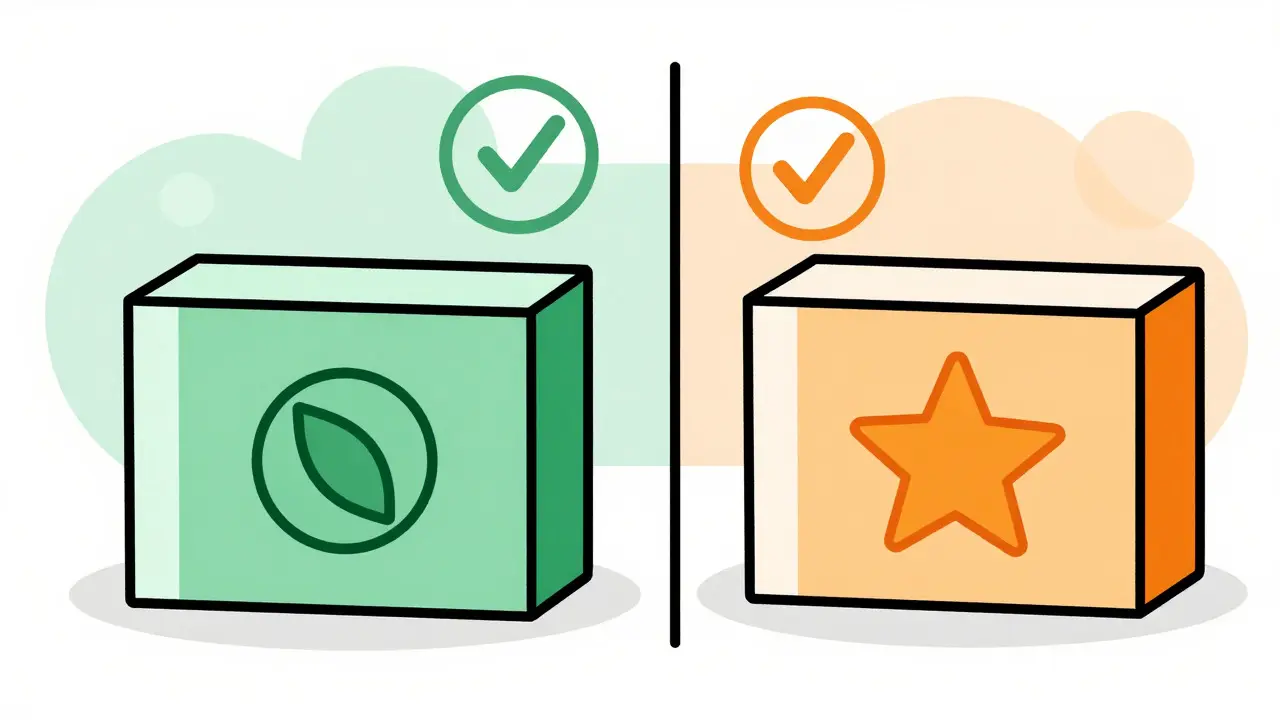
To save money effectively, you need to distinguish between two categories that often get lumped together: traditional generics and authorized generics. Both are approved by the Food and Drug Administration (FDA), but their origins and pricing mechanics differ significantly.
- Traditional Generics are medications manufactured by third-party companies after a brand-name drug's patent expires. They must prove bioequivalence, meaning they work in the body the same way as the original brand.
- Authorized Generics (AGs) are identical copies of the brand-name drug, produced by the original manufacturer or a partner, but sold under a generic label. They are chemically the same product, just with a different box.
The critical difference lies in how insurance plans and Pharmacy Benefit Managers (PBMs) treat them. Traditional generics often face aggressive price negotiations from PBMs, which can lead to very low net prices for insurers. Authorized generics, however, may retain some of the brand's rebate structure. This means that while the list price of an AG might be lower than the brand, the actual cost passed to you could be higher than a traditional generic due to how rebates are calculated. A study in the Journal of the American Pharmacists Association found that patients who specifically asked about authorized generics saved 15-25% more than those who only asked about generics generally. This suggests that nuance matters.
The Price Drop: What to Expect After Patent Expiration
When a patent expires, the clock starts ticking on price reductions. Historically, within one year of a generic entering the market, prices typically fall by more than 75%. In extreme cases, like the antiretroviral combination Truvada, prices plummeted from $50 per tablet to $3 within two years of additional generic approvals. This kind of dramatic drop is the ideal scenario, but it doesn't happen instantly for every drug.
You should be aware that not all generics trigger an immediate crash in price. The FDA's 2022 report noted that for 110 products, the price reduction was less than 10% shortly after generic entry. This usually happens when there is only one generic competitor or when the drug is a "complex" formulation, such as inhalers or skin creams, which are harder to replicate. If your medication hasn't seen a price drop, it’s worth asking if more competitors are expected soon. The FDA’s Generic Drug User Fee Amendments (GDUFA) III aims to speed up approvals for these complex products through 2027, potentially opening up more savings opportunities in the near future.
Scripts for Your Doctor and Pharmacist
Knowing what to ask is half the battle. Many pharmacists are busy and may default to the formulary default without exploring alternatives. Here are specific, polite phrases you can use to prompt a deeper conversation.
- At the Doctor's Office: "Before we finalize this prescription, is there a generic version available? Specifically, is there an authorized generic or a traditional generic that my insurance covers at a lower tier?"
- At the Pharmacy Counter: "I see this is billed as a brand-name or high-tier drug. Can you check if there is a therapeutic equivalent that would lower my copay? I’m open to switching if the FDA considers them equivalent."
- Regarding Authorized Generics: "Is this an authorized generic? How does my insurance handle rebates for this versus a traditional generic? Will I actually save money out-of-pocket?"
- If Copays Are Still High: "My deductible is high. Can you run a cash-price comparison using tools like GoodRx to see if paying cash for a generic is cheaper than using my insurance?"
These questions signal to your providers that you are informed and willing to make small adjustments for significant savings. It shifts the dynamic from passive acceptance to active management of your healthcare costs.
Navigating Insurance and Rebate Complexities
This is where many patients get stuck. You might find out that a generic exists, but your copay doesn't change. Why? Because of rebates. Insurers negotiate discounts with drug manufacturers. Sometimes, the brand-name drug has a deep rebate agreement that makes its *net* cost to the insurer lower than the generic's net cost, even if the generic's list price is lower. This creates a situation where the insurer keeps the brand on a preferred formulary tier despite the higher sticker price.
Dr. Stephen Schondelmeyer, a pharmaceutical economist, has cautioned that savings don't always reach patients due to these complex PBM rebate structures. To combat this, you can ask your insurance representative directly: "Does this plan have a rebate preference for the brand name over the generic?" If the answer is yes, ask if there is an exception process or a step-therapy requirement that forces you to try the generic first. Additionally, keep in mind that high-deductible health plans (HDHPs) often mean you are paying the full list price until your deductible is met. In these cases, the list price of the generic is what matters most, making cash-pay apps incredibly useful.
| Feature | Traditional Generic | Authorized Generic (AG) |
|---|---|---|
| Manufacturer | Third-party company | Original brand manufacturer or partner |
| Chemical Composition | Bioequivalent to brand | Identical to brand |
| List Price Impact | Often 75-90% lower than brand | Typically 50-67% lower than brand |
| Rebate Structure | Subject to aggressive PBM negotiation | May retain brand-like rebate structures |
| Insurance Treatment | Usually lowest formulary tier | Varies; sometimes treated similarly to brand |

Practical Tools and Resources
You don't have to rely solely on your pharmacist's memory or your insurance rep's script. There are digital tools designed to expose hidden savings. Apps like GoodRx and SingleCare allow you to compare cash prices across pharmacies. Often, the cash price for a generic is significantly lower than the insured copay, especially if you haven't met your deductible. Before filling a new prescription, take five minutes to scan the barcode in these apps. It’s a quick habit that can save hundreds of dollars a year.
Also, consider consulting your insurance plan’s formulary specialist. These are human beings whose job is to explain why a drug is on a certain tier. They can tell you if a generic is missing from the formulary or if an authorized generic is being misclassified. Persistence pays off. If one pharmacist says "no," ask to speak to the pharmacy manager or call the number on the back of your insurance card.
Frequently Asked Questions
Are authorized generics the same quality as brand-name drugs?
Yes. Authorized generics are literally the same product as the brand-name drug, just packaged differently. They come from the same manufacturing facilities and undergo the same quality controls. The only difference is the label and the marketing strategy used by the manufacturer.
Why is my generic copay higher than a friend's brand-name copay?
This usually happens due to rebate structures. Your insurance plan may have a better financial deal with the brand-name manufacturer, causing them to place the brand on a lower formulary tier than the generic. Ask your insurance provider about "rebate pass-through" policies to see if this is the case.
Can I switch between an authorized generic and a traditional generic?
Generally, yes, provided both are on your formulary and your doctor agrees. Since both are FDA-approved equivalents, switching shouldn't affect your treatment outcome. However, check with your pharmacist to ensure the specific formulation (e.g., extended-release vs. immediate-release) matches your needs.
What if my doctor insists on the brand name?
Doctors sometimes prefer brands due to familiarity or perceived reliability. You can politely ask, "Is there a clinical reason the generic wouldn't work for me?" If not, request a note allowing substitution. Most states allow pharmacists to substitute generics unless the doctor writes "Dispense as Written" (DAW).
Do biosimilars work the same way as generics?
Biosimilars are the biological equivalent of generics. They are highly similar to the reference biologic but not identical due to the complexity of biological molecules. Like generics, they offer significant savings-often 50% below the reference product-and are increasingly common for conditions like arthritis and cancer.