
Imagine walking into a pharmacy and picking up a prescription for $5 instead of $300. That is the power of generic drugs. They make up nine out of ten prescriptions filled in the United States today. But how do we know these cheaper alternatives are just as safe and effective as the expensive brand-name versions? The answer lies with the U.S. Food and Drug Administration (FDA) and a specific legal pathway known as the Abbreviated New Drug Application, or ANDA.
The FDA does not approve generics by accident. It follows a strict regulatory framework established decades ago to ensure that every generic pill you swallow works exactly like the original. This system balances public health needs with scientific rigor, allowing manufacturers to skip costly clinical trials while still proving their product is identical in performance to the brand-name drug.
The Legal Foundation: Hatch-Waxman and Section 505(j)
To understand how the FDA approves generics, you have to look at the law. The current system was born from the Drug Price Competition and Patent Term Restoration Act of 1984, commonly called the Hatch-Waxman Act. This legislation created a compromise between pharmaceutical innovators and generic manufacturers. It allowed brand-name companies to extend patent protection slightly to offset time lost during FDA review, while giving generic makers a shortcut to market once those patents expired.
Under this act, specifically Section 505(j) of the Federal Food, Drug, and Cosmetic Act, generic manufacturers can submit an ANDA rather than a full New Drug Application (NDA). An NDA requires years of preclinical animal studies and human clinical trials to prove a new drug is safe and effective. An ANDA skips all of that. Instead, it relies on the premise that if the original drug has already been proven safe and effective by the FDA, the generic version just needs to be equivalent.
This legal structure is managed by the FDA's Office of Generic Drugs (OGD), which sits within the Center for Drug Evaluation and Research (CDER). The OGD acts as the gatekeeper, reviewing thousands of applications annually to ensure they meet federal standards before reaching your local pharmacy shelf.
What "Therapeutic Equivalence" Really Means
When the FDA says a generic is "therapeutically equivalent," it means something very specific. It is not just similar; it must be identical in key areas. According to regulations outlined in Title 21 of the Code of Federal Regulations (21 CFR 314.94), an approved ANDA must demonstrate several critical factors:
- Identical Active Ingredients: The chemical substance that treats your condition must be the same molecule, in the same strength.
- Same Dosage Form and Route: If the brand name is a tablet taken orally, the generic must also be an oral tablet. It cannot be a capsule or an injection unless specifically justified.
- Identical Use Indications: The generic must be approved for the same medical conditions as the reference listed drug (RLD).
- Bioequivalence: The drug must enter the bloodstream at the same rate and to the same extent as the brand-name version.
You might notice that inactive ingredients-like fillers, dyes, or binders-can differ between brands. This is why some people experience different side effects, such as stomach upset or allergic reactions to dyes, even though the active medicine is the same. However, the FDA ensures these variations do not affect the drug's ability to work.
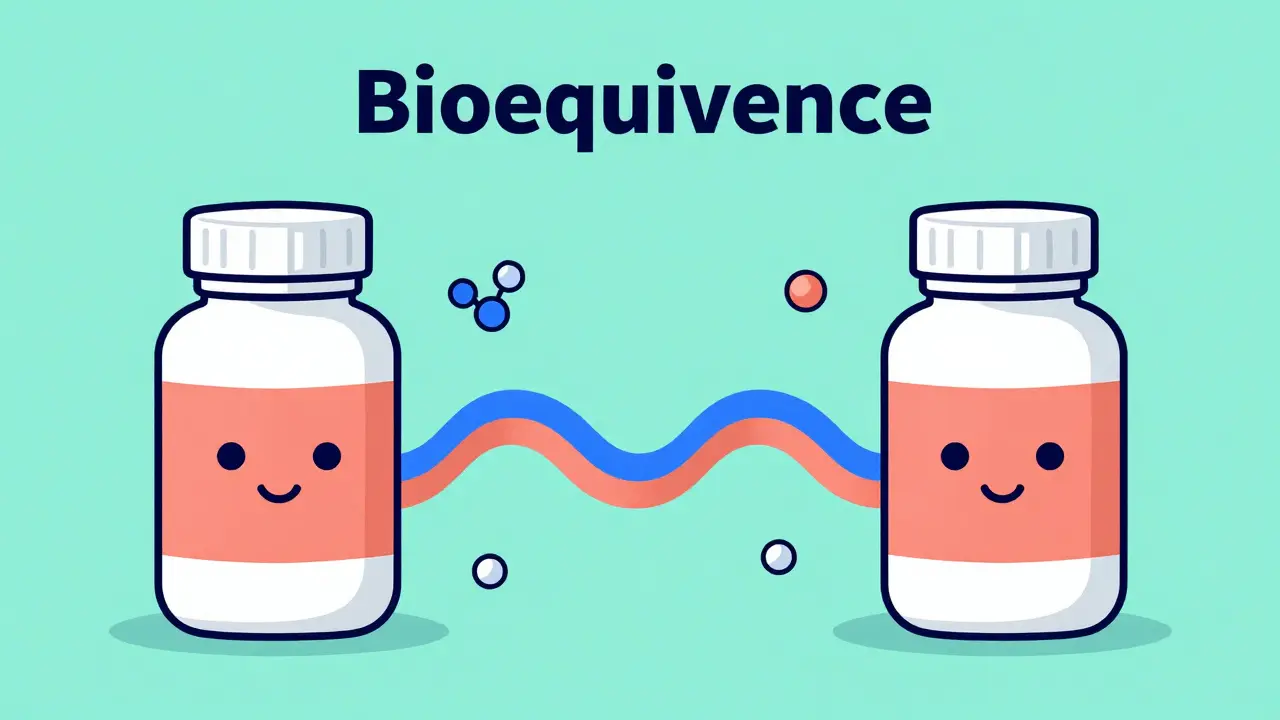
The Bioequivalence Test: Proving Performance
The heart of the ANDA process is bioequivalence testing. Since generic manufacturers do not repeat large-scale patient trials, they must prove their drug behaves the same way in the body as the brand-name counterpart. This is done through pharmacokinetic studies involving healthy volunteers.
In a typical study, 24 to 36 healthy participants take the generic drug and then the brand-name drug (or vice versa) in a crossover design. Blood samples are taken over time to measure two key metrics:
- AUC (Area Under the Curve): This measures the total amount of drug absorbed into the bloodstream over time.
- Cmax (Maximum Concentration): This measures the peak level of the drug in the blood.
FDA guidance mandates that the 90% confidence interval for the ratio of geometric means between the generic and brand-name drug must fall within 80.00% to 125.00% for both AUC and Cmax. In plain English, this means the generic drug's absorption must be statistically indistinguishable from the brand-name drug's absorption. If the numbers fall outside this narrow window, the application fails.
For complex drugs, such as inhalers, topical creams, or extended-release formulations, standard blood tests may not be enough. These products require specialized methodologies, sometimes including clinical endpoint studies, to prove equivalence. This complexity has become a major focus for the FDA in recent years, with nearly 40% of approvals in fiscal year 2023 involving complex generic products.
The Review Timeline and GDUFA Metrics
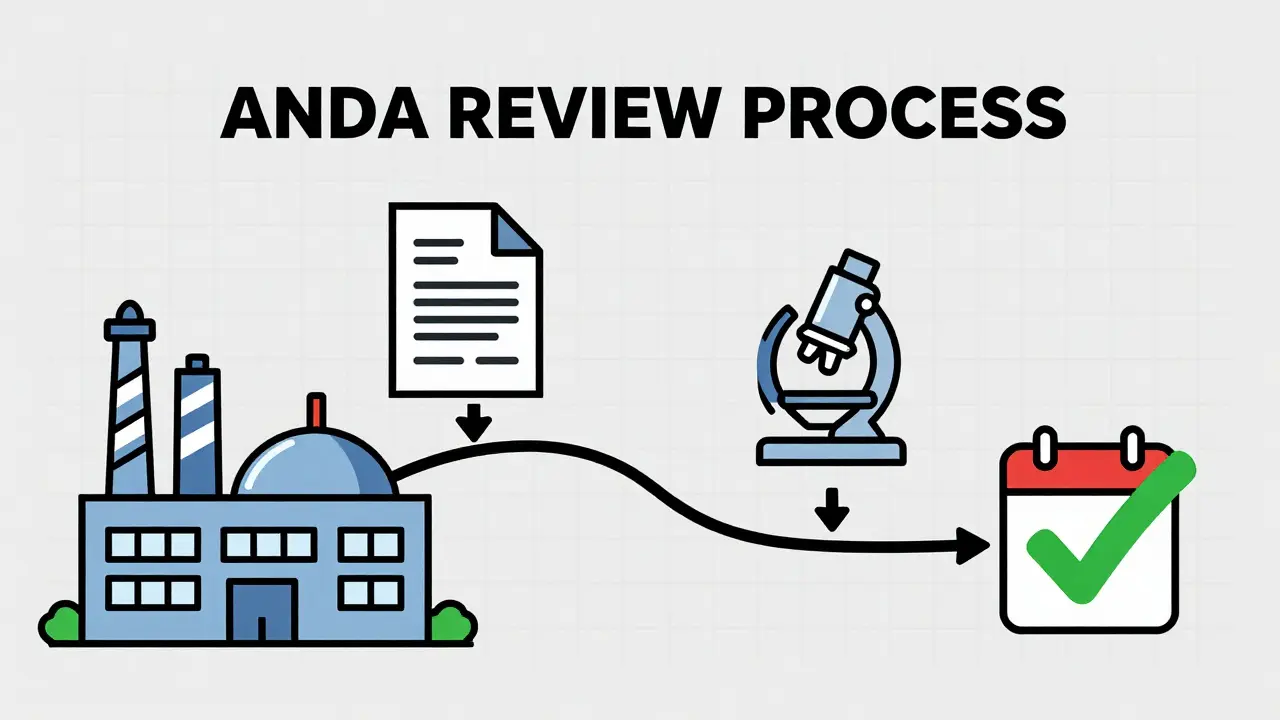
Getting an ANDA approved is not instant. The process follows a structured timeline governed by the Generic Drug User Fee Amendments (GDUFA). The current framework, GDUFA III, sets strict performance goals for the FDA to keep the pipeline moving.
| Stage | Description | Target Timeframe |
|---|---|---|
| Filing Review | Initial check for completeness. If incomplete, the FDA issues a Refuse-to-Receive (RTR) letter. | 60 days |
| Substantive Review | Detailed scientific evaluation of chemistry, manufacturing, and bioequivalence data. | 10 months (Standard) 8 months (Priority) |
| Inspection | FDA inspects manufacturing facilities to ensure Current Good Manufacturing Practice (CGMP) compliance. | Varies (often concurrent with review) |
The Filing Review is the first hurdle. In 2022, about 15.3% of submissions received RTR letters because they lacked essential information, often related to Chemistry, Manufacturing, and Controls (CMC) sections. Once filed, the clock starts ticking toward the Target Action Date (TAD). Priority reviews, reserved for drugs in shortage or first-time generics, get a faster eight-month TAD. Standard applications have ten months.
Manufacturing quality is non-negotiable. Facilities must comply with CGMP regulations (21 CFR parts 210 and 211). The FDA inspects roughly 82.7% of generic drug facilities annually. If a facility fails inspection, the drug cannot be approved, regardless of how good the bioequivalence data looks. This rigorous oversight ensures that the pills produced in India, China, or the U.S. meet the same high standards.
Cost Savings and Public Health Impact
Why does this system matter so much? The financial impact is staggering. While generic drugs account for 90% of prescription volume in the U.S., they represent only 23% of total spending. According to the Generic Pharmaceutical Association, this dynamic saves consumers and insurers approximately $132.6 billion annually.
Compare the development costs: bringing a new brand-name drug to market costs around $2.6 billion and takes 10 to 15 years. Developing a generic via the ANDA pathway costs between $2.4 million and $6.3 million and typically takes three to four years. This drastic reduction in cost and time allows multiple manufacturers to compete, driving prices down further.
Real-world feedback supports this model. A 2023 survey by the National Community Pharmacists Association found that 89% of pharmacists reported generic drugs reduce patient out-of-pocket costs by 80% to 85%. For example, when biosimilar insulin options gained traction following FDA approvals, patients saw monthly costs drop from hundreds of dollars to under $100. Despite occasional complaints about efficacy differences, FDA investigations into adverse event reports show that over 92% of perceived issues stem from underlying disease progression rather than problems with the generic product itself.
Challenges and Future Directions
The system is not perfect. Backlogs remain a concern. As of late 2022, there were over 1,800 pending ANDAs, with some waiting more than three years for a decision. Resource constraints within the OGD have been cited as a primary cause. To address this, the FDA has launched initiatives like the Complex Generic Drugs Initiative and is integrating artificial intelligence to assist in reviewing simpler applications.
Another challenge is drug shortages. Generics make up 78% of the products on the FDA's drug shortage list. Supply chain vulnerabilities are significant, with 78% of active pharmaceutical ingredients for generics originating from facilities outside the United States. In response, the FDA announced a pilot program in October 2025 to prioritize reviews for generic companies manufacturing products domestically, aiming to bolster supply chain resilience.
Looking ahead, GDUFA IV negotiations concluded in September 2024 with a $2.1 billion funding commitment through 2027. This includes specific allocations for complex generics and real-world evidence integration. The goal is to maintain the balance between rapid access to affordable medicines and unwavering safety standards.
Is an ANDA the same as an NDA?
No. An NDA (New Drug Application) is required for new, innovative drugs and involves extensive clinical trials to prove safety and efficacy. An ANDA (Abbreviated New Drug Application) is used for generic drugs and relies on existing safety data from the brand-name drug, focusing instead on proving bioequivalence and manufacturing quality.
Can generic drugs have different inactive ingredients?
Yes. While the active ingredient must be identical, inactive ingredients like fillers, colors, and binders can vary. These differences rarely affect therapeutic effectiveness but may occasionally cause allergies or minor side effects in sensitive individuals.
How long does it take for the FDA to approve a generic drug?
Under GDUFA III guidelines, the target action date is 10 months for standard applications and 8 months for priority reviews. However, the total development time from start to submission is typically 3 to 4 years.
Are generic drugs as safe as brand-name drugs?
Yes. The FDA requires generic drugs to be bioequivalent to brand-name drugs, meaning they perform identically in the body. Rigorous manufacturing inspections and quality controls ensure they meet the same high safety standards.
What is the Orange Book?
The Approved Drug Products with Therapeutic Equivalence Evaluations, commonly known as the Orange Book, is a publication by the FDA that lists all approved drug products along with their therapeutic equivalence ratings. It helps prescribers and pharmacists identify interchangeable generic alternatives.
Popular Posts



How Exercise Improves ADHD Symptoms
1 Oct 2025