
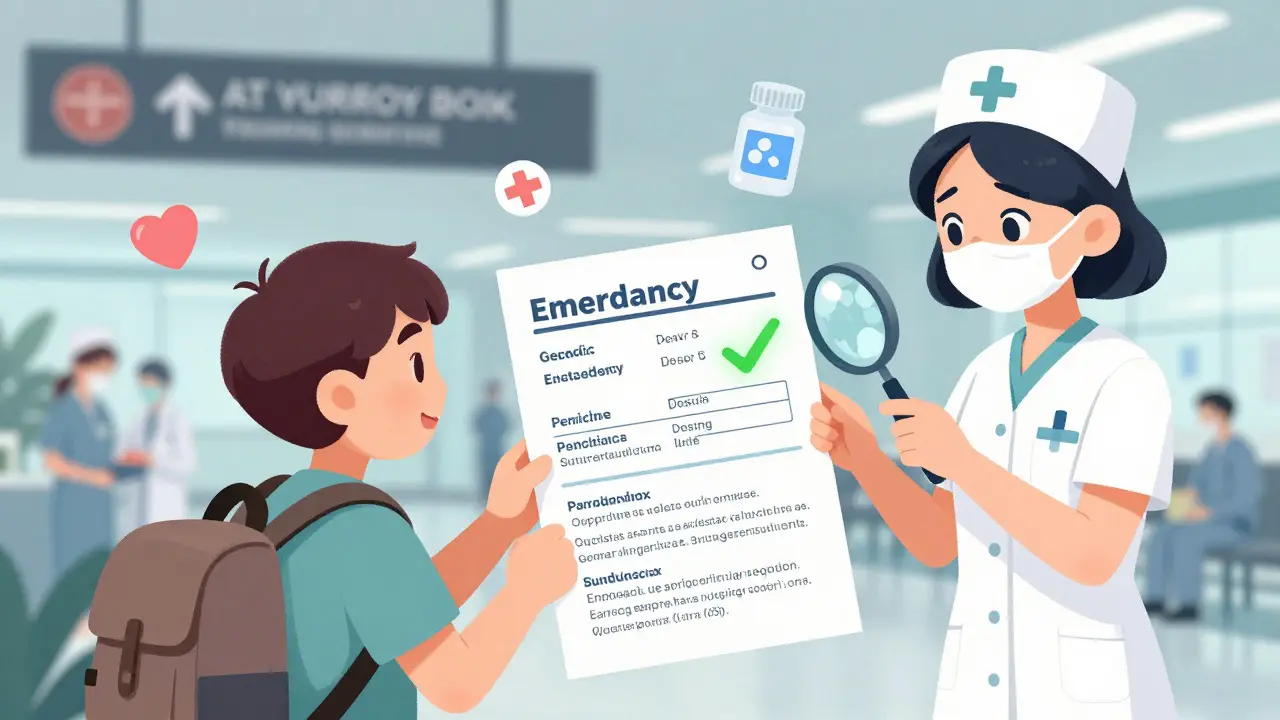
When you’re traveling abroad and something goes wrong-maybe you get sick, have an accident, or suffer an allergic reaction-your body can’t speak the local language. But your medications can. If you don’t have a clear, printed list of what you’re taking, in a language the doctor understands, you could face delays, wrong treatments, or even dangerous mistakes. This isn’t theoretical. In 2020, a study in JAMA Internal Medicine found that patients who carried a multilingual medication list had 28% fewer medication errors during hospital admissions. That’s not just convenience. That’s life or death.
Why a multilingual medication list matters
Every year, over 25 million people in the U.S. alone have limited English proficiency. Many of them travel. Others live abroad, work overseas, or visit family in countries where English isn’t spoken. In an emergency, you might not be able to say your name, let alone explain that you take 5 mg of warfarin every Monday, Wednesday, and Friday. Emergency rooms in London, Tokyo, or Mexico City don’t have time to guess. They need facts fast. Without a translated list, staff might miss a drug interaction, give you a medication you’re allergic to, or repeat a dose you already took. A 2021 study showed that language barriers increase adverse drug events by 35%. That’s why a simple printed list, in your native language and the language of the country you’re visiting, can cut emergency room time by over 20 minutes.What to include on your list
A good multilingual medication list isn’t just a copy of your prescription bottle. It needs to be clear, complete, and consistent. Here’s what to write down:- Medication name - Use the generic name (like metformin), not the brand (like Glucophage). Generic names are the same worldwide.
- Dosage - How much you take (e.g., 500 mg).
- Frequency - How often (e.g., once daily, twice a week).
- Purpose - Why you take it (e.g., “for high blood pressure,” “for type 2 diabetes”).
- Prescribing doctor - Name and clinic, so they can verify if needed.
- Start date - When you began taking it.
- Supplements and herbs - Things like fish oil, garlic pills, or traditional remedies. These are often missed but can cause serious interactions.
Don’t forget over-the-counter drugs, vitamins, or even herbal teas you take daily. A 2022 survey found that 52% of non-English speakers were taking herbal medicines not listed on their forms-because they didn’t think they counted.
Where to get translations
You don’t need to hire a translator. Several trusted organizations already offer free, medically accurate multilingual lists.- Tennessee Pharmacists Association (TPA) Universal Medication List - Available in 10 languages: English, Spanish, Chinese, Vietnamese, Korean, Arabic, Russian, Somali, Nepali, and French. It’s printable, free, and used by hospitals across the U.S. You can download it from their website.
- NPS MedicineWise app - Originally from Australia, this app lets you enter your meds, set reminders, and switch the interface to 11 languages including Arabic, Hindi, Persian, and Vietnamese. It syncs across phones and lets you email or print a list. It’s free on iOS and Android.
- MedlinePlus - Run by the U.S. National Library of Medicine, this site offers medication guides in over 40 languages. While it doesn’t let you create a personal list, you can use their templates to build your own.
- British Red Cross Emergency Phrasebook - This isn’t a medication list, but it’s the best tool for communicating in an emergency. It includes 150+ medical phrases translated into 36 languages. You can print the section on medications and carry it with your list.
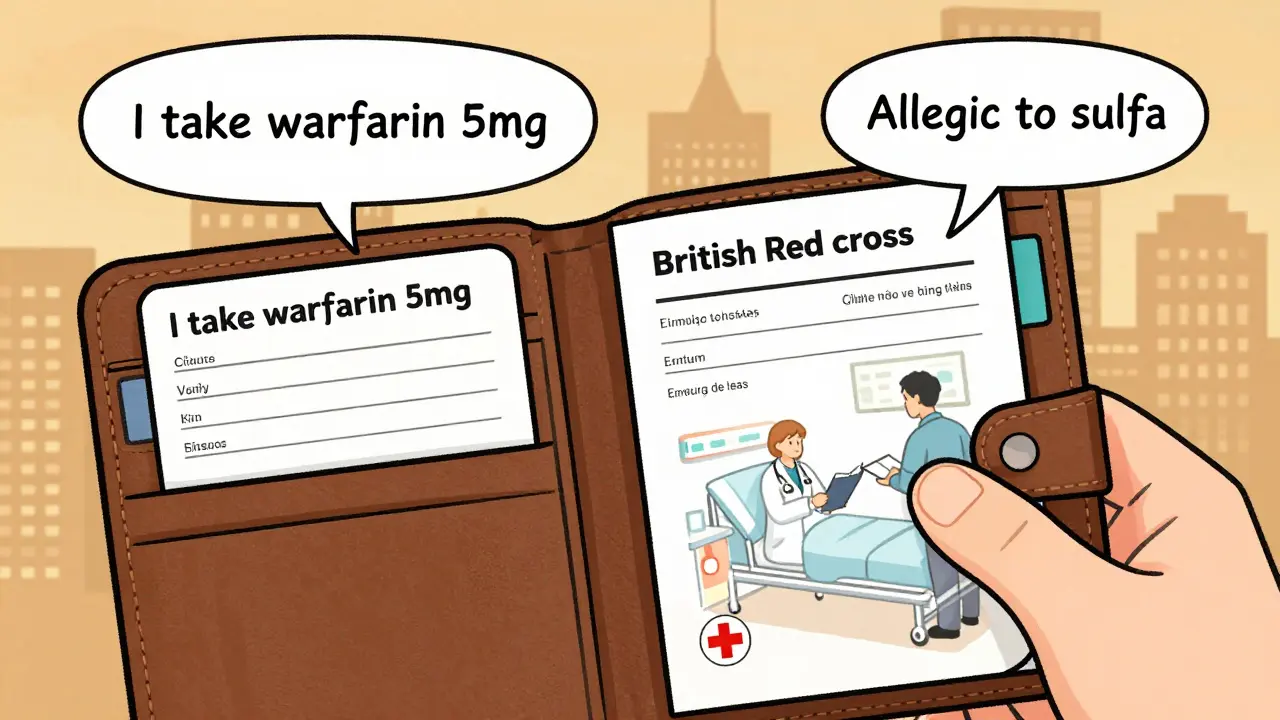
For example: If you’re from Vietnam and traveling to Germany, download the Vietnamese version of the TPA list and the German version of the Red Cross phrasebook. Put them together in a plastic sleeve inside your wallet.
How to use it in an emergency
Carrying the list isn’t enough. You need to make sure it’s used.- Keep it physical - Digital files on your phone can die. Print two copies. Put one in your wallet. Put the other in your luggage. If you’re flying, keep one in your carry-on.
- Use a clear format - Use bold headings. Leave space between each medication. No cursive handwriting. Stick to block letters.
- Teach someone - If you’re traveling with a friend or family member, show them how to hand the list to a nurse. Say: “If I can’t speak, give this to the doctor.”
- Update it every time - Every time your doctor changes your dose or adds a new drug, update the list. A 2022 study found that 78% of medication errors happen during transitions of care-like after a doctor’s visit.
One woman in Chicago told her story on Reddit: She had an allergic reaction and couldn’t speak. The ER nurse saw her Spanish-language list, spotted the penicillin allergy, and stopped the treatment before it was too late. She said her primary care doctor gave her the list during her last checkup. That’s all it took.
What to avoid
Not all translations are equal. Here’s what goes wrong:- Using Google Translate - It doesn’t know medical terms. “Take once daily” might become “Take one time every day” or worse, “Take one pill for death.”
- Only using English - Even if you speak English, you might not be able to during a panic attack or stroke.
- Leaving out herbal meds - Many cultures use traditional remedies. If you take turmeric, ginseng, or ashwagandha, include them. They can interfere with blood thinners and anesthesia.
- Using outdated versions - If your list says “2021” and you started a new drug in 2025, it’s useless.
A doctor in Ohio reported three near-misses in one month because patients brought lists with translations from their home countries. One used “heart pill” instead of “amlodipine.” Another wrote “3 times a day” but meant “every 8 hours.” Translation isn’t just about words-it’s about meaning.
What’s new in 2026
The tools are getting better. In January 2024, the CDC added medication safety guides in eight new languages, including Amharic, Hmong, and Oromo, to help refugees and displaced communities. Google now shows translated medication info directly in search results for over 100 common drugs in 30 languages. And in late 2025, the American Pharmacists Association will release the first national standard for multilingual medication lists, requiring pharmacies to offer them in languages that match their local patient population.For now, the best system is still simple: print, update, carry, and share.
Quick checklist: Your multilingual medication list
- ☑️ Generic names only
- ☑️ Dosage, frequency, purpose, doctor, start date
- ☑️ Includes supplements and herbs
- ☑️ Printed in your language + one other (e.g., English + Spanish)
- ☑️ Carried in wallet and luggage
- ☑️ Updated after every doctor visit
- ☑️ Shown to travel companion
Can I use Google Translate to make my medication list?
No. Google Translate often gets medical terms wrong. For example, it might translate “take with food” as “take with meal” or “take with death.” Use official sources like the Tennessee Pharmacists Association list or MedlinePlus. They’re reviewed by pharmacists and tested for accuracy.
What if my language isn’t on the list?
If your language isn’t available, ask your pharmacist. Many pharmacies have access to professional medical translation services. You can also use the British Red Cross Phrasebook to write down your meds manually in simple phrases: “I take [name] [dose] [time].” Then have a trusted person help you translate it into the local language. Even a handwritten note is better than nothing.
Do I need a list if I’m only traveling for a few days?
Yes. Emergencies don’t care about trip length. A fall, allergic reaction, or sudden illness can happen anytime. Over 60% of medication errors in travelers happen during short trips because people assume they’re “just visiting” and skip precautions.
Can I store my list on my phone?
You can, but don’t rely on it alone. Phones die. Screens crack. You might not be able to unlock it if you’re unconscious. Always carry a printed copy. Use the app as a backup, not your main tool.
How often should I update my list?
Update it every time your doctor changes your meds-even a small dose change. Studies show that 78% of errors happen during transitions of care, like after a hospital visit or new prescription. Make it part of your routine: update it the day after your checkup.
13 Comments

guy greenfeld
February 18 2026
They’re not telling you the whole story. The real reason this works? Because hospitals are terrified of lawsuits. If you die because they gave you the wrong pill and you had a list? Boom. Class action. So they quietly promote these lists-not out of compassion, but because their insurance premiums are rising.
Meanwhile, the FDA and WHO? Silent. The pharmaceutical companies? Still pushing brand names. And don’t get me started on how they bury the real drug interactions in footnotes only pharmacists can decode.
Trust me. This is all a distraction. The real solution? Universal healthcare with AI translators built into every EHR. But they won’t do that. Too expensive. Too ethical. Too… human.

John Haberstroh
February 19 2026
I used to think this was overkill. Then I watched my cousin have a seizure in Lisbon because the paramedics couldn’t read his handwritten list. He took melatonin, turmeric, and a weird herbal tea his grandma swore by. None of it was translated. He ended up in ICU for three days.
Now I print mine on waterproof paper. Laminated. In English, Portuguese, and Mandarin. Because you never know who’s gonna be the one helping you. Could be a tourist from Shanghai. Could be a nurse from Nairobi. Could be a kid who just learned English last year.
It’s not about language. It’s about clarity. And sometimes, clarity is the only thing standing between you and a coma.

Agnes Miller
February 20 2026
i got this list from my pharmacist last year and i still have it in my purse. it saved me when i passed out at the airport. they saw "warfarin 5mg tues/thurs/sat" and knew not to give me the ibuprofen. thank you whoever made this. you’re a lifesaver.

PRITAM BIJAPUR
February 21 2026
As someone from India who’s traveled across 17 countries, I can tell you-this is the single most practical piece of advice I’ve ever received. In Dubai, I had a panic attack and couldn’t speak. The nurse looked at my list-written in English and Hindi-and immediately called the pharmacist on duty. No confusion. No delay.
And yes, I include ashwagandha. Because in my culture, it’s not a supplement-it’s medicine. And guess what? It interacts with beta-blockers. The American docs had no clue. My list did.
Also, I use the NPS app. It’s brilliant. Syncs with my Google Calendar. Reminds me when to update it. I’ve convinced 12 friends to use it. One of them just saved her mother in Thailand.
Stop treating this like a chore. Treat it like armor.

Logan Hawker
February 23 2026
Look, I’m all for ‘multilingual lists,’ but let’s not pretend this is some revolutionary breakthrough. We’re talking about a PDF printed on 8.5x11 paper. That’s not innovation. That’s… duct tape on a collapsing bridge.
Meanwhile, we’re ignoring the real problem: the complete absence of real-time, AI-powered, context-aware medical translation embedded into hospital systems. We have autonomous cars, quantum computing, and yet we’re still handing people laminated sheets?
And don’t even get me started on the ‘British Red Cross Phrasebook.’ That’s a 1990s relic. If I had to rely on that, I’d rather just write ‘I’m dying’ in crayon.
This isn’t progress. It’s palliative care for a broken system.

James Lloyd
February 24 2026
Agreed with the list format-but here’s a tweak: always include your blood type and allergies at the top. I’ve seen too many people bury it under ‘metformin 500mg daily.’ If you’re unconscious, the first thing they need to know isn’t your diabetes meds-it’s whether they can give you penicillin or a transfusion.
Also, use a monospace font like Courier. No cursive. No fancy fonts. Hospitals scan these things with OCR. Fancy fonts = misreads = mistakes.
And yes, update it the day after your appointment. I’ve had patients bring lists from 2021. One guy was on three new meds he didn’t mention. That’s not negligence. That’s a death sentence.

Tony Shuman
February 25 2026
So now we’re encouraging people to carry foreign-language documents? Next thing you know, they’ll want us to translate the Constitution into Swahili so tourists can understand their rights.
This isn’t America’s problem. If you can’t speak English, maybe you shouldn’t be here. We have enough on our plate without becoming the world’s medical translator service.
And don’t even get me started on ‘herbal supplements.’ You think I want my ER staff dealing with some guy who says he takes ‘spiritual root tea’ for ‘energy’? That’s not medicine. That’s a cult.
Stop pandering. Stop translating. Just teach people English. Or stay home.

Brenda K. Wolfgram Moore
February 25 2026
I’ve been a nurse for 22 years. I’ve seen this save lives. Not once. Not twice. Dozens. A woman in Detroit came in with chest pain. Her list said ‘digoxin 0.125 mg daily’-but the handwritten version said ‘0.25.’ We caught it because we had the printed, clean version.
And yes, the supplements matter. I had a patient who took ‘ginseng for fatigue’ and ended up with a stroke because it clashed with his blood thinner. He didn’t think it counted. Neither did his doctor.
This isn’t about language. It’s about trust. When someone hands you a list, they’re saying, ‘I trust you to save me.’ Don’t make them regret it.

Digital Raju Yadav
February 26 2026
Why are we letting foreigners dictate how our hospitals operate? This is cultural imperialism. Why should an Indian man’s ayurvedic herbs be treated the same as American prescriptions? Who authorized this? Who voted on it?
And why is the CDC pushing Amharic and Oromo? We have enough immigrants already. This isn’t healthcare. It’s demographic engineering.
Next thing you know, they’ll require every ER to have translators for every dialect spoken in Somalia. Then we’ll be bankrupt. Then we’ll be weak. Then we’ll be gone.
Stop this. Now.

Carrie Schluckbier
February 26 2026
Okay, but what if the list is fake? What if someone prints a list with fake meds to get free drugs? Or to hide an addiction? I’ve seen people list ‘oxycodone 30mg daily’ when they’re not even on pain meds. Then they show up at the ER and demand it.
And what if the translation is wrong? I once saw a list that said ‘aspirin 100mg’-but the Spanish version said ‘aspirin 1000mg.’ That’s a lethal dose.
This isn’t safety. It’s a liability magnet. And someone’s gonna die because of a typo on a Google Translate printout.
Why not just require everyone to carry a medical ID bracelet? That’s been around for 50 years. Simpler. Harder to fake. Harder to misread.

Liam Earney
February 27 2026
Let me just say-this entire piece, while well-intentioned, is fundamentally flawed in its assumption that language is the primary barrier. It’s not. It’s power. It’s hierarchy. It’s the fact that a hospital in New York will prioritize a white American woman’s verbal description over a brown man’s printed list, even if the list is perfectly accurate.
I’ve worked in three different ERs. I’ve seen patients with perfect, multilingual, laminated, updated lists ignored because they didn’t ‘sound convincing.’ Because their accent was ‘too thick.’ Because the nurse was tired. Because the doctor didn’t want to look up a word.
So yes, print the list. Carry it. Update it. But don’t mistake preparation for justice. The system doesn’t care about your paper. It cares about your skin color, your accent, your visa status.
And until we fix that? This list? It’s just a beautiful, tragic, paper-thin illusion of safety.
Logan Hawker
March 1 2026
Actually, I’ve been thinking about this more. What if the real solution isn’t translation… but elimination? What if we just stop using brand names entirely? What if every drug in every country had a universal, standardized, numeric code-like a barcode for medicine?
Imagine: You scan the pill. A device reads ‘C12H15NO2’ and instantly displays: ‘generic name: ibuprofen, dose: 200mg, purpose: anti-inflammatory.’ No language needed. No translation. No confusion.
Why are we still stuck in the 1950s with paper lists? We have blockchain, AI, QR codes. Why are we still using crayon?
Maybe the multilingual list isn’t the answer… it’s just the last gasp of a dying system.
Write a comment
Popular Posts
Steph Carr
February 17 2026
Let’s be real-this isn’t just about medication lists. It’s about recognizing that the healthcare system still treats non-English speakers like puzzle pieces that don’t quite fit. I’ve seen ERs where nurses stared at a Spanish translation like it was ancient hieroglyphs. The fact that we need a printed sheet to survive basic medical care says more about our society than it does about individual preparedness.
And yet, no one’s talking about why these resources aren’t standardized in every clinic, every pharmacy, every hospital. Why is it up to the patient to carry the burden of systemic failure? This isn’t convenience. It’s a civil rights issue wrapped in a plastic sleeve.
I carry mine in my wallet. Always have. But I also demand that my doctor’s office print one out for me. No excuses. If you’re prescribing meds, you’re responsible for ensuring I understand them. Period.