
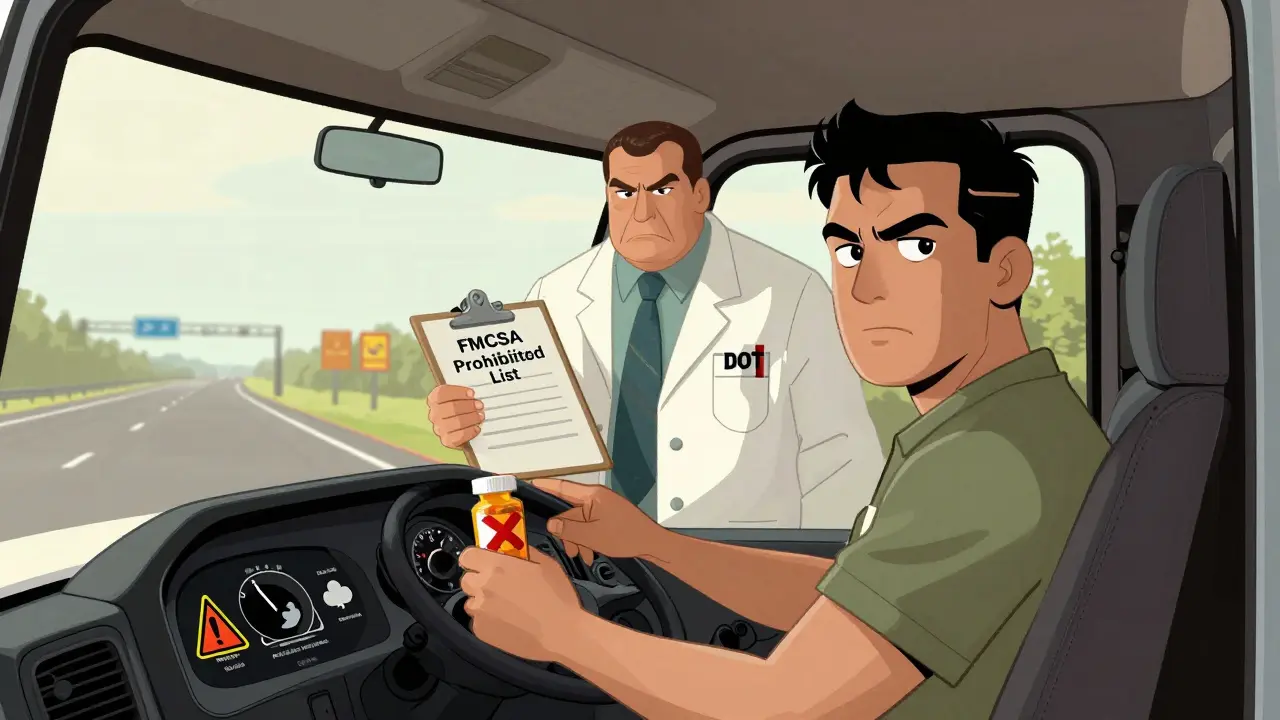
Driving a commercial vehicle isn’t just about knowing the road-it’s about knowing what’s in your system. Every day, thousands of truckers, bus drivers, and delivery operators face a tough choice: take a medication that helps them function, or risk losing their license. The Federal Motor Carrier Safety Administration (FMCSA) doesn’t play guesswork when it comes to safety. If a drug-even one prescribed by your doctor-could slow your reaction time, make you drowsy, or cloud your judgment, it’s off the table. And the consequences aren’t just theoretical. In 2020, commercial driver medication use was linked to 4.2% of all large truck crashes, contributing to over 1,200 deaths.
What Medications Are Banned for Commercial Drivers?
The FMCSA doesn’t just ban illegal drugs. It also prohibits a long list of prescription and over-the-counter medications that can impair driving. Schedule I substances like marijuana-even if legal in your state-are completely out. So are amphetamines (including Adderall and Vyvanse), opioids like codeine and oxycodone, and any form of PCP. These aren’t suggestions. They’re federal rules under 49 CFR §391.41 and §382.107.
But here’s where it gets messy: many of these drugs are prescribed for real, everyday conditions. ADHD, chronic pain, anxiety, depression-these are common among drivers, especially those over 45. A 2021 study by Dr. Gary Solomon, a certified DOT medical examiner with over two decades of experience, found that 35% of drivers he examined were on medications that required special review. Antidepressants were the most common. But even if your doctor says it’s safe, the FMCSA doesn’t automatically agree.
And it’s not just prescription drugs. Over-the-counter cold medicines containing pseudoephedrine or dextromethorphan can trigger false positives on DOT drug tests. Sleep aids, allergy pills, even some cough syrups can get you flagged. Drivers who don’t disclose these during their DOT physical risk failing the exam-or worse, getting caught later during a roadside inspection.
How the DOT Physical Works: Full Disclosure Required
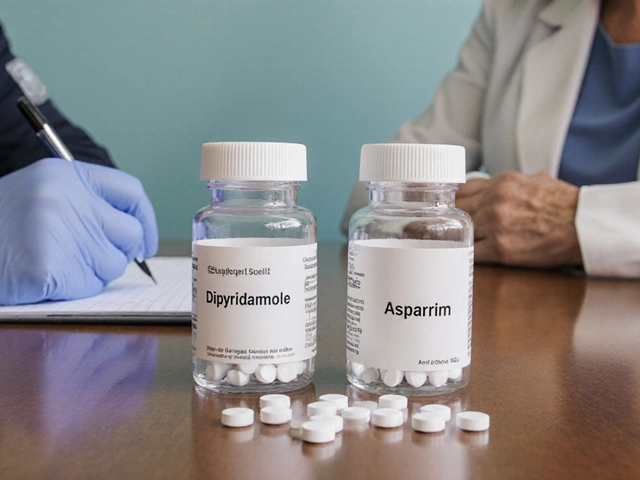
Every two years (or more often, depending on your health), you must pass a DOT physical exam conducted by a Medical Examiner listed in the National Registry of Certified Medical Examiners (NRCME). This isn’t a quick checkup. It’s a detailed review of your medical history, current conditions, and every medication you take-prescription, OTC, or herbal.
You’ll be asked to bring a complete list, including dosages and why you’re taking each one. The examiner will check for signs of impairment, review your prescriptions, and may even contact your prescribing doctor. If you’re on a banned substance, the examiner can’t issue a medical certificate unless you qualify for an exemption.
There’s no hiding anything. The FMCSA’s Drug and Alcohol Clearinghouse now requires all medication-related restrictions to be reported within 24 hours. If you lie, get caught, and your employer finds out, you could face immediate suspension, fines, or even criminal charges. In 2024 alone, over 12,800 drivers went through the medical review process because of medication issues.
Why Adderall and Vyvanse Are a Big Problem
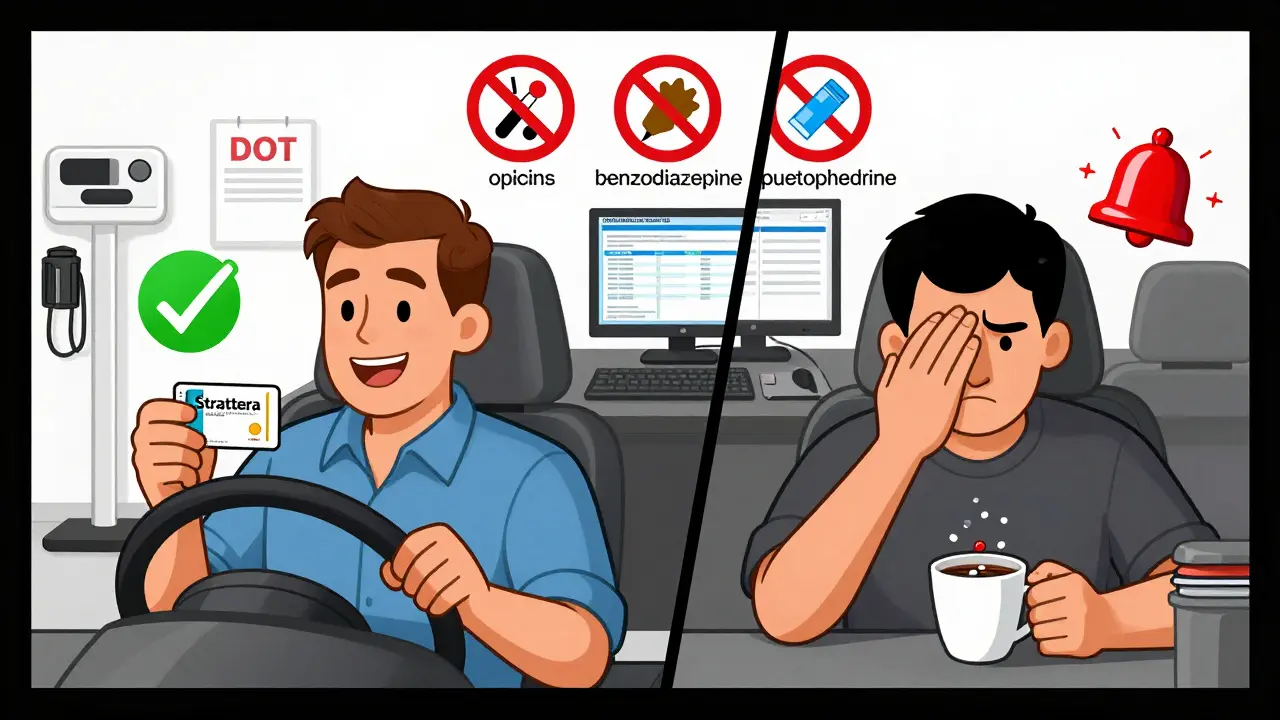
Many drivers with ADHD rely on stimulants like Adderall or Vyvanse to stay alert during long hauls. These drugs work. But under DOT rules, they’re classified as Schedule II controlled substances-and they’re banned for CDL holders, no exceptions.
Unlike in many other jobs, the Americans with Disabilities Act (ADA) doesn’t protect commercial drivers here. Reasonable accommodations? Not when you’re operating a 40-ton truck at 70 mph. Even if your doctor says you’re fine, the FMCSA says no.
Reddit threads and TruckersReport forums are full of stories. One driver in Ohio lost his CDL after a random test flagged Adderall. Another in Texas spent six months switching to Strattera, a non-stimulant ADHD medication that’s allowed. He passed his next DOT physical and got his license back. But not everyone has that option. For many, the cost of switching treatments, the loss of effectiveness, or the side effects of alternatives make it nearly impossible.
What About Pain Medications?
Chronic pain is one of the biggest reasons drivers leave the industry. A 2022 survey by the Owner-Operator Independent Drivers Association (OOIDA) found that 63% of CDL drivers had to stop taking effective pain medications because of DOT rules. Many switched to non-opioid options like gabapentin or physical therapy. But for others, the trade-off was worse than the pain: depression, sleeplessness, or inability to work.
Some drivers have turned to medical exemptions. The FMCSA’s Skill Performance Evaluation (SPE) certificate allows drivers with certain physical impairments to operate under strict conditions. But for medication-based exemptions? Those are rare. Only about 32% of SPE applications related to medication use are approved. And even if you get one, you’ll need regular follow-ups, documentation, and possibly a co-driver.
What’s Allowed? Safe Alternatives and Strategies
Not all medications are banned. Many are perfectly fine if they don’t impair your driving. Here’s what’s generally acceptable:
- Antihypertensives (blood pressure meds)
- Insulin (with proper monitoring)
- Thyroid medications
- Some antidepressants like SSRIs (sertraline, escitalopram)
- Non-stimulant ADHD meds like Strattera
- CPAP machines for sleep apnea (with compliance logs)
For drivers with sleep apnea, the good news is that 92% of those using CPAP machines successfully maintain their certification. The key? Consistent use and documentation. Many carriers now require drivers to upload nightly CPAP usage data through electronic logging devices.
For pain, non-opioid options like NSAIDs (ibuprofen, naproxen) are allowed if taken as directed. Physical therapy, acupuncture, and weight management are encouraged. Some drivers use CBD oil-but only if it’s 100% THC-free. Even trace amounts can trigger a positive test.
How Carriers Are Adapting (and Failing)
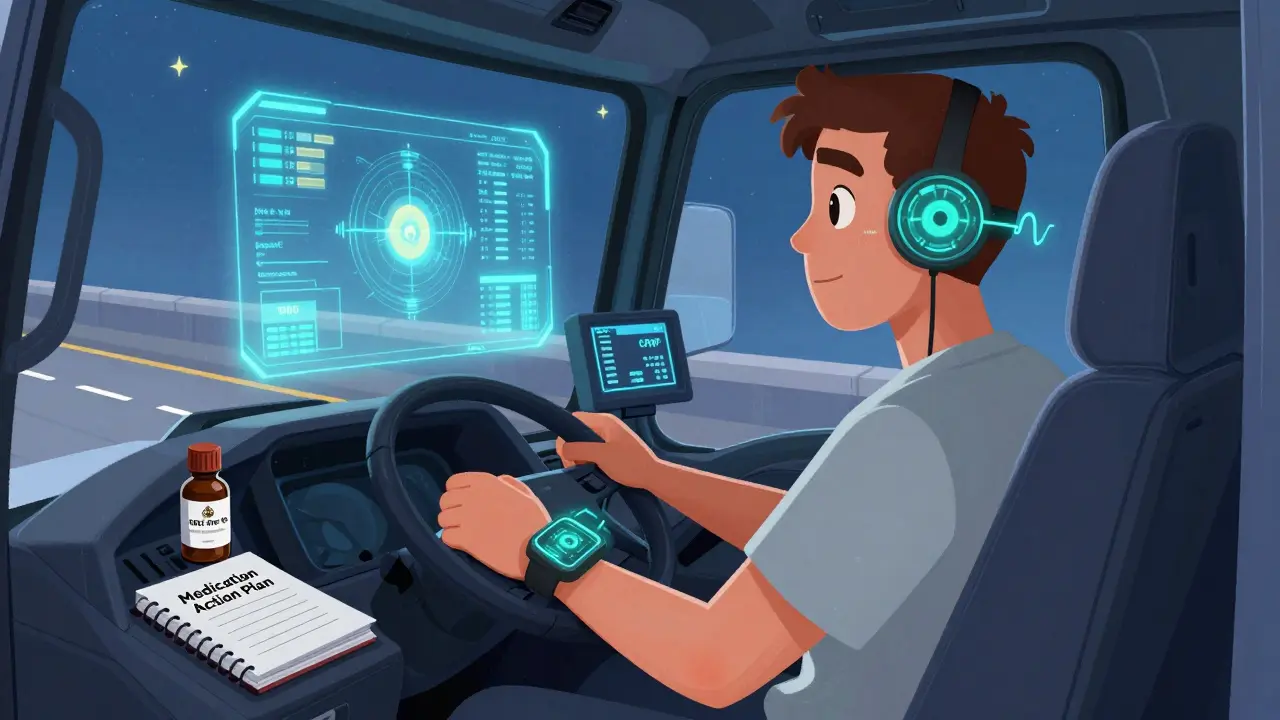
Companies aren’t just leaving it to drivers. More than 67% of carriers now use electronic medication tracking systems to monitor compliance. That’s up from just 18% in 2019. These systems flag high-risk medications, remind drivers when renewals are due, and help safety managers spot patterns.
But not everyone is on board. The FMCSA’s 2023 Compliance Review found that 28% of carriers failed medication management audits. The average fine? $14,200 per violation. Some small fleets still rely on paper logs. Others assume a doctor’s note is enough. It’s not.
And the cost of non-compliance goes beyond fines. A single crash involving a driver on a banned medication can cost a company millions in lawsuits, insurance hikes, and lost contracts. That’s why smart carriers now require all new hires to submit their medication list before orientation.
The Future: Wearables, Data, and a Growing Crisis
The FMCSA is testing real-time impairment detection. A $4.7 million pilot program with Samsara and KeepTruckin is using biometric wearables to track pupil dilation, heart rate variability, and microsleeps. If successful, this could replace some of the outdated drug tests with actual performance data.
But there’s a looming problem: aging drivers. The Commercial Vehicle Medical Research Foundation warns that 43% of drivers over 50 take at least one medication that conflicts with DOT rules. Without policy changes, they predict a driver shortage of 54,000 by 2027.
And now, the FMCSA is proposing to add all benzodiazepines-like Xanax and Klonopin-to the banned list, even with a prescription. That’s because crashes involving these drugs rose 22% between 2019 and 2023. The industry is pushing back. Many argue that with proper monitoring, these drugs can be used safely.
For now, the rules stay strict. The science says: if a drug can affect your ability to drive safely, it’s not worth the risk.
What You Should Do Right Now
If you’re a commercial driver, here’s your action plan:
- Review every medication you take-prescription, OTC, or supplement. Cross-check them against the FMCSA’s prohibited list.
- Talk to your doctor and your DOT medical examiner together. Don’t assume your doctor knows the rules. Bring the FMCSA guidelines with you.
- Document everything. Keep a Medication Action Plan that notes how each drug affects your alertness, reaction time, and mood.
- Don’t wait for a test. If you’re on a borderline medication, get a pre-check with your Medical Examiner before your next DOT physical.
- Know your rights. You can appeal a denial. You can apply for an SPE certificate. You can switch to safer alternatives. But you can’t ignore it.
There’s no shortcut. But there is a path forward-for those willing to be honest, proactive, and informed.
Can I take my prescribed antidepressants if I have a CDL?
Yes, many antidepressants are allowed if they don’t cause drowsiness, dizziness, or impaired judgment. SSRIs like sertraline (Zoloft) and escitalopram (Lexapro) are commonly approved. But you must disclose them during your DOT physical, and your Medical Examiner may require a letter from your prescribing doctor confirming you’re stable and safe to drive. Stimulant-based antidepressants like Wellbutrin are also generally permitted.
What happens if I get caught driving while on a banned medication?
You’ll be immediately removed from duty and placed out-of-service. Your CDL may be suspended or revoked. Your employer is required to report you to the FMCSA Drug and Alcohol Clearinghouse, which affects your ability to get hired by any other carrier. You’ll need to complete a Substance Abuse Professional (SAP) evaluation and return-to-duty process before you can drive again. Fines for the carrier can exceed $10,000.
Is CBD oil allowed for commercial drivers?
Only if it’s 100% THC-free. Even trace amounts of THC can trigger a positive drug test under DOT standards. Most CBD products-even those labeled “broad-spectrum”-contain enough THC to fail a test. The FMCSA doesn’t distinguish between medical and recreational use. If it’s in your system, it’s a violation. Stick to non-cannabis alternatives unless you’re certain of the product’s purity.
Can I get a medical exemption for opioids if I have chronic pain?
No. The FMCSA prohibits all Schedule II narcotics-including oxycodone, hydrocodone, and fentanyl-regardless of medical need. There are no exemptions. The only option is to switch to non-opioid pain management, such as physical therapy, nerve blocks, or non-addictive medications like gabapentin. Some drivers qualify for a Skill Performance Evaluation (SPE) certificate if their condition is stable and they can demonstrate safe driving ability without opioids.
Do I need to tell my employer about my medications?
You are not required to tell your employer directly-but you must disclose all medications to your DOT Medical Examiner. Your employer will see the results of your medical certificate and any restrictions. If you’re on a banned substance and your medical certificate is denied or restricted, your employer will be notified. Lying or hiding medications can result in termination and permanent disqualification from commercial driving.
9 Comments

Akriti Jain
January 23 2026
lol the gov't wants us to drive 18-wheelers on coffee and willpower 🤡 Meanwhile, your boss is probably on Xanax and still doing Zoom calls 😂 Who’s really the danger here? Also, CBD oil is fine if you buy it from that guy in the truck stop parking lot who says ‘it’s hemp, bro’ 🌿😉 #TruckerLife #GovernmentOverreach

Mike P
January 25 2026
Let me get this straight-some guy in Ohio got his license yanked for Adderall but the guy next to him is popping oxycodone like M&Ms and nobody says a word? That’s not safety, that’s hypocrisy. We’re talking about a 40-ton machine moving at 70 mph and you’re worried about a guy taking his ADHD med? What’s next? Banning caffeine? You want to save lives? Start with enforcing seatbelt laws and stopping 18-wheeler drivers from texting with one hand while eating a burrito with the other. This whole thing is a scam to push out older drivers so they can hire cheaper, younger kids who don’t know how to change a tire.
And don’t even get me started on CBD. If you can’t tell the difference between hemp oil and weed oil, you shouldn’t be allowed to operate a scale. The FMCSA needs to stop playing doctor and start enforcing real rules. If you’re impaired, you’re out. Period. Not because of your prescription bottle, but because your eyes are glazed and your steering’s wobbly.
Also, the fact that 28% of carriers failed medication audits? That’s not a driver problem. That’s a management problem. Your safety officer is asleep at the wheel. Fix that before you ban my Adderall.

Jasmine Bryant
January 27 2026
Just wanted to add-SSRIs like sertraline are generally okay but they can still cause drowsiness in the first 2-4 weeks. I had a driver friend who passed his DOT physical but crashed because he didn’t tell his med examiner he just started Lexapro. The key is not just disclosure, but timing. Wait at least a month after starting or changing dosage before getting certified. Also, don’t forget to bring your pill bottles. One time I forgot and they thought I was hiding something… turned out I just had a bottle of fish oil labeled ‘Rx’ 😅
And for anyone asking about Strattera-yes, it works, but it takes 3-6 weeks to build up. Don’t switch cold turkey. Talk to your psych and your DOT examiner together. They can coordinate.

Margaret Khaemba
January 29 2026
I’m from Kenya and we don’t have CDLs, but I’ve driven delivery vans here and I can relate. In Nairobi, a lot of drivers take painkillers for back pain because there’s no access to PT. No one checks their meds. It’s scary. I’m glad the U.S. is trying to standardize this. Maybe we can learn from your system. I do wonder though-what about drivers in rural areas who can’t afford to switch meds? Is there any financial aid or subsidy program for non-stimulant alternatives? I’d love to see more equity in this.

Malik Ronquillo
January 29 2026
They banned Adderall but let you drive with a CPAP machine? Bro. One’s a pill. The other’s a mask that makes you look like a robot. If you’re asleep at the wheel, you’re asleep at the wheel. Why is the machine okay but the pill isn’t? That’s not logic. That’s bureaucracy with a side of irony.

Brenda King
January 30 2026
Biggest thing I learned after my DOT physical: bring your meds list printed out. Not on your phone. Not in your head. Printed. And write the dosage next to each one. The examiner doesn’t care if you’ve been on it for 10 years. If it’s not on paper, it didn’t happen. Also, don’t be shy. I was nervous about admitting I was on Zoloft but the examiner just nodded and said, ‘Good. That’s better than the guy who came in on Vicodin last week.’ We’re all just trying to get home safe.

Keith Helm
January 30 2026
FMCSA 49 CFR §391.41. Non-compliance constitutes a federal violation. Medical examiner must verify all substances against Schedule II-IV prohibitions. Failure to disclose is grounds for immediate disqualification. Employer notification is mandatory. No exceptions.

Daphne Mallari - Tolentino
January 31 2026
It is regrettably evident that the current regulatory framework exhibits a profound lack of nuance in its pharmacological adjudication. The categorical prohibition of Schedule II stimulants, irrespective of therapeutic efficacy or individual pharmacodynamic response, constitutes a form of epistemic authoritarianism. One cannot help but note the incongruity between the FMCSA’s reliance on binary compliance metrics and the complex, multidimensional nature of neurocognitive function. A more sophisticated, evidence-based, tiered assessment model-perhaps incorporating longitudinal performance analytics and pharmacogenomic profiling-is not merely desirable; it is imperative for the integrity of the profession.


Ryan Riesterer
January 22 2026
The FMCSA’s prohibited drug list is a necessary evil. Schedule II stimulants like Adderall are banned because the risk profile is unambiguous-reduced reaction time, erratic behavior under fatigue, and the potential for crash escalation is statistically significant. Even if a driver feels fine, pharmacokinetics don’t care about subjective wellness. The 35% prevalence rate among examined drivers isn’t anecdotal-it’s a systemic compliance failure masked as self-medication.
What’s missing from the narrative is the lack of standardized pharmacovigilance protocols across medical examiners. Some DOT examiners defer entirely to prescribing physicians; others apply rigid interpretations. This inconsistency creates arbitrariness in certification, which undermines trust in the system. We need a national algorithmic decision tree, not human discretion.