
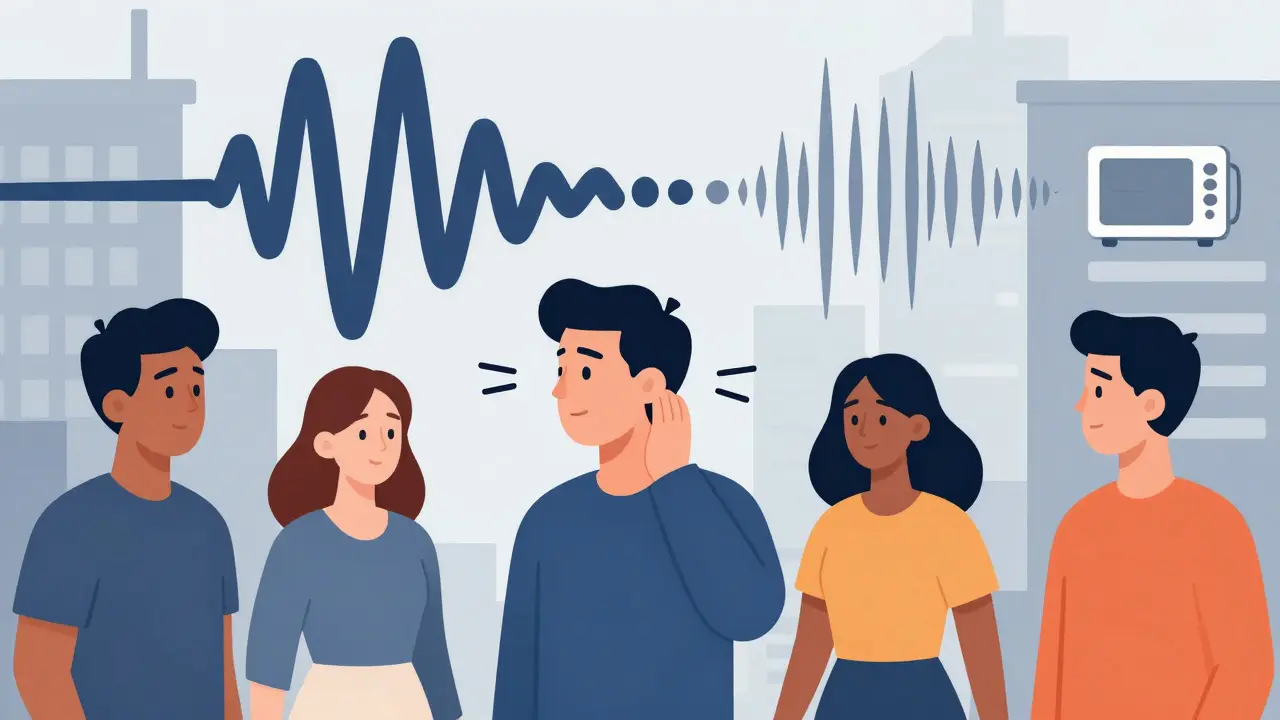
Have you ever wondered why you can hear the low rumble of a passing truck but miss the high-pitched beep of a microwave? That gap in your hearing isn't just random; it's mapped out on a graph called an audiogram, which is a visual representation of hearing sensitivity across different frequencies. Getting this map requires a procedure known as audiometry testing, which is a clinical procedure for measuring hearing sensitivity through sound detection thresholds. It sounds technical, but it’s really just a way to measure exactly what you can and cannot hear. Understanding these tests and the numbers behind them-specifically decibel levels, which are units used to quantify the intensity of sound-is the first step toward taking control of your hearing health.
What Is Audiometry and Why Does It Matter?
Audiometry is not a single test but a collection of procedures designed to diagnose hearing loss. Think of it like an eye exam, but instead of checking how well you see letters at different distances, we check how well you hear tones at different pitches and volumes. The goal is to find your "threshold"-the softest sound you can detect 50% of the time. This baseline is crucial because it tells us if you have normal hearing or if there is a problem. If there is a problem, it helps us figure out where it is located: in the outer ear, middle ear, inner ear, or even the nerve pathways leading to the brain.
The gold standard for this assessment is pure-tone audiometry, which is a test that measures the softest sound a patient can detect at specific frequencies using pure tones. According to the American Academy of Family Physicians (AAFP), this method remains the most reliable way to assess hearing. It involves listening to beeps at various pitches, ranging from deep bass notes to high-pitched whines. By mapping these responses, audiologists can create a detailed picture of your hearing landscape. This isn't just about knowing if you're "deaf" or "not deaf." It’s about understanding the nuances of your hearing so that treatments, like hearing aids, can be programmed precisely to your needs.
How Pure-Tone Audiometry Works
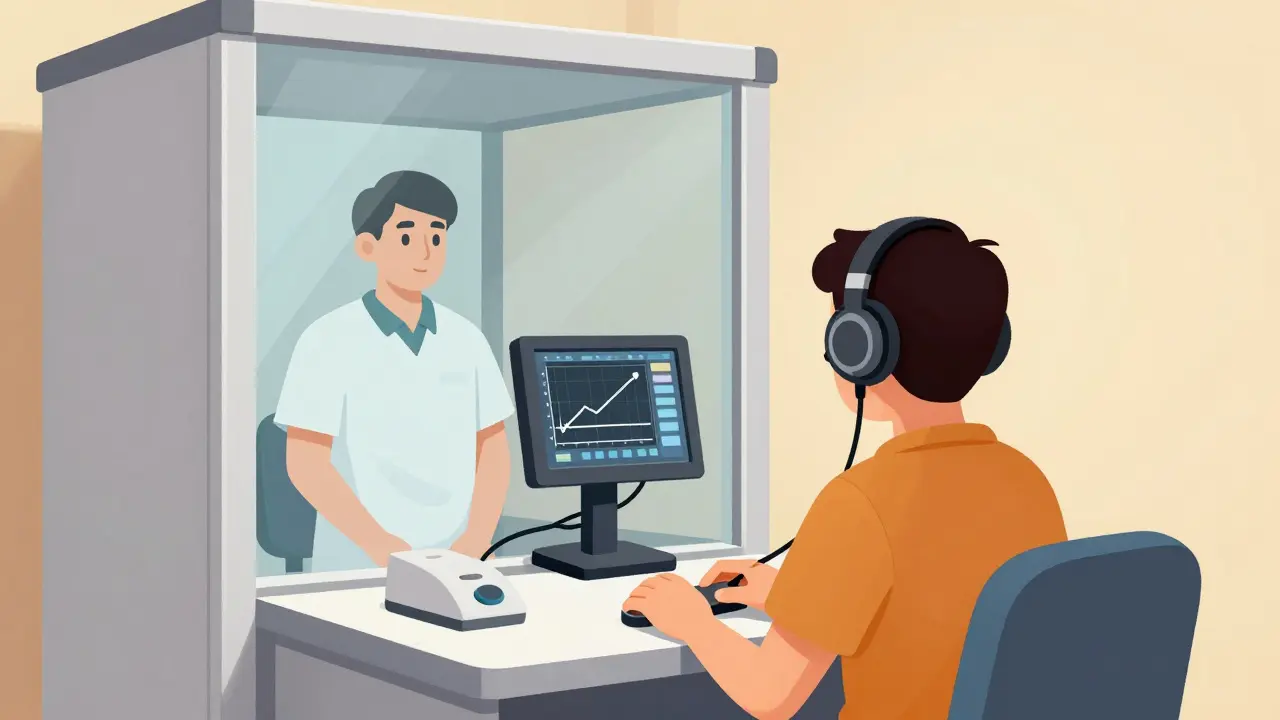
During a pure-tone test, you sit in a soundproof booth wearing headphones. An audiologist presents tones at specific frequencies, measured in Hertz (Hz). These frequencies typically range from 250 Hz (low pitch) to 8000 Hz (high pitch). The volume of these tones is adjusted in increments of 5 to 10 decibels (dB). You raise your hand or press a button every time you hear a tone, no matter how faint.
The process follows a strict protocol known as the modified Hughson-Westlake method. Here is how it usually goes:
- The audiologist starts with a tone you can easily hear.
- They lower the volume by 10 dB until you stop responding.
- They then raise the volume in smaller 5 dB steps to pinpoint the exact level where you start hearing it again.
- This threshold is recorded on the audiogram.
- The process is repeated for each frequency and each ear.
This method ensures accuracy. It prevents you from guessing and helps eliminate false positives. The result is a series of points plotted on a graph. If your thresholds are within 25 dB HL (hearing level) across all frequencies, you are considered to have normal hearing. Anything above that indicates some degree of hearing loss.
Understanding Decibel Levels and Hearing Loss Categories
Decibels are logarithmic, meaning a small increase in dB represents a significant jump in sound intensity. In audiometry, we use dB HL to standardize measurements against average young adult hearing. Here is how those numbers translate into real-world hearing ability:
| Threshold (dB HL) | Hearing Status | Real-World Impact |
|---|---|---|
| -10 to 25 | Normal | You can hear whispers and soft speech clearly. |
| 26 to 40 | Mild Loss | You might miss soft consonants like 's' or 'f' in noisy rooms. |
| 41 to 55 | Moderate Loss | Conversations become difficult without lip-reading or amplification. |
| 56 to 70 | Moderately Severe | You likely struggle to follow group conversations entirely. |
| 71 to 90 | Severe Loss | You may only hear loud sounds like shouting or doorbells. |
| 91+ | Profound Loss | You rely heavily on visual cues and sign language. |
Notice how a mild loss of 30 dB might seem small numerically, but it means you are missing sounds that are half as intense as normal hearing allows. This is why many people don't realize they have hearing loss until others tell them they are turning up the TV too loud. The decibel scale helps quantify this invisible deficit.
Air Conduction vs. Bone Conduction: Finding the Source
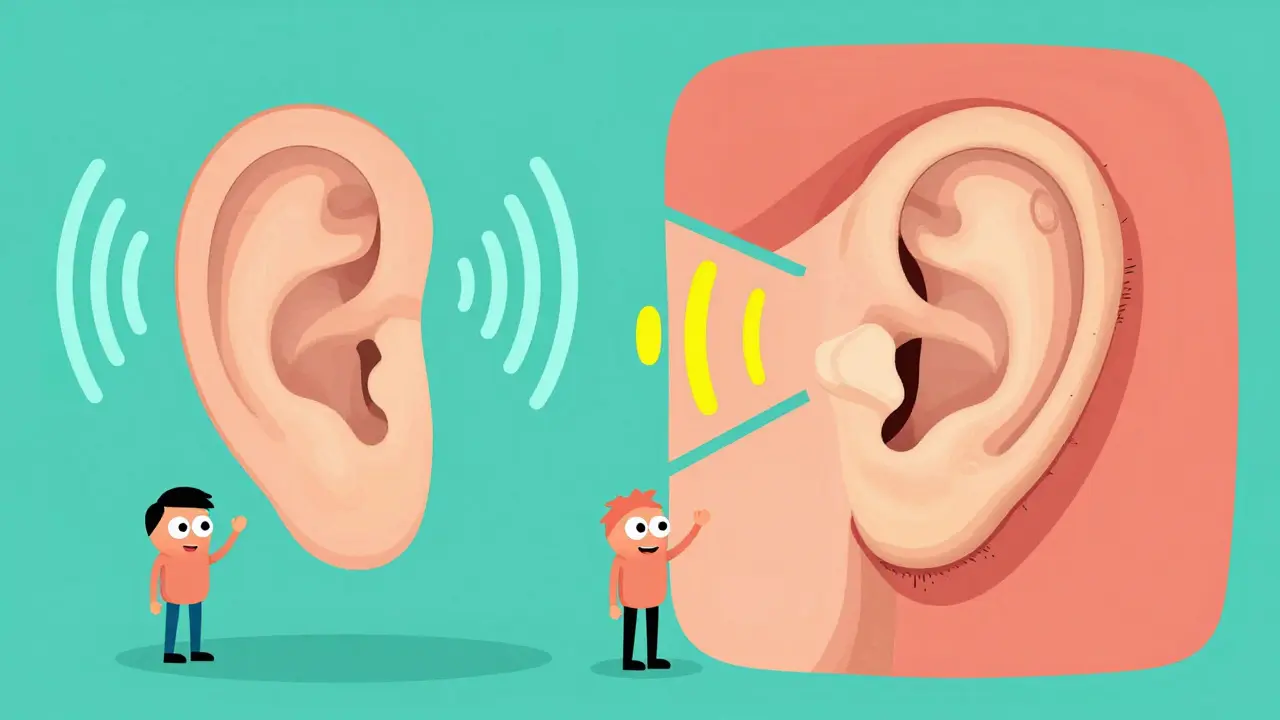
Pure-tone testing usually includes two types of sound delivery: air conduction and bone conduction. Air conduction uses headphones to send sound waves through the ear canal, eardrum, and middle ear bones to the inner ear. This tests the entire hearing pathway.
Bone conduction, on the other hand, bypasses the outer and middle ear. A device called a bone oscillator vibrates directly against the mastoid bone behind your ear or on your forehead. These vibrations travel straight to the cochlea (inner ear). By comparing air and bone conduction results, audiologists can determine the type of hearing loss:
- Conductive Hearing Loss: If your bone conduction is normal but air conduction is poor, the problem is in the outer or middle ear. This could be due to earwax, fluid, or a perforated eardrum. There is often an "air-bone gap" of 15 dB or more.
- Sensorineural Hearing Loss: If both air and bone conduction show similar losses, the issue is in the inner ear or auditory nerve. This is permanent and often caused by aging or noise exposure.
- Mixed Hearing Loss: A combination of both conductive and sensorineural issues.
This distinction is vital because conductive losses can sometimes be treated medically or surgically, while sensorineural losses typically require hearing aids or cochlear implants.
Beyond Tones: Speech and Middle Ear Tests
Hearing tones is one thing; understanding speech is another. That’s why speech audiometry is a critical part of the assessment. Two main tests are used here:
Speech Reception Threshold (SRT): This determines the quietest level at which you can repeat 50% of common words correctly. Ideally, this number should match your pure-tone average. If it doesn’t, it might indicate a neurological issue or non-organic hearing loss.
Speech Discrimination Test: Also known as word recognition, this measures how clearly you understand speech when it is presented at a comfortable, loud volume. Someone with good hearing might score 100%, while someone with nerve damage might score 60% even if the volume is turned up. This helps predict how well hearing aids will work for you.
Additionally, tympanometry, which is a test that assesses middle ear function by measuring eardrum compliance, checks the mobility of your eardrum. A probe is placed in your ear, and air pressure changes to see how the eardrum moves. This takes just seconds but provides key data on middle ear health, detecting issues like fluid buildup that pure-tone tests might miss.
Who Needs Audiometry and When?
You might think audiometry is only for older adults, but it’s relevant at every stage of life. Newborns undergo screening before leaving the hospital to catch hearing loss early, ensuring language development isn’t delayed. Children who struggle in school might have undiagnosed hearing issues affecting their learning. Adults exposed to loud noises at work or through hobbies need regular monitoring to prevent further damage.
If you find yourself asking people to repeat themselves, turning up the volume excessively, or feeling fatigued after social interactions, it’s time for a test. The American Speech-Language-Hearing Association (ASHA) recommends annual screenings for adults over 50, or sooner if you notice changes. Early detection leads to better outcomes, whether that means treating an infection or fitting hearing aids before isolation sets in.
Preparing for Your Test and Interpreting Results
There’s little preparation needed for audiometry. Just avoid loud noises beforehand, as temporary threshold shifts can skew results. Wear comfortable clothing, and if you wear glasses, inform the audiologist, as the bone conduction oscillator might interfere with them.
After the test, your audiologist will walk you through your audiogram. Don’t be intimidated by the symbols. Circles usually represent the right ear, and X’s represent the left. The vertical axis shows volume (decibels), and the horizontal axis shows pitch (frequency). Look for patterns. A downward slope to the right suggests high-frequency loss, common in age-related hearing decline. A flat line might indicate uniform loss across all frequencies.
Remember, the goal isn’t just to get a diagnosis but to create a plan. Whether that plan involves medical treatment, hearing protection, or assistive devices, audiometry provides the roadmap. Understanding your decibel levels empowers you to make informed decisions about your hearing health, ensuring you stay connected to the world around you.
How long does an audiometry test take?
A comprehensive diagnostic audiometry test typically takes 30 to 45 minutes. This includes pure-tone testing, speech audiometry, and tympanometry. Simple screening tests can be completed in 2 to 3 minutes.
Is audiometry painful?
No, audiometry is non-invasive and painless. Some patients find the bone conduction oscillator slightly uncomfortable if they wear glasses, but it is generally well-tolerated.
What is the difference between dB SPL and dB HL?
dB SPL (Sound Pressure Level) measures physical sound intensity. dB HL (Hearing Level) is calibrated to account for human hearing sensitivity at different frequencies, making it the standard for clinical audiograms.
Can I do audiometry at home?
Home screening apps exist, but they are not diagnostic. They lack controlled environments and calibrated equipment, leading to inaccurate results. Professional testing is required for accurate diagnosis.
Why is masking used in audiometry?
Masking involves presenting noise to the non-test ear to prevent it from hearing the test tone. This ensures that the response comes from the ear being tested, especially when there is a significant hearing difference between ears.
14 Comments

Gavin Edley
July 9 2026
Oh please, another article trying to convince us that these medical rituals are some sort of holy grail of health. I’ve had three audiograms in ten years and every single one tells me I have 'mild loss' which is basically code for 'buy our expensive hearing aids.' It’s a racket. My ears work fine when I want them to. This whole decibel obsession is just anxiety manufacturing for people who are perfectly happy ignoring the world until it shouts at them.

jeremy pritchett
July 10 2026
YOu gotta LISTEN to your body man!!! If ur missing sounds its a sign somethin is off with the universe inside yer head. DONT IGNORE IT. Get tested. Its not just about hearing trucks vs microwaves its about being PRESENT in life. Wake up and take care of yr senses before they fade away into the void. DO IT NOW!!

Chandan Sharma
July 10 2026
The pretension of reducing human auditory perception to mere logarithmic scales is somewhat amusing, yet undeniably necessary for clinical precision. One must appreciate the elegance of the Hughson-Westlake method; it is a ballet of thresholds, a delicate dance between silence and sound. To dismiss the nuance of air versus bone conduction as trivial is to display a profound ignorance of otological science. The distinction is not merely academic; it is the chasm between mechanical obstruction and neural decay. We should treat our cochleae with the reverence they deserve, rather than treating them like cheap headphones we leave on the floor.

Katie Dixon
July 10 2026
I mean, look, I love that we’re talking about this because honestly, if we don’t fix our hearing, how are we going to hear the truth? You know what I’m saying? It’s all connected. Like, if you can’t hear the high frequencies, you’re literally tuning out the important stuff. And don’t even get me started on how foreign countries handle this-probably totally different systems, probably worse. But here in America, we have the best tech, right? So use it. Don’t be shy about walking into that booth. It’s your right to hear clearly. Also, does anyone else feel weird having someone vibrate their skull? Just asking.

Chris Munton
July 11 2026
It is morally incumbent upon every individual to maintain their physical faculties in optimal condition, for neglecting one's hearing is akin to neglecting one's duty to society and oneself. The assertion that mild hearing loss is inconsequential is a dangerous fallacy propagated by those who wish to remain disconnected from reality. When one fails to detect the subtle consonants of speech, one is not merely missing data; one is failing to engage fully in the communal discourse. Therefore, the pursuit of audiometric testing is not a choice but an ethical imperative. Those who refuse to undergo such assessments are displaying a level of self-indulgence that borders on narcissism, prioritizing their comfort over the clarity of communication that binds us together as a cohesive unit.

Amrithaa Thayaparan
July 12 2026
ur so clueless if u think this is optional. its basic hygiene for ur brain. stop acting like a child and go get tested. the fact that ppl ignore this shows how degraded our society has become. we let our bodies rot while scrolling phones. pathetic. get yer dB levels checked or stay deaf and stupid.

Paul Diamond
July 12 2026
One might ponder whether the quantification of sensory experience through decibels truly captures the essence of hearing, or if it merely imposes a rigid structure upon the fluid nature of perception. The audiogram serves as a map, yes, but maps are never the territory itself. There is a philosophical disconnect between the threshold of detection and the threshold of understanding. We measure the volume, but do we measure the meaning? Perhaps the true test lies not in the booth, but in the silence between the tones.

Sydney Jarrett
July 13 2026
Let’s break down the psychophysics here because everyone is glossing over the critical importance of masking protocols. If you have asymmetric hearing loss and the audiologist doesn’t use contralateral masking, your results are garbage. Pure nonsense. You need to understand that the interaural attenuation for air conduction is roughly 40dB for circumaural headphones. Without masking, the non-test ear picks up the signal via bone conduction, leading to a shadow curve. This isn't just trivia; it’s fundamental diagnostic integrity. Most laypeople have no idea how easily these tests can be invalidated by poor technique. Educate yourselves or accept flawed data.

Lorena Suarez
July 13 2026
i went for mine last week and it was actually kinda chill. just sat there listening to beeps. took like 20 mins total. didnt hurt at all. good to know whats going on tho.

Isis Fleming
July 13 2026
It is imperative to note that tympanometry provides crucial adjunctive data that pure-tone audiometry alone cannot offer. While the latter assesses sensitivity, the former evaluates middle ear mechanics. A Type A tympanogram indicates normal compliance, whereas a Type B suggests fluid or perforation. Ignoring this component of the battery of tests would be clinically negligent. Patients should ensure their audiologist performs both to rule out conductive pathologies that may be medically reversible. Early intervention remains the cornerstone of effective audiological management.

Ben Murphy
July 14 2026
The pervasive negligence regarding auditory health reflects a broader societal decay in personal responsibility. Individuals who fail to monitor their sensorineural thresholds are essentially choosing isolation. The jargon surrounding dB HL and SRT is not designed to confuse, but to standardize objective measurement against subjective experience. To dismiss these metrics is to embrace chaos. One must adhere to the rigorous standards established by ASHA. Failure to do so is not merely a health oversight; it is a moral failing against one’s own potential for connection.

Fred Stone
July 15 2026
hey guys just a tip if u wear glasses tell the doc before the bone conduction part. the thing behind yer ear hurts if u dont adjust. also dont listen to loud music before hand or the numbers will be messed up. easy fix really.

Peter Sverla
July 15 2026
I find myself fascinated by the intersection of technology and biology here. The way we translate waveforms into data points is quite remarkable. However, I often wonder if the standardized thresholds account for individual variations in neural processing speed. Does a slower response time affect the threshold determination? It seems like a variable that could skew results for neurodivergent individuals. Has anyone researched this aspect of audiometry?



Anna Bartle
July 7 2026
Just got my audiogram done yesterday! It’s wild how much detail they can pull from just pressing a button. The speech discrimination test was the most eye-opening part for me. I thought I heard fine, but my score was only 75% at comfortable volumes. That explains why I’m always asking 'what?' in restaurants.
Don’t ignore those high-frequency drops either. They sneak up on you.