
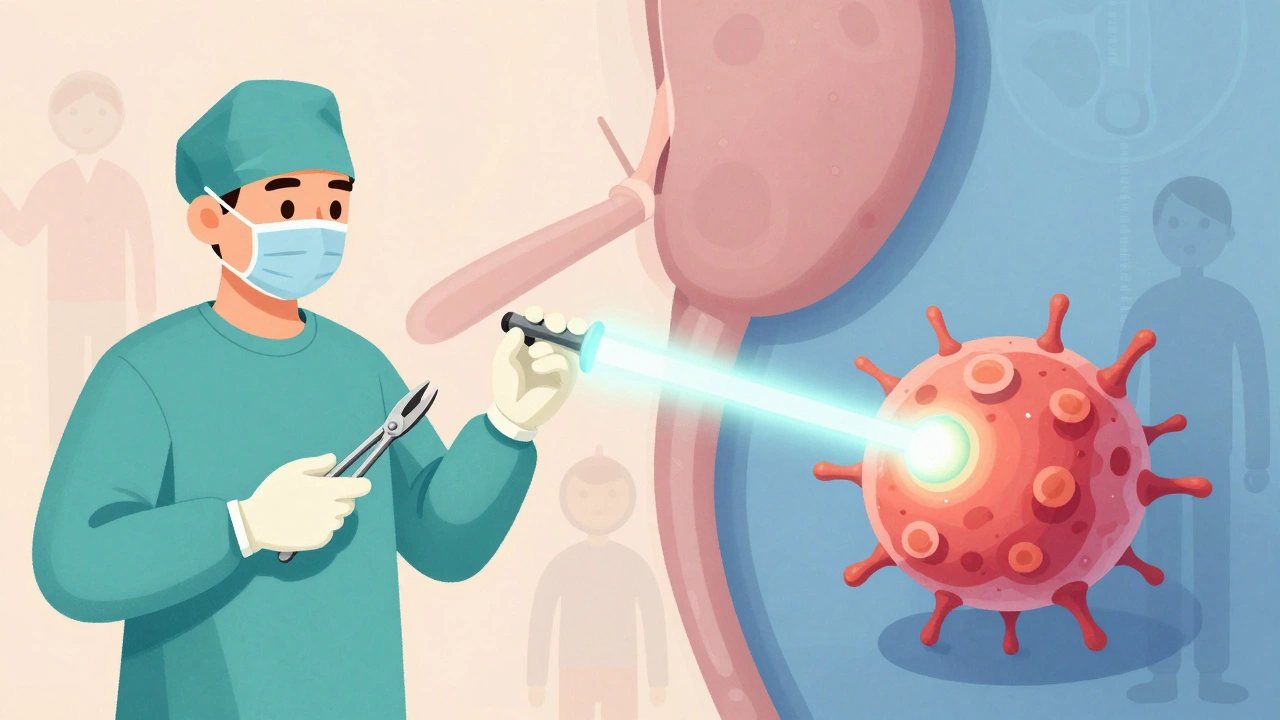
When you’re first told you have localized cancer, one of the first big decisions you’ll face is: radiation or surgery? Both aim to remove or destroy the tumor where it started - that’s what "local control" means. But they’re not the same. One cuts it out. The other zaps it. And the choice isn’t just about which one works better - it’s about what you’re willing to live with afterward.
What Does Local Control Even Mean?
Local control means stopping the cancer where it began. It doesn’t care if it’s in your prostate, lung, or breast - if the tumor hasn’t spread, your doctors will try to get rid of it right at the source. That’s different from treating cancer that’s already moved to your bones or liver. For early-stage cancers, this is often the most effective way to cure.Surgery: Take It Out
Surgery means cutting the tumor out. For prostate cancer, that’s a radical prostatectomy - removing the whole gland. For lung cancer, it might mean removing a lobe or even part of the lung. The big advantage? You get the tumor out. Your pathologist can look at it under a microscope and tell you exactly how aggressive it was, whether it had started to spread to nearby tissue, and whether you need more treatment after. The procedure itself is usually one-time. A prostatectomy takes 2-4 hours. A lung lobectomy might take 3-5 hours. You’ll stay in the hospital for a few days, then recover at home over 6-8 weeks. It’s intense, but it’s over.Radiation: Zap It In Place
Radiation therapy doesn’t cut anything. It uses high-energy beams - usually from a machine called a linear accelerator - to kill cancer cells where they are. Modern systems can target within 1-2 millimeters, so they miss healthy tissue better than ever. For prostate cancer, traditional radiation means daily 15-30 minute sessions, five days a week, for 7-9 weeks. That’s a lot of trips. But newer methods like stereotactic body radiation therapy (SBRT) can do the same job in just 1-5 sessions. For early-stage lung cancer, SBRT is often used instead of surgery if you’re not a good candidate for an operation. The biggest perk? No hospital stay. No big incision. You walk in, get treated, and walk out. But the effects aren’t always immediate. It can take months for the cancer to shrink, and side effects can show up later.Which One Works Better?
It depends on the cancer - and who you are. For prostate cancer, the landmark ProtecT trial followed 1,643 men for 10 years. It found no difference in survival between surgery, radiation, or just watching. Survival rates were all above 95%. But here’s the catch: 13-14% of men in either treatment group had the cancer come back locally. That’s higher than the 25% in the watchful waiting group. But another study - this one looking at 91,000 men - found surgery had better long-term survival for high-risk cases. At 15 years, 62% of men who had surgery were still alive versus 52% who had radiation. Why the difference? The ProtecT trial mostly included low-risk patients. The other study had more high-risk cases. So your risk level matters a lot. For lung cancer, the numbers are clearer. A 2022 analysis of over 30,000 patients found that surgery gave a 71.4% five-year survival rate. SBRT - the best radiation option - gave 55.9%. That’s a big gap. But here’s the thing: SBRT was used mostly in patients who couldn’t have surgery. If you’re healthy enough for surgery, it’s still the gold standard.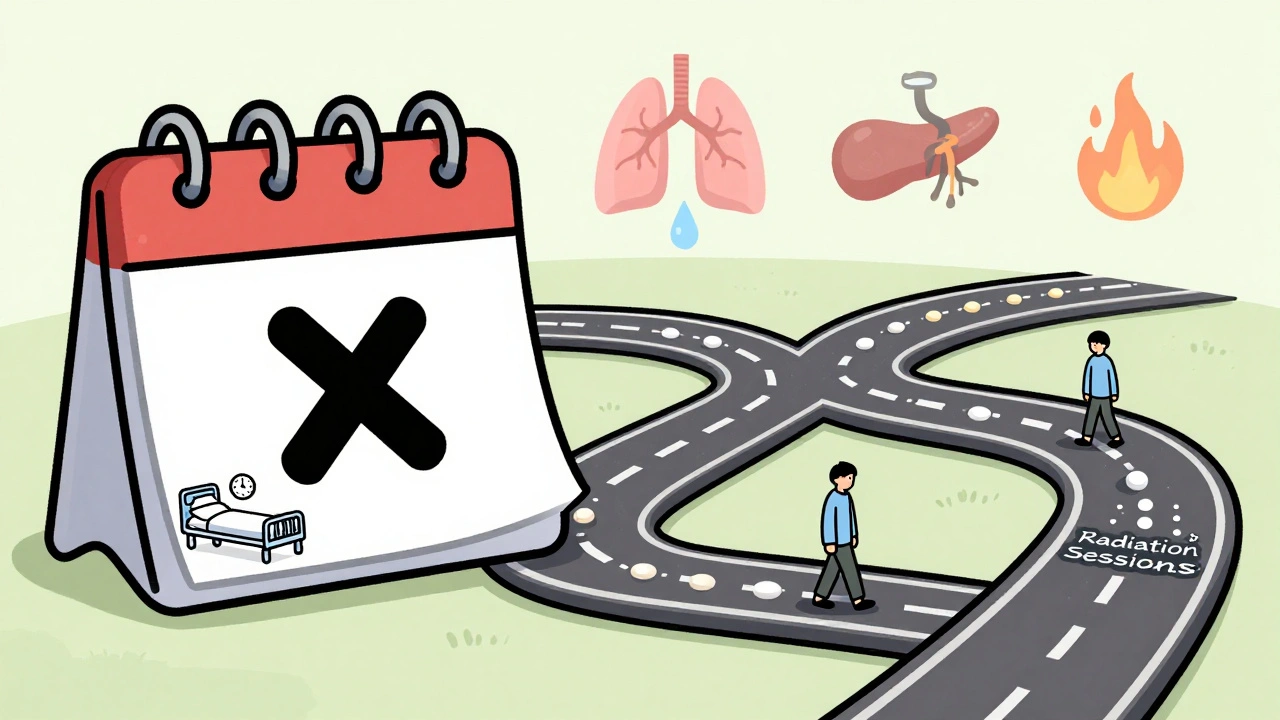
Side Effects: What You’ll Actually Live With
This is where the real decision happens. For prostate cancer, surgery often means urinary leakage and erectile dysfunction. The NIH study found that 14% of men who had surgery had urinary leakage 10 years later - compared to just 4% who had radiation. But radiation had more bowel problems: 8% had serious issues after 10 years, versus 3% after surgery. For high-risk patients, the numbers get worse: 25% of surgical patients had long-term leakage, while 11% of radiation patients did. But radiation plus hormone therapy pushed bowel problems up to 7%. For lung cancer, surgery means losing some lung function. You might feel short of breath more easily. Radiation can cause inflammation in the lung tissue - sometimes lasting months or years. It can also damage the esophagus, making swallowing painful during treatment. Neither option is "easier." They just trade one set of problems for another.Logistics: Time, Travel, and Life
Surgery is a sprint. You go in, recover hard for a few weeks, and then you’re done. Radiation is a marathon. Daily trips for nearly two months mean you need reliable transportation, time off work, and maybe even a place to stay near the treatment center. If you live far from a cancer center, that’s a huge burden. SBRT for lung cancer changes that. Five visits, no hospital stay. That’s why it’s so popular for older patients or those with other health problems. You don’t have to be in perfect shape to handle it.Who Gets Which?
Guidelines from the National Comprehensive Cancer Network (NCCN) are clear:- For prostate cancer: Surgery and radiation are both standard for low, intermediate, and high-risk cases. Active surveillance is only for very low-risk.
- For early-stage lung cancer: Surgery is first choice if you’re healthy enough. SBRT is the go-to if you can’t have surgery.
The Real Rule: Talk to Both Doctors
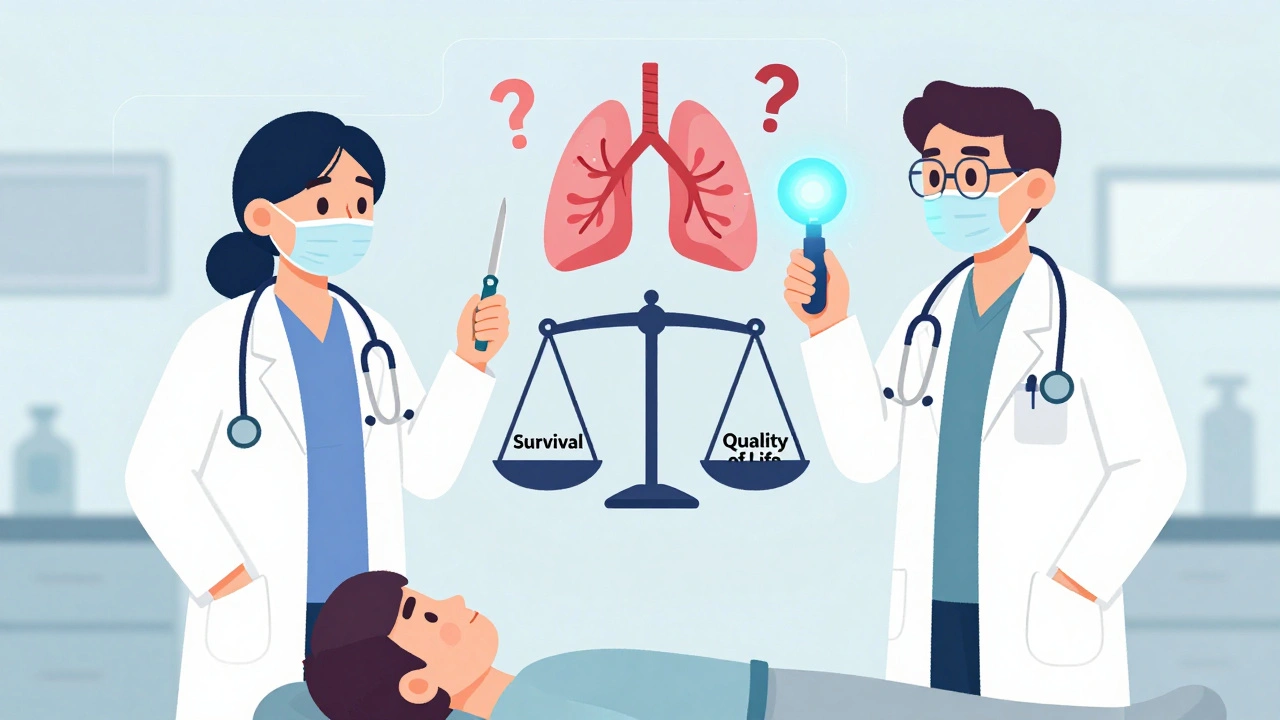
You need to meet with a surgeon and a radiation oncologist. Not just one. Both. The American Society of Clinical Oncology says this is the standard of care. Why? Because each specialist sees the problem through their own lens. The surgeon sees the tumor as something to remove. The radiation oncologist sees it as something to target. Dr. Christopher King at Cedars-Sinai puts it simply: "Talk with a surgeon and a radiation oncologist before you make your decision." Don’t let one doctor convince you. Get the facts from both sides. Ask: "What would you do if this were your father?" That question often gets you the real answer.What About Newer Options?
Focal therapy for prostate cancer - where only part of the gland is treated - is still experimental. Proton beam therapy, which may spare more healthy tissue, is being studied. But these aren’t yet standard. The PARTICLE trial, which compares partial gland ablation to full treatment, won’t have results until 2025. Right now, the two main choices are still surgery and radiation. Everything else is still on the horizon.What Should You Do?
If you’re facing this decision, here’s what actually works:- Get your cancer staged properly. Know your risk level - low, intermediate, or high.
- Meet with a urologist or thoracic surgeon. Ask about the surgery: What’s the recovery? What’s the chance of incontinence or impotence?
- Meet with a radiation oncologist. Ask about the treatment schedule, side effects, and how precise the targeting is.
- Ask both: "What’s the chance this cancer comes back? What’s the chance I’ll need more treatment later?"
- Think about your life. Can you handle daily trips for two months? Are you okay with the possibility of long-term bowel or urinary issues?
Is radiation safer than surgery?
Neither is "safer" - they’re just different. Surgery has immediate risks like bleeding and infection, but the treatment is over quickly. Radiation avoids surgery but can cause long-term side effects like bowel or bladder damage that show up years later. For older patients or those with other health issues, radiation often has fewer immediate risks. But for younger, healthier patients, surgery may offer better long-term control - especially for lung cancer.
Can I have both radiation and surgery?
Yes, sometimes. If surgery removes most of the tumor but the pathologist finds high-risk features, radiation may be added afterward to kill any leftover cells. This is called adjuvant therapy. In other cases, radiation is used first to shrink a tumor, then surgery follows. This is neoadjuvant therapy. It’s not common, but it’s done when the cancer is tricky to remove all at once.
Does radiation cause cancer later?
The risk is very low. Modern radiation is so precise that it targets only the tumor and a tiny margin around it. The chance of a new cancer developing from radiation treatment is less than 1% over 10-20 years. That’s far lower than the risk of the original cancer coming back if you don’t treat it. The benefit of controlling your current cancer far outweighs the tiny risk of a future one.
Why do some studies say surgery is better and others say they’re equal?
Because the patients are different. The ProtecT trial focused on low-risk prostate cancer - men with slow-growing tumors. In that group, both treatments work well. The UCSF study included more high-risk men - those with aggressive cancers. In those cases, surgery showed better survival. The key is matching the treatment to your cancer’s behavior, not just choosing the "popular" one.
What if I can’t afford daily radiation trips?
You’re not alone. Many patients struggle with travel, time off work, or childcare during 7-9 weeks of daily treatment. Ask your cancer center about support programs - some offer lodging, transportation help, or financial aid. SBRT is a shorter option and may be available even if you’re not a surgical candidate. If your cancer is low-risk, active surveillance might be an option while you figure things out.
Should I wait and see instead of choosing either?
Only if your cancer is very low-risk - meaning it’s slow-growing and unlikely to spread soon. For most men with low- to high-risk prostate cancer, or anyone with early-stage lung cancer, waiting is not recommended. The chance of the cancer growing and becoming harder to treat is real. Active surveillance is a valid choice, but only after you’ve fully understood the risks and committed to regular testing.
15 Comments

Jennifer Anderson
December 7 2025
ok so i just read this whole thing and im like… why does no one talk about how radiation feels like your insides are being microwaved for 8 weeks? like i get it’s non-invasive but also?? my aunt cried every day after treatment. not because of pain, just… exhaustion. like your soul gets tired.

Sadie Nastor
December 8 2025
thank you for writing this. i’m 42, early stage lung cancer, and i’ve been crying every night wondering if i should pick the thing that kills me slowly or the thing that breaks me fast. both sound like losing. but i’m gonna talk to both docs. and maybe get a second opinion from a guy who doesn’t get paid by the machine. 🤍

Sangram Lavte
December 9 2025
From India, we don’t have access to SBRT in most places. Radiation here means 35 sessions over 7 weeks. No travel support. No financial aid. Surgery is cheaper, faster, and more available. But we still get told ‘radiation is gentler’. Gentler for whom? Not for us.

Kurt Russell
December 10 2025
Listen. I’m a nurse. I’ve seen 300+ patients choose between these two. The ones who survive 10+ years? They didn’t pick based on what sounded easier. They picked based on what they could live with. Not what they feared. Ask yourself: ‘What’s my life worth after treatment?’ Not ‘What’s the least painful?’

Ashley Farmer
December 11 2025
Thank you for sharing this. I’m a cancer survivor too, and I remember how overwhelming it felt to choose. I wish someone had told me to bring a notebook to both appointments. Write down everything. Even the things they say ‘you probably won’t care about.’ You will. One day, you will.

Helen Maples
December 12 2025
Stop romanticizing ‘active surveillance.’ If your cancer is aggressive enough to be called ‘early-stage,’ you don’t get to wait. You get to act. This isn’t a Netflix binge - it’s your life. Stop waiting for permission to fight.

Nancy Carlsen
December 13 2025
My mom chose radiation for her breast cancer. She said, ‘I don’t want to be cut open and left with scars that remind me every day.’ I get it. But she also said, ‘I don’t want to be afraid every time I pee.’ That’s the trade-off nobody shows you on the brochure. 💔

Nicholas Heer
December 13 2025
They don’t want you to know this - but radiation is a corporate money machine. Hospitals make 3x more from radiation than surgery. That’s why they push it. And SBRT? Only available in rich areas. You think this is about medicine? Nah. It’s about profit. Wake up.

Wesley Phillips
December 15 2025
Look I’ve read the papers. The stats are fine. But here’s the real truth: surgery is a clean break. Radiation is a slow leak. One ends. The other lingers. And when your bladder starts acting up at 65 because of 2019 radiation? Who’s gonna fix that? The same guy who sold you the treatment?

Oliver Damon
December 17 2025
It’s funny how we treat cancer like a math problem - survival rates, side effect percentages. But it’s not. It’s a story. And the best outcome isn’t the longest life - it’s the life you still recognize as yours. Would you rather be alive and angry? Or alive and at peace? That’s the question no oncologist asks.

Kyle Flores
December 17 2025
i just got diagnosed. i’m scared. but reading this made me feel less alone. i’m gonna go talk to both docs. and bring my sister. she’s good at asking the hard questions. thanks for writing this. really.

Stacy here
December 18 2025
They’re all lying. The ‘gold standard’ is just what Big Pharma lets them say. Proton therapy? It’s better. But they won’t tell you because insurance won’t pay. And the trials? All funded by the same companies that make the machines. You think they want you to know radiation causes secondary cancers? Of course not. They need your repeat visits.

Ted Rosenwasser
December 18 2025
As a medical historian, I find it fascinating how we’ve elevated ‘local control’ to a dogma. In the 1950s, we used to amputate entire limbs for localized sarcomas. Now we zap a prostate. Progress? Or just a shift in what we’re willing to tolerate? The real question isn’t surgery vs. radiation - it’s: how much of ourselves are we willing to sacrifice for a statistical chance?

Ryan Sullivan
December 19 2025
Look, if you’re still deciding between surgery and radiation, you’re not ready. You need to stop Googling. Stop watching YouTube vlogs. Go sit in a room with someone who’s been through both. Not a doctor. Not a nurse. A real person who’s 7 years out. And ask them: ‘Would you do it again?’ If they hesitate? That’s your answer.


David Brooks
December 7 2025
Bro. I had prostate cancer. Surgery. Lost control for 8 months. Had to wear diapers like a baby. But I’m alive. Radiation would’ve taken forever and I’d still be scared it’s coming back. No regrets. Just don’t let fear make the call - let facts. And coffee. Lots of coffee.