
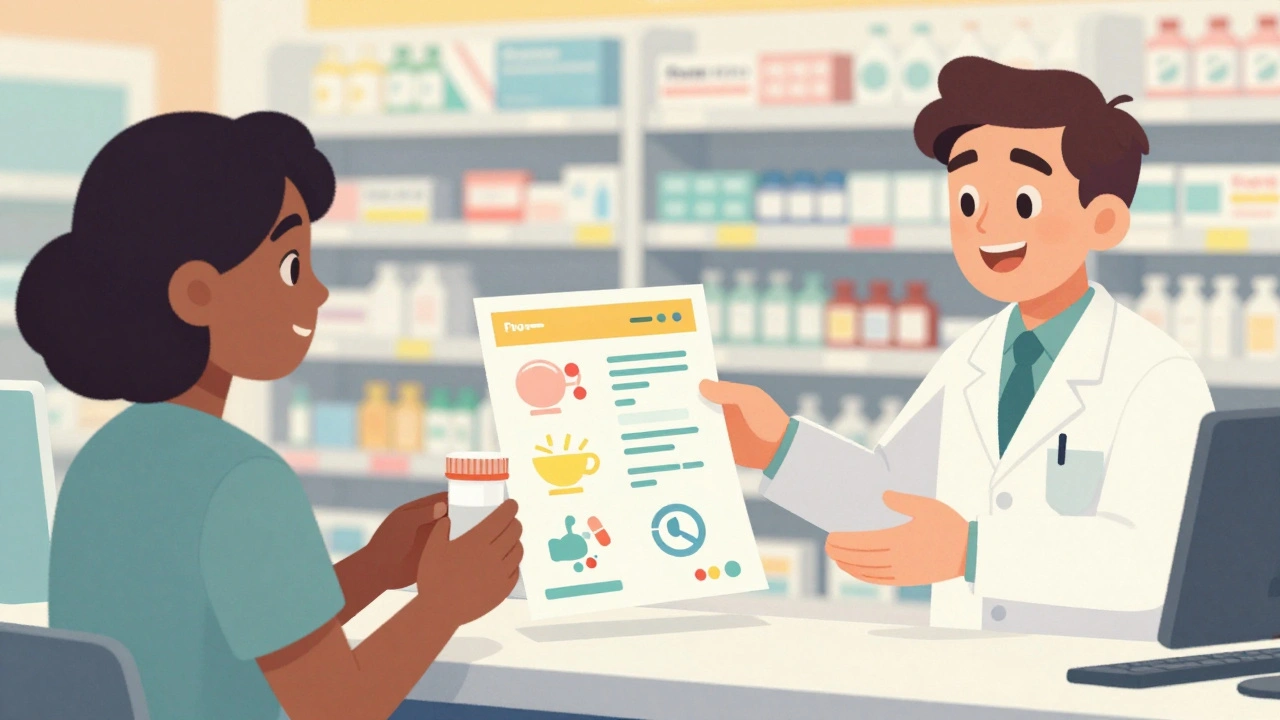
Getting your medication right shouldn’t feel like solving a puzzle. Yet too many people leave the pharmacy with a bottle and a sheet of fine-print text they can’t read-or worse, don’t trust because it doesn’t make sense. You’re not alone. In the U.S., 63% of medication errors happen because patients don’t understand their instructions. That’s not just a statistic. It’s your risk. And here’s the truth: you have the right to get instructions you can actually use.
You Don’t Have to Guess What the Label Means
Pharmacies aren’t required by federal law to give you clear, written instructions with your prescription. That’s not a rumor. It’s fact. A 2023 report from MyMedicationRights.org found no national rule forcing pharmacies to hand out easy-to-read guides. So if you get a two-page sheet full of words like "take on an empty stomach" or "avoid concurrent use with CYP3A4 inhibitors," you’re not being given bad service-you’re being left to figure it out yourself. But here’s the flip side: you have rights. The American Medical Association says you have the right to ask questions and get answers you understand. Tennessee Oncology, AmerisourceBergen, Vivo Health Pharmacy, and even the federal Office of Personnel Management all list this as a core patient right. You’re not asking for a favor. You’re claiming something you’re already entitled to.What Clear Instructions Look Like
Good medication instructions aren’t just shorter. They’re designed for real life. Think of them like a recipe your grandma would follow:- Instead of "Take one tablet by mouth twice daily," it says: "Take one pill in the morning and one at night."
- Instead of "Avoid grapefruit juice," it says: "Don’t drink grapefruit juice. It can make this medicine dangerous."
- Instead of a wall of text, it’s a one-page sheet with big fonts, bullet points, and maybe even pictures showing when to take the pill.
How to Ask-And How to Get What You Need
Asking for better instructions isn’t rude. It’s smart. And there’s a right way to do it. Research from the University of Illinois shows a five-step method works 89% of the time. Here’s how:- Ask to speak to the pharmacist, not the technician. Technicians fill prescriptions. Pharmacists explain them. At chain pharmacies, 73% of staff are required to pass complex requests up to the pharmacist.
- Use exact language from your rights. Say: "I’m exercising my right under the AmerisourceBergen Patient Rights document to receive education in a language I understand." Or: "I have the right under the AMA Code of Medical Ethics to receive information I can understand." People respond better when you name the rule.
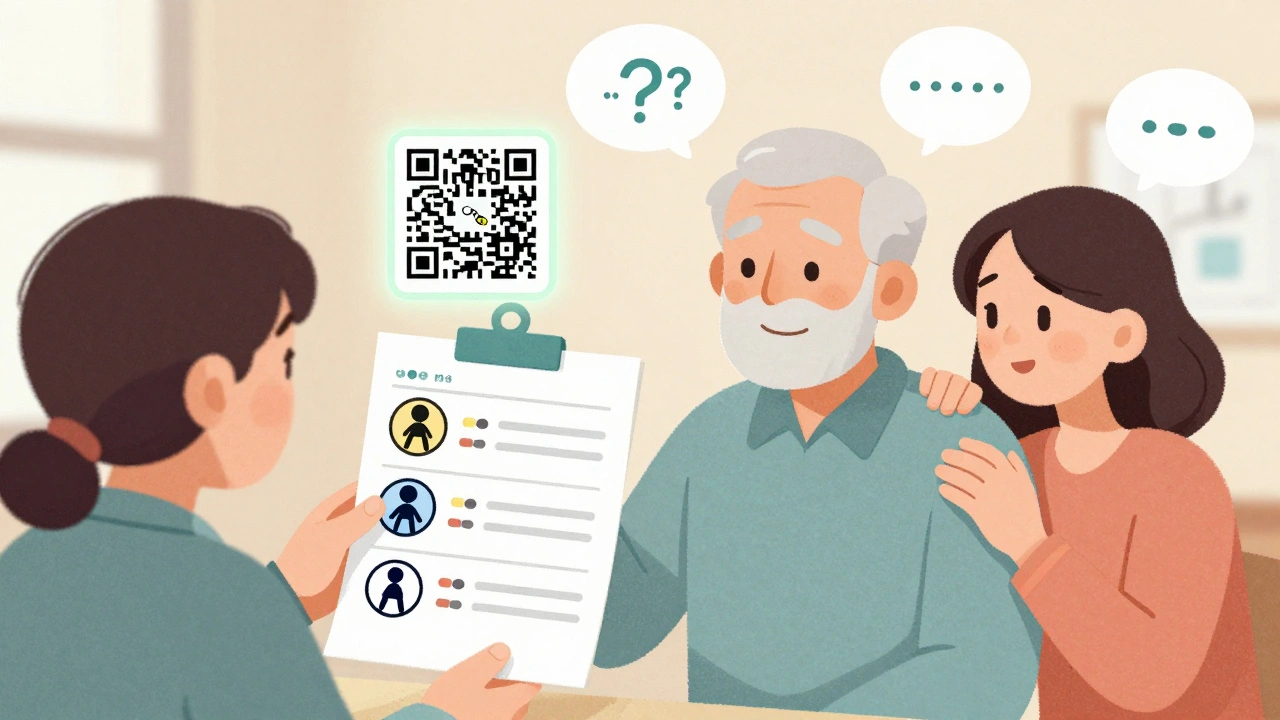
- Ask for a visual schedule. Say: "Can you make me a chart with pictures or times?" A 2023 study in the Annals of Internal Medicine found visual schedules improved adherence by 42% for people on multiple medications.
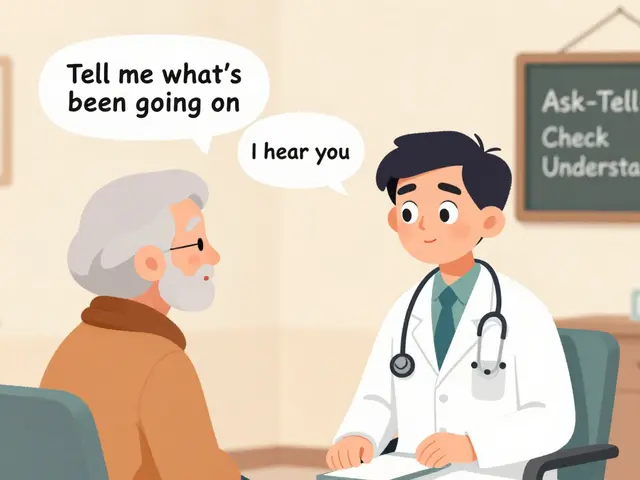
- Do a read-back. After they explain, say: "Let me repeat it back to make sure I got it." This simple step cuts errors by 63%, according to Johns Hopkins Medicine.
- Write it down. Say: "I’m writing this down for my medical records." Pharmacies are 58% more likely to give you written instructions when they know you’re documenting it.
Timing Matters
Don’t wait until your refill. The best time to ask is when you’re picking up a new prescription. Pharmacists have more time then. A 2022 study found 87% of pharmacists say they can spend extra minutes explaining new meds-but only 12% feel they have time during refills. Walk in early. Bring your list of meds. Ask before you leave.If You Don’t Speak English
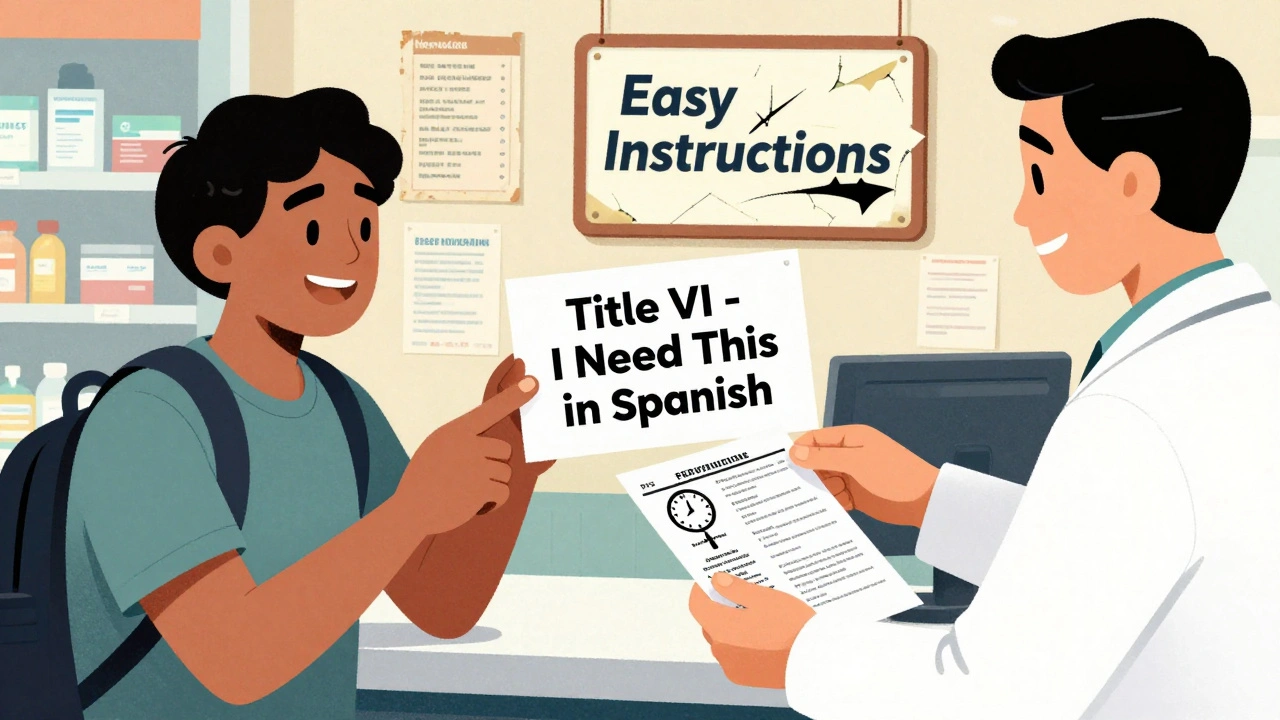
If English isn’t your first language, you have even stronger protections. Title VI of the Civil Rights Act of 1964 says healthcare providers must give you help in your language. That includes medication instructions. Say: "I need my medication instructions in [Spanish, Mandarin, Arabic, etc.] per federal law." A 2023 CMS report found 92% of pharmacies will provide translated materials when asked this way.What If They Say No?
Sometimes, you’ll get pushed back. Maybe they say, "We don’t do that." Or, "This is what we always give." Here’s what to do:- Stay calm. Say: "I understand this isn’t standard, but I need something I can use. Can you help me get it?"
- Ask for a printed copy of their patient rights policy. Most pharmacies have one posted or available.
- If they still refuse, ask to speak to the pharmacy manager. If that doesn’t work, call the pharmacy’s corporate customer service line. Chains like CVS and Walgreens have national hotlines that track complaints.
- Write down what happened: date, time, who you spoke to, what they said. This helps if you need to file a formal complaint later.
What’s Changing-and What’s Coming
Things are improving, slowly. In 2024, Walgreens started adding QR codes to prescriptions that link to video instructions in 20 languages. CVS rolled out a system called "Medi-Simplify" that creates pictogram-based guides. The FDA is working on new rules that could require all prescription labels to include plain language and simple icons by 2026. Congress is also considering the Patients’ Right to Know Their Medication Act (H.R. 1173), which would make clear, one-page instructions mandatory nationwide. But you don’t have to wait for laws to change. Right now, you have the power to get instructions you can understand. It’s not about being difficult. It’s about being safe.Real Stories, Real Results
One woman in Ohio asked her pharmacist for a picture chart for her diabetes meds. He made one on the spot with stick figures holding pills at breakfast, lunch, and bedtime. She said it was the first time she didn’t feel confused. A veteran in Texas cited his right under Tennessee Oncology’s Patient Bill of Rights. The pharmacist pulled out a laminated schedule with icons for each pill-morning, afternoon, night. He showed it to his wife. They both cried. These aren’t rare cases. They’re what happens when people stop accepting confusion as normal.Can I ask for medication instructions in a language other than English?
Yes. Under Title VI of the Civil Rights Act, pharmacies must provide language assistance for patients who don’t speak English. You can say: "I need my medication instructions in [language] per federal law." Most pharmacies will provide translated materials when asked this way. Some even offer phone interpreters if you need help speaking to the pharmacist.
What if my pharmacy won’t give me written instructions?
If your pharmacy refuses, ask to speak to the manager. If that doesn’t work, call the corporate customer service number for the pharmacy chain. Many have national hotlines that track complaints. Write down what happened-including the date, time, and who you spoke to. You can also file a complaint with your state pharmacy board. Most states have a public website where you can submit concerns about pharmacy practices.
Are there apps or tools that can help me understand my meds?
Yes. Apps like Medisafe, MyTherapy, and MyMeds let you input your prescriptions and send you reminders with simple explanations. Some pharmacies now offer scannable QR codes on labels that link to video instructions in plain language. Companies like Meds 2.0 create personalized, FDA-cleared guides that pharmacies can print on request. Ask your pharmacist if they use any of these tools.
Why do some pharmacies give good instructions and others don’t?
Large chains like CVS and Walgreens have standardized systems and more funding to update their processes. Independent pharmacies often lack the staff, time, or money to create custom materials. Some still use old templates from 20 years ago. That’s why asking matters-you help push them to improve. Also, pharmacies near hospitals or in areas with high patient needs are more likely to have better systems because they’ve seen the consequences of poor communication.
Can I get my instructions in a larger font or easier format?
Absolutely. You can ask for a large-print version, a simplified one-page summary, or even a picture chart. There’s no rule saying you have to accept small, dense text. If you have vision issues, learning disabilities, or just find medical jargon confusing, say so. Pharmacists are trained to adapt. Many will rewrite instructions on the spot if you explain what you need.
How do I know if my instructions are good enough?
Ask yourself: Can I explain this to someone else without guessing? Can I tell exactly when to take each pill? Do I know what to avoid (like alcohol or other meds)? If you’re unsure about any part, the instructions aren’t good enough. A simple test: if you had to give these instructions to your parent or child, would they understand them? If not, ask for help.
Is it okay to take a picture of my medication label or instructions?
Yes. Taking a photo of your label and instructions is a smart way to keep track. You can use it to show family members, share with a new doctor, or review before you take your pill. Just make sure you don’t share photos with personal info (like your name or address) on public platforms. For personal use, it’s perfectly safe and encouraged.
What to Do Next
Start today. The next time you pick up a prescription, don’t just take the paper and go. Stop. Ask. Say: "Can you help me make sure I understand this?" Then use one of the steps above. You don’t need to be loud or angry. You just need to be clear. Your health depends on you knowing what to do with your medicine. That’s not too much to ask. It’s your right.12 Comments

Aidan Stacey
December 11 2025
OH MY GOD. I cried reading this. My mom died because she didn’t understand her blood thinner instructions. They gave her a pamphlet written like a legal contract. She thought ‘twice daily’ meant morning and afternoon-not 12 hours apart. She took three pills in one day. This isn’t just about clarity-it’s about survival. Thank you for writing this like your life depends on it. Because it does.

Jean Claude de La Ronde
December 12 2025
So let me get this straight-we live in a country where you need to be a lawyer to read your own prescription, but we’re surprised people mess up? Wow. And I thought Canada’s ‘6th-grade reading level’ rule was overkill. Turns out, the US just thinks confusion is a feature, not a bug. Next up: mandatory cryptic instructions on toothpaste tubes. ‘Use sparingly. Avoid oral flora.’

Courtney Blake
December 13 2025
Ugh. Another ‘you have rights’ article. Newsflash: rights don’t mean shit if you’re not loud enough. My aunt asked for a picture chart and got told ‘we don’t do that.’ She didn’t escalate. She just stopped taking her meds. Now she’s in the hospital. This isn’t about being polite. It’s about being a damn advocate. Stop asking. Start demanding.
Also, why are we still talking about CVS? They’re the same as every other chain. The only difference is their marketing budget.

Doris Lee
December 14 2025
Yes yes yes. I’ve been telling my friends this for years. Just say ‘I need this in plain language’ and they usually give it. I asked for a picture chart for my thyroid meds last month and the pharmacist drew stick figures with clocks. I framed it. It’s on my fridge now. Small wins, folks. They matter.

Frank Nouwens
December 14 2025
While the sentiment is commendable and the actionable steps are well-structured, one must acknowledge the systemic constraints under which community pharmacists operate. Staffing shortages, time pressures, and lack of institutional support render even well-intentioned practices difficult to implement consistently. The onus should not rest solely on the patient to navigate bureaucratic inertia.

Kaitlynn nail
December 15 2025
So… you’re telling me I have to *ask* for stuff I paid for? Wild. I thought the pill bottle was supposed to come with a decoder ring. Next thing you know, they’ll charge extra for ‘not dying from confusion.’

Aileen Ferris
December 17 2025
Wait so the US is the only country that doesn’t do this? LOL. I thought we were the land of innovation. Turns out we’re just really good at making people feel dumb. Meanwhile, my cousin in Dublin gets her meds with a little cartoon of a cat taking a pill. I’m jealous.

Michelle Edwards
December 17 2025
You don’t have to be loud to be heard. Just be consistent. I’ve been asking for simple instructions since my diagnosis. Now my pharmacist keeps a stack of picture charts behind the counter. I didn’t change the system. I just kept showing up. You can too.

Sarah Clifford
December 17 2025
OMG I JUST ASKED FOR A CHART AND THE PHARMACIST LAUGHED. THEN GAVE ME A STICKER. I WAS SO MAD I CRIED. WHY IS THIS SO HARD??

Ben Greening
December 17 2025
The empirical evidence presented regarding adherence improvement via visual aids is statistically significant and warrants broader institutional adoption. However, the absence of federal mandates remains a structural deficiency in the U.S. healthcare delivery model. Policy intervention, not patient advocacy alone, is required to effect scalable change.

Queenie Chan
December 18 2025
I love how this post reads like a love letter to the quiet revolution happening in pharmacies-where one person, armed with a clipboard and a stubborn voice, turns a wall of jargon into a lifeline. It’s not about grand laws. It’s about the pharmacist who scribbles ‘take with food’ on a napkin because you looked confused. That’s the real magic. That’s the stuff that saves lives. And it’s already happening. You just have to ask for it.
Write a comment
Popular Posts

Taylor Dressler
December 11 2025
Just wanted to say this is one of the most practical, well-researched guides I’ve seen on medication literacy. The five-step method is gold-especially the read-back trick. I’ve used it with my dad after his heart surgery, and it literally prevented a dosage error. Pharmacies aren’t trained to teach, but you don’t need them to be. You just need to ask like you mean it.