You walk out of the pharmacy with a prescription that costs $12 instead of $187. Sounds great, right? But then your doctor calls back, worried because you switched from the brand-name version to a generic substitute without telling them. This friction is the daily reality of Preferred Generic Lists. These lists are not just random choices; they are strategic tools used by insurers to control costs while trying to maintain health outcomes.
If you have ever wondered why your insurance covers one blood pressure pill but charges you double for another that looks identical on the label, this article explains the mechanics behind it. We will break down how formularies work, who decides what gets on the list, and how you can navigate these tiers to save money without compromising your care.
The Mechanics of Tiered Formularies
At its core, an insurance formulary is a categorized list of approved drugs. Think of it as a menu where some items are marked "Chef's Recommendation" (Tier 1) and others are "Premium Add-Ons" (Tier 3 or 4). The goal is simple: steer patients toward medications that offer the best value. According to data from the Kaiser Family Foundation in 2023, nearly all major insurers use these tiered structures. In fact, 98% of commercial plans and 100% of Medicare Part D plans implement preferred generic lists as their most cost-effective option.
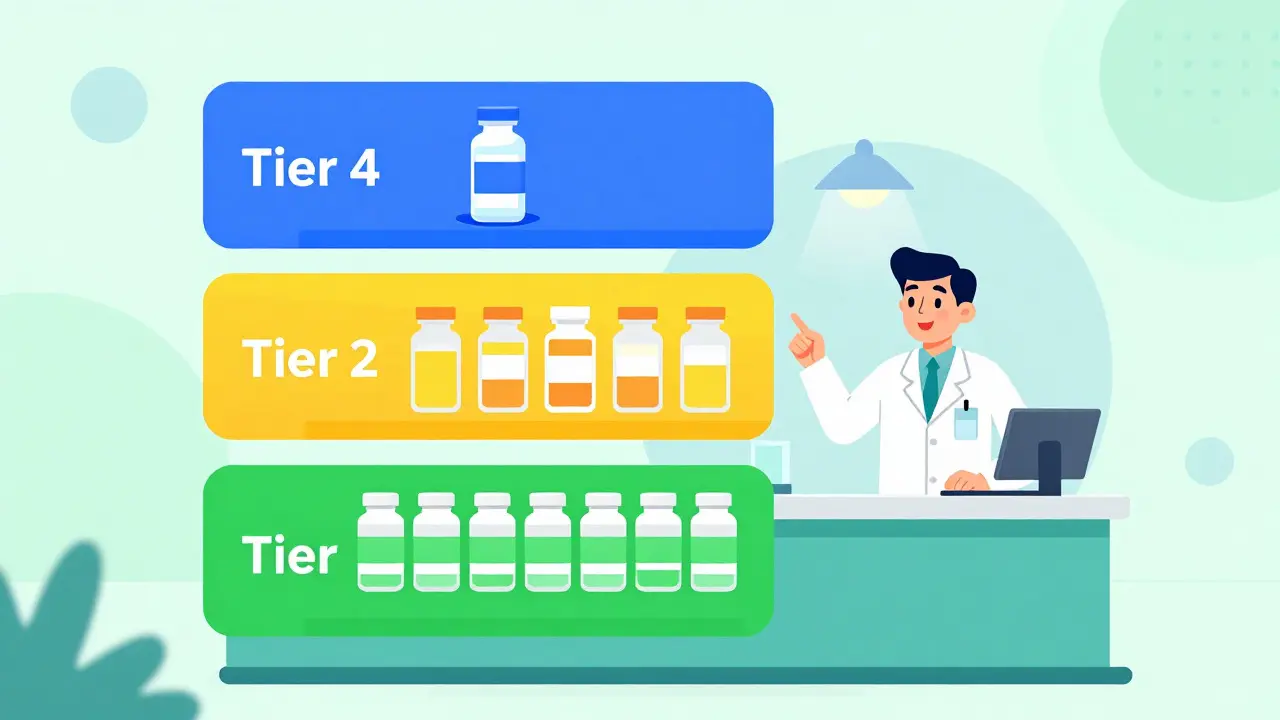
Here is how the typical four-tier structure breaks down:
- Tier 1 (Preferred Generics): These are the cheapest options. You might pay a flat copay of $5 to $15 for a 30-day supply. Humana’s 2024 documentation confirms these low-cost brackets are standard for basic generics.
- Tier 2 (Non-Preferred Generics & Preferred Brands): Costs jump here, often ranging from $25 to $50 per month. This tier includes generics that didn't win the insurer's price negotiation or older brand-name drugs.
- Tier 3 (Non-Preferred Brands): Expect to pay $50 to $100. These are branded drugs that have cheaper alternatives available but aren't the insurer's top pick.
- Tier 4 (Specialty Drugs): Often biologics or complex treatments. Costs can exceed $100 per fill or require coinsurance (a percentage of the total price).
Why does this matter to you? Because when generics and brands share the same tier-which happens in about 48% of products-the out-of-pocket difference can be surprisingly small. A 2021 Health Care Cost Institute analysis found that in such cases, the mean list price was $349 for the brand versus $197 for the generic, but flat copays meant the patient only paid $3 more for the brand ($26 vs $23). However, if your plan uses coinsurance instead of flat copays, that gap widens dramatically. Beneficiaries paying coinsurance faced average savings of $194 per prescription by choosing generics over brands, according to a 2022 PMC study.
Who Decides What Makes the List?
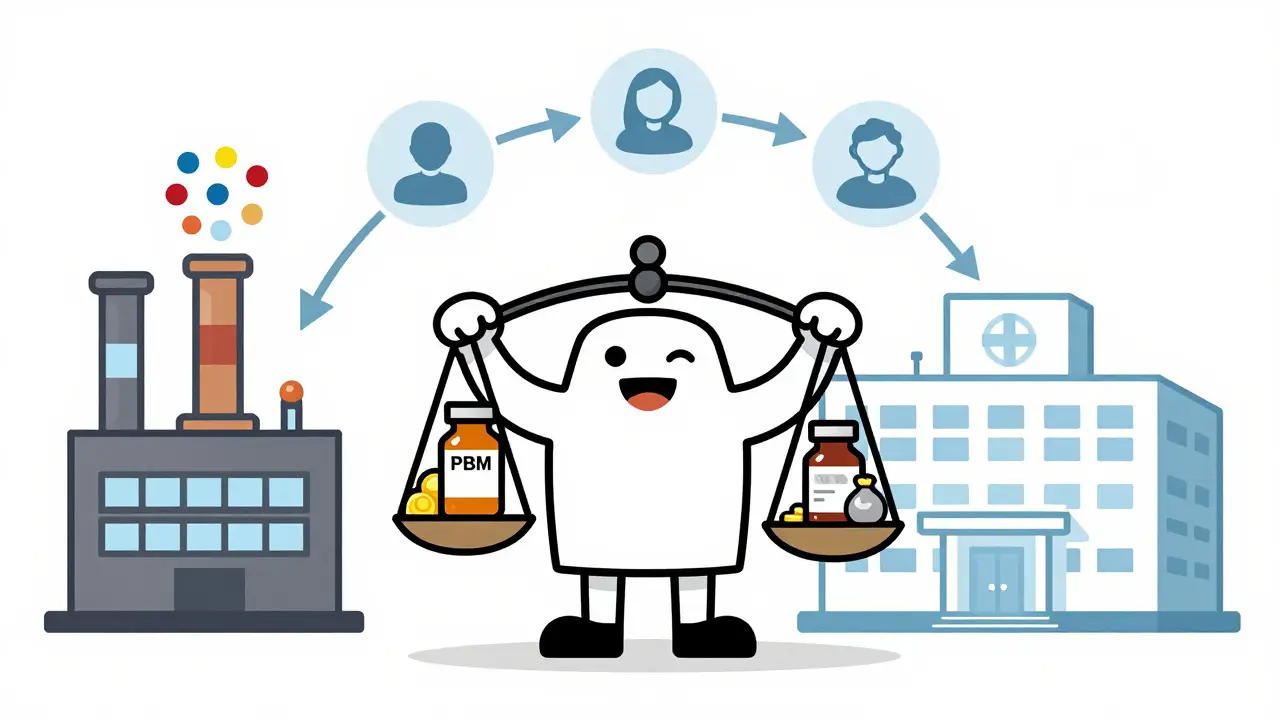
You might think your doctor picks your medication based solely on science. While medical necessity is crucial, the final decision on which drug gets the "preferred" status involves Pharmacy Benefit Managers (PBMs). PBMs like CVS Caremark, Express Scripts, and OptumRx act as middlemen between insurers, pharmacies, and drug manufacturers. They negotiate rebates-discounts given by manufacturers in exchange for favorable placement on the formulary.
This process creates a complex web of incentives. The FDA reports that generic drugs typically cost 80-85% less than brand-name counterparts. When multiple generic competitors enter the market, prices can drop by up to 95%. PBMs leverage this competition. By placing a specific generic manufacturer's product on Tier 1, they secure better pricing for the insurer. If you switch to that specific generic, the insurer saves money, and often, so do you.
| Tier Level | Drug Type | Typical Copay/Cost | Insurer Strategy |
|---|---|---|---|
| Tier 1 | Preferred Generics | $5 - $15 | Maximize volume, lowest net cost after rebates |
| Tier 2 | Non-Preferred Generics / Preferred Brands | $25 - $50 | Balanced access and cost control |
| Tier 3 | Non-Preferred Brands | $50 - $100 | Discourage use unless medically necessary |
| Tier 4 | Specialty/Biologics | >$100 or Coinsurance | Manage high-cost outliers, strict prior authorization |
The Biosimilar Bottleneck
While traditional generics have smooth sailing, newer biological drugs face a different challenge. Biosimilars are highly similar versions of biologic drugs, but they are not exact copies due to the complexity of manufacturing living cells. Despite being clinically equivalent, biosimilar adoption lags significantly in the US compared to Europe. In 2023, only 15% of eligible biologic prescriptions switched to biosimilars in the US, whereas Europe saw rates around 85%.
Why the resistance? It often comes down to co-pay assistance programs. Brand-name biologic manufacturers frequently offer coupons or assistance cards that reduce out-of-pocket costs for patients. Biosimilar manufacturers, competing on lower list prices, often lack these deep-pocketed marketing budgets. As a result, a patient might see a lower list price for the biosimilar but end up paying more out-of-pocket because they lose the manufacturer's discount. Scott Glovsky, an insurance specialist, noted in 2023 that 78% of brand-name biologic manufacturers offer co-pay assistance that biosimilars simply don't match, creating a perverse incentive where the "cheaper" drug feels more expensive to the user.
Patient Frustrations and Real-World Impact
It is not just about numbers; it is about trust. Many patients feel caught between their doctor's advice and their insurer's wallet. On Reddit, users have shared stories like reducing monthly costs from $187 to $12 for levothyroxine by switching to a preferred generic. That is a massive win. But others report frustration when they try to stick with a brand-name drug they know works well for them.
A GoodRx survey of 15,000 patients found that while 76% appreciated the lower costs of preferred generics, 63% hit a wall when their doctor requested a brand-name exception. This leads to "prior authorization" hurdles, where the insurer demands proof that the cheaper option failed before approving the expensive one. For chronic pain management, 42% of physicians reported treatment delays due to these step-therapy protocols, according to the American Medical Association.
There is also a knowledge gap. Medicare’s 2023 Beneficiary Survey revealed that 58% of enrollees couldn't identify their plan's formulary tier structure. This confusion contributes to unexpected bills. If you don't know your plan favors Manufacturer A's generic statin over Manufacturer B's, you might be surprised at the register.
How to Navigate Your Formulary Effectively
You don't have to be a pharmacist to manage this, but a little proactive effort pays off. Here are concrete steps to take control of your medication costs:
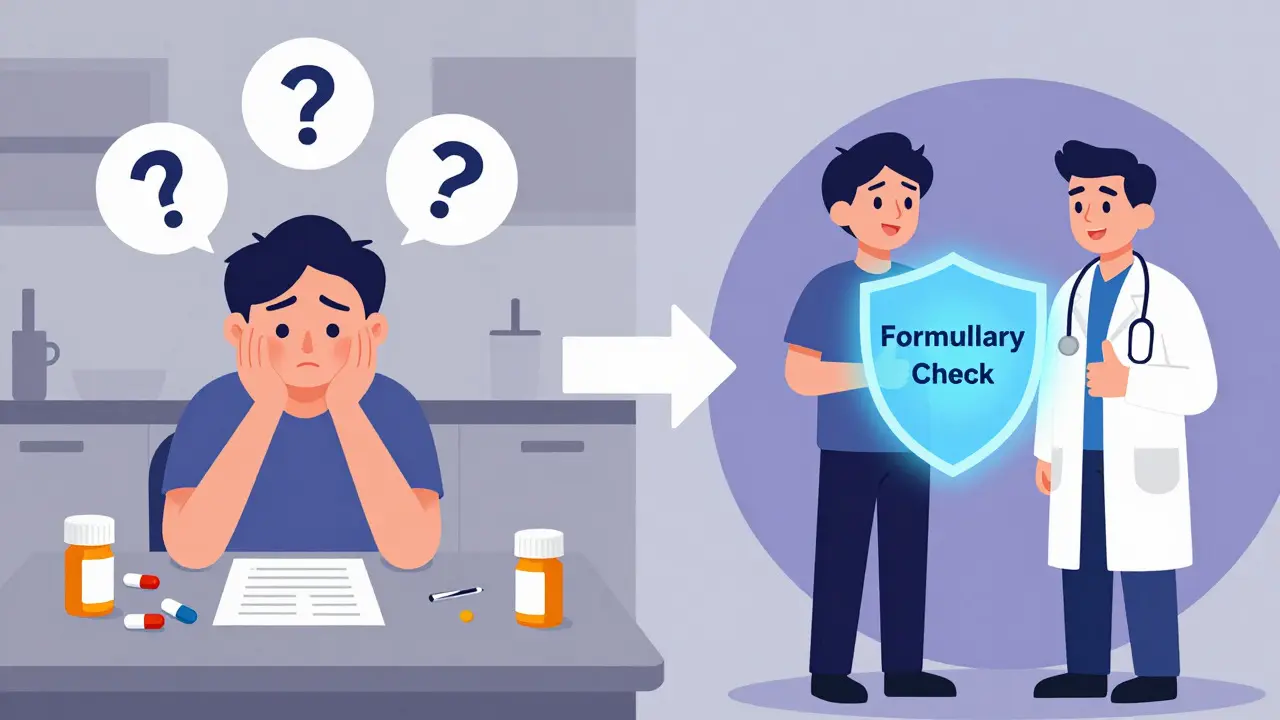
- Check Before You Fill: Use your insurer’s online tool or call customer service to verify the tier status of your prescription before going to the pharmacy. Medicare’s Plan Finder tool scores high for usability (4.2/5), while commercial plans lag behind (2.8/5), so you may need to dig deeper.
- Ask About Alternatives: If your prescribed drug is in Tier 3 or 4, ask your doctor: "Is there a preferred generic in Tier 1 that would work for me?" Pharmacists can also suggest therapeutically equivalent options within the same class.
- Understand 'Dispense as Written': In 89% of states, pharmacists can automatically substitute a generic unless your doctor marks the prescription "dispense as written." If you have a strong preference for a brand name (perhaps due to past side effects), make sure your doctor notes this explicitly.
- Appeal Wisely: If you are denied coverage for a non-preferred drug, don't give up. Appeals succeed in 68% of cases. Success usually requires detailed physician documentation explaining why the preferred generic is unsuitable for your specific medical history.
The Future of Preferred Lists
The landscape is shifting. The Inflation Reduction Act mandates a $2,000 annual out-of-pocket cap for Medicare Part D starting in 2025, which is projected to increase generic utilization by 7-12 percentage points. Additionally, CMS is pushing for greater transparency, requiring plans to publicly disclose tier placement criteria by mid-2024.
We are also seeing the rise of "Value-Based Formularies," where tier placement depends on real-world effectiveness data rather than just price. UnitedHealthcare launched such a program for diabetes medications in early 2024. Furthermore, new rules aim to place biosimilars in the same tier as reference biologics, which could boost biosimilar usage from 15% to 45% by 2025. However, watch out for "accumulator adjusters," where insurers exclude manufacturer co-pay assistance from counting toward your deductible, potentially neutralizing those savings.
Are generic drugs less effective than brand-name drugs?
No. The FDA requires generic drugs to demonstrate bioequivalence within 80-125% of the brand-name product's pharmacokinetic profile. Research shows therapeutic equivalence in 98.5% of generic approvals. Most differences are negligible for the vast majority of patients.
Why does my insurance prefer one generic over another?
Insurers and PBMs negotiate rebates with manufacturers. Placing a specific manufacturer's generic on Tier 1 ensures higher volume sales for that company in exchange for a lower price. This helps keep overall healthcare costs down.
What is a biosimilar and why is it hard to get?
A biosimilar is a highly similar version of a biologic drug. Adoption is difficult because brand-name manufacturers often provide co-pay assistance cards that biosimilar makers lack, making the out-of-pocket cost for the biosimilar sometimes higher despite a lower list price.
Can I force my insurer to cover a brand-name drug?
You can request an exception through a prior authorization or appeal process. If your doctor documents that the preferred generic caused adverse effects or was ineffective, appeals succeed in approximately 68% of cases.
Do preferred generic lists change?
Yes, formularies are updated regularly, often annually during open enrollment. New generics entering the market or changes in rebate agreements can shift drugs between tiers. Always check your plan's current formulary before assuming a drug's cost.