
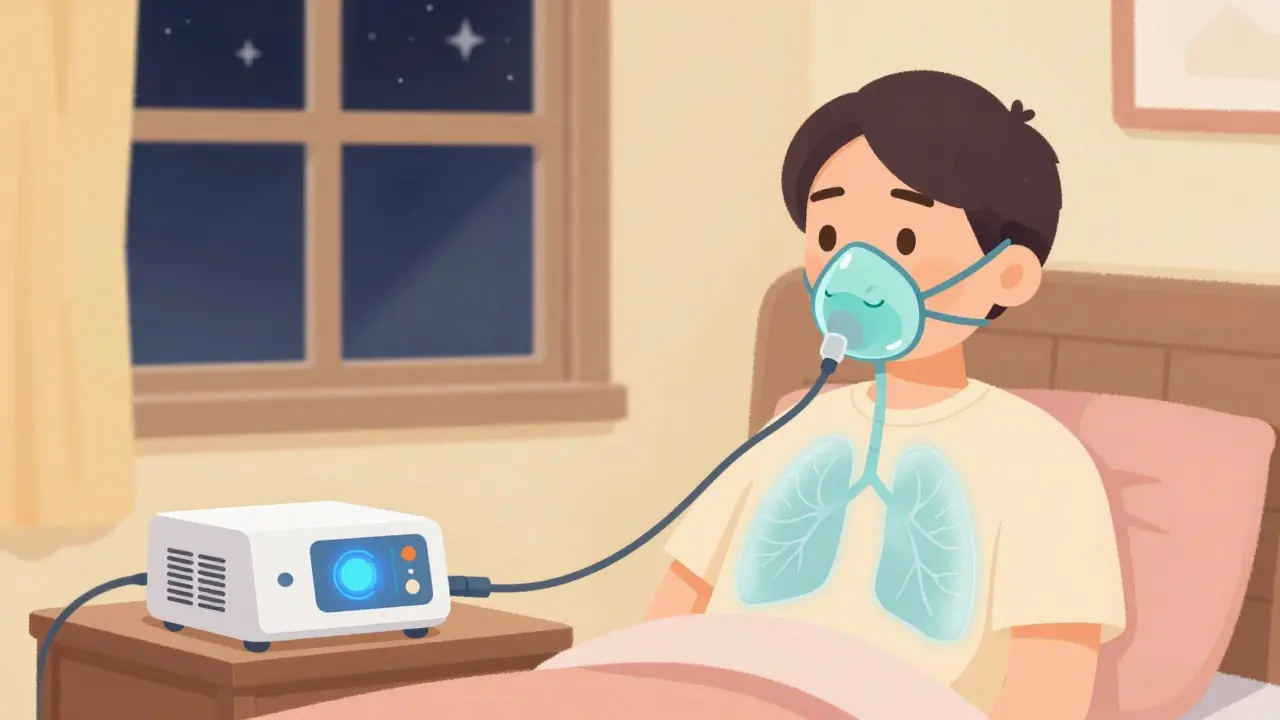
When someone is diagnosed with ALS, the focus quickly shifts from treatment to survival. It’s not about curing the disease-it’s about keeping the person comfortable, breathing, and eating for as long as possible. Two interventions stand out above all others: noninvasive ventilation (NIV) and proper nutrition. These aren’t optional extras. They’re the difference between months and years.
Why Noninvasive Ventilation Matters More Than You Think
ALS doesn’t just steal your ability to walk or speak. It slowly paralyzes the muscles that let you breathe. By the time you feel out of breath climbing stairs, your lungs are already struggling. That’s when NIV steps in. It’s not a ventilator hooked to your throat. It’s a mask-nasal or full-face-that delivers air pressure to help your lungs inflate. Think of it like a helper that takes over when your diaphragm gives out.
Studies show NIV adds about 7 months to life on average. In one study, people who used NIV lived 453 days. Those who didn’t? Only 215 days. That’s more than a year of life. And it’s not just about living longer. People report fewer morning headaches, better sleep, and more energy during the day. One ALS forum user wrote, “After four weeks of using NIV, I felt like I could breathe again.” That’s not a miracle-it’s science.
Doctors don’t wait until you’re gasping for air. The European and Canadian guidelines say to start NIV when your forced vital capacity (FVC) drops below 80% of normal, or when you have symptoms like daytime sleepiness, morning headaches, or trouble lying flat. These are early warning signs. Waiting until you’re in respiratory distress means you’ve already lost ground.
Some U.S. insurance companies still require FVC under 50% before approving NIV. That’s outdated. Research from 2013 showed that even people with bulbar weakness-where speech and swallowing are affected-benefit just as much from NIV. The mask doesn’t care if you can talk. It only cares if you can breathe.
How NIV Works: Settings, Devices, and Real-World Use
Most people start with a BiPAP machine. It gives two levels of pressure: higher when you inhale, lower when you exhale. Initial settings? Usually IPAP at 12-14 cm H₂O, EPAP at 4-6 cm H₂O, with a backup rate of 12 breaths per minute. These aren’t set in stone. They’re adjusted based on blood tests and how you feel.
Adherence is the biggest hurdle. In the first 30 days, many users only wear the mask 5-10 hours a week. Skin irritation, dry mouth, and the feeling of fighting the air pressure turn people off. But here’s the truth: most people who stick with it for a year end up wearing it 27-30 days a month. The discomfort fades. The benefits don’t.
For those whose breathing worsens during the day, portable ventilators like the Philips Trilogy 100 or 106 become essential. These aren’t just nighttime machines. They’re lightweight (under 12 pounds), run on batteries for 8-12 hours, and can switch to volume control mode if your lungs get too weak. They cost $6,000-$10,000-more than a BiPAP-but for people who need daytime support, they’re life-changing. One user said, “I took my Trilogy to the grocery store. I didn’t have to stop halfway just to catch my breath.”
Device data tells the real story. If you use NIV for more than 4 hours a day, your survival improves. Period. No guesswork. The machine logs it. Your doctor checks it. And if you’re not hitting that mark? That’s not a failure-it’s a signal. Maybe the mask doesn’t fit. Maybe the pressure is too high. There are solutions.

Nutrition Isn’t Just About Eating-It’s About Survival
Weight loss in ALS isn’t normal. It’s dangerous. Losing 10% of your body weight in six months cuts survival time in half. Why? Your body uses energy to keep breathing. If you’re not eating enough, your body starts burning muscle-including the muscles that help you breathe.
The solution isn’t forcing more meals. It’s a PEG tube. Percutaneous endoscopic gastrostomy. That’s a fancy way of saying a feeding tube placed directly into your stomach through a small incision in your belly. It’s not for people who can’t swallow. It’s for people who are losing weight despite trying to eat.
Studies show PEG stabilizes weight. One study found that without PEG, ALS patients lost an average of 12.6% of their body weight in six months. With PEG? Just 0.5%. That’s not a small difference. That’s the difference between being too weak to sit up and being able to laugh with your family.
Timing is everything. The best time to get a PEG is before your FVC drops below 50% or your BMI falls under 18.5. Why? Because once your breathing gets too weak, the procedure becomes riskier. If you wait until you’re already losing weight, you’re already behind.
People worry about the tube. They think it’s a sign of giving up. But it’s not. It’s a tool. Like NIV. Like a wheelchair. It doesn’t change who you are. It helps you keep living the way you want to.
Putting It All Together: The Power of Combined Care
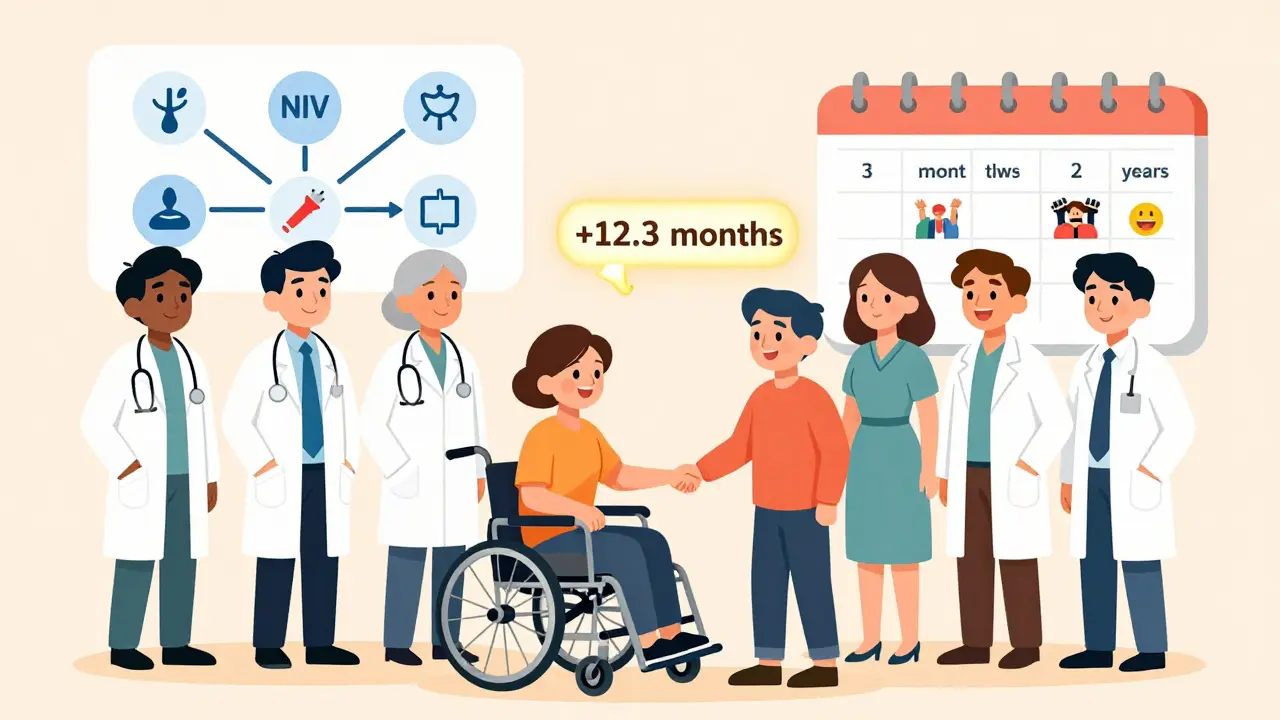
NIV and PEG don’t work in isolation. Together, they’re a force. A 2021 analysis of ALS registries across multiple countries found that patients who got both interventions lived 12.3 months longer than those who got neither. That’s over a year. That’s birthdays. That’s holidays. That’s time with grandchildren.
That’s why multidisciplinary ALS clinics-teams with neurologists, respiratory therapists, dietitians, and social workers-have such better outcomes. One study showed a 7.5-month survival advantage over standard care. Why? Because they don’t wait. They monitor. They act.
Here’s what that looks like in practice:
- At your 3-month check-up, your FVC is 75%. Your doctor says, “Let’s talk about NIV.”
- At 6 months, your weight drops 5%. Your dietitian says, “Let’s get the PEG done before it gets worse.”
- By 8 months, you’re using your BiPAP every night and getting nutrition through the tube. You’re not just surviving. You’re still talking. Still watching movies. Still holding your partner’s hand.
What Stops People? And How to Overcome It
Not everyone uses NIV or gets a PEG. Why? Three big reasons:
- Mask discomfort. Skin breakdown, pressure sores, dry mouth. Solution: Try different mask types (nasal pillows, full-face, hybrid). Use humidifiers. Ask for a silicone cushion. Most clinics have trial kits.
- “I can still eat.” Waiting too long to get the PEG. Solution: Don’t wait until you’re choking. Get it done before you’re in crisis.
- “It’s too expensive.” NIV devices cost money. PEG is surgery. But most insurance covers them. And if you’re in the U.S., ask about Medicare Part B or Medicaid waivers. Nonprofits like the ALS Association help with equipment loans.
The biggest barrier? Fear. Fear of losing independence. Fear of what it looks like. But people who use NIV and PEG don’t feel like burdens. They feel like themselves-just with better support.
What’s Next? Research and Real-World Gaps
There’s still work to do. Right now, we don’t have a perfect way to predict who will stick with NIV. We don’t know the exact point when every patient should start. Some trials are testing AI models that use breathing patterns, weight trends, and sleep data to recommend timing. Others are testing CO₂ monitors that alert you before you’re in trouble.
But here’s what we know for sure: if you have ALS and you’re not using NIV when your breathing declines, you’re missing out on months of life. If you’re losing weight and haven’t considered a PEG, you’re risking your ability to stay strong, alert, and present.
These aren’t end-of-life decisions. They’re life-extension tools. Simple. Proven. Effective.
When should I start noninvasive ventilation (NIV) for ALS?
Start NIV when your forced vital capacity (FVC) drops below 80% of normal, or if you have symptoms like morning headaches, daytime sleepiness, or trouble breathing while lying down. Waiting until you’re gasping for air means you’ve already lost valuable time. Early use adds months to your life and improves sleep and energy.
Does NIV work if I have trouble speaking or swallowing?
Yes. Past concerns about bulbar weakness delaying NIV use have been disproven. Studies show people with speech and swallowing issues get the same survival benefit as those without. NIV supports breathing-it doesn’t depend on your ability to talk or eat.
Is a PEG tube only for people who can’t swallow?
No. A PEG tube is for anyone losing weight despite eating. Weight loss in ALS is dangerous-it weakens breathing muscles. The goal isn’t to replace eating but to prevent weight loss before it becomes severe. Getting a PEG before FVC drops below 50% or BMI falls under 18.5 gives you the best chance to stay strong.
How long does NIV extend life in ALS?
On average, NIV adds about 7 months to survival. Some studies show median survival increases from 215 days without NIV to 453 days with it. The key is using it at least 4 hours per day. Consistency matters more than the device type.
What’s the difference between BiPAP and Trilogy ventilators for ALS?
BiPAP machines are typically used for nighttime breathing support and cost $1,200-$2,500. Trilogy ventilators are more advanced-they support daytime use, have battery power, volume control, and oximetry. They cost $6,000-$10,000 but offer mobility and better pressure management as ALS progresses. Many users report higher comfort and satisfaction with Trilogy devices.
9 Comments

Lisandra Lautert
February 24 2026
Start NIV at FVC <80%. Not 50%. Not when you’re gasping. At 80%. That’s the guideline. Period.

Cory L
February 25 2026
I’ve been watching my uncle go through this, and honestly? The moment he got that BiPAP, he started laughing again. Not because he was cured-but because he could breathe without feeling like he was drowning. And the PEG? He was scared at first, but now he eats pizza with his grandkids again. Not through his mouth. But he’s there. That’s the win. These aren’t death machines. They’re life machines.
And yeah, the mask sucks at first. But so does climbing stairs with a brick tied to your chest. You adapt. You fight. And if you don’t? You’re not giving up on treatment-you’re giving up on yourself.

Southern Indiana Paleontology Institute
February 26 2026
Y’all in the US are obsessed with these gadgets. Back in my day, people just ate good food, worked hard, and didn’t whine about breathing. Now we got machines for everything. You think a mask is gonna save you? Nah. You need grit. Real grit. Not some $8,000 contraption that makes you look like a sci-fi robot.
And PEG? That’s just the government’s way of making you a feeding tube zombie. You ain’t supposed to live forever. You’re supposed to live with honor. Let nature take its course. Stop spending taxpayer money on this.

Anil bhardwaj
February 27 2026
My cousin in India has ALS. He’s got a fan blowing air at his face and eats rice with his hands. No mask. No tube. Just family. He’s still smiling. Maybe we’re overcomplicating this? Not everyone needs a machine to live with dignity.

lela izzani
February 28 2026
One thing I’ve learned from working with ALS families: the biggest predictor of adherence to NIV isn’t cost or comfort-it’s how early the conversation happens. If the neurologist brings it up at diagnosis, not when the patient’s FVC is at 40%, the chances of acceptance skyrocket.
And it’s not just about the device. It’s about the team. The respiratory therapist who shows up at 8 PM to adjust the mask. The social worker who finds a loaner Trilogy. The dietitian who makes pureed meals that taste like home. That’s the real intervention. Not the machine. The people behind it.

Joanna Reyes
February 28 2026
I’ve read every study, talked to every specialist, and sat through every support group meeting on this topic-and here’s what I’ve realized: the data doesn’t lie, but the narrative does. We talk about NIV and PEG like they’re two separate interventions, but they’re not. They’re part of a single, systemic shift in care-one that moves from reactive to proactive. And that shift is what saves lives.
When you wait until someone’s FVC is below 50%, you’re already in damage control. But if you start the conversation at 80%, you’re not just extending life-you’re preserving agency. The person still chooses when to use the mask. Still chooses when to eat. Still chooses who’s in the room. The tools don’t take away autonomy-they protect it. And that’s why, when families finally understand that, they don’t see a tube or a mask. They see their loved one-still there, still here, still breathing on their own terms.

Stephen Archbold
March 2 2026
Just wanted to say thanks for this post. My brother started NIV last year and honestly? It’s been the best thing since his diagnosis. The first week was rough-mask sores, dry mouth, felt like a space alien-but by week three? He slept through the night for the first time in months.
And yeah, the PEG was scary. But now he’s got his favorite curry again. No choking. No stress. Just food. Just joy.
Don’t let fear stop you. Talk to your team. Ask for trial masks. Ask for help. You’re not alone.

Nerina Devi
March 3 2026
In India, we don’t have access to these machines. But we have something else-community. My neighbor with ALS doesn’t have a BiPAP, but his sons take turns holding his chest when he breathes. His daughter blends his food into smoothies and feeds him by hand. No tube. No mask. Just love. Maybe the real miracle isn’t the device. Maybe it’s refusing to let someone die alone.


Joseph Cantu
February 23 2026
They say NIV adds months, but who’s really benefiting? I’ve seen families drained dry paying for machines that just sit there collecting dust while insurance companies laugh. This isn’t healthcare-it’s a profit loop disguised as compassion. They push the mask like it’s a miracle, but what about the people who can’t afford the humidifier, the replacement cushions, the nightly maintenance? They don’t talk about that. They just want you to feel grateful for the crumbs.
And don’t get me started on PEG tubes. ‘It’s just a tool,’ they say. Yeah, right. Like a wheelchair is just a tool. It’s a marker. A symbol that you’re no longer ‘you’ in their eyes. The system doesn’t want you to live-it wants you to be managed. Efficient. Contained. Don’t be fooled by the science. This is control dressed in white coats.