
TCA Therapeutic Drug Monitoring Calculator
Therapeutic Drug Monitoring Calculator
Enter your TCA blood level to determine if it falls within the safe therapeutic range. This tool helps understand potential toxicity risk based on current medical guidelines.
Note: This tool provides general information only. Actual therapeutic ranges can vary between labs and patients. Always consult your healthcare provider for clinical decisions.
Tricyclic antidepressants (TCAs) like amitriptyline and nortriptyline aren’t just old drugs-they’re dangerous if not handled carefully. Even a small overdose can kill. A single extra pill can send someone into cardiac arrest. That’s why therapeutic drug monitoring isn’t optional for these medications. It’s the difference between safe treatment and a trip to the ICU.
Why TCAs Are So Risky
TCAs work by boosting serotonin and norepinephrine in the brain. But they don’t stop there. They also block receptors in the heart, gut, and nervous system. That’s why side effects like dry mouth, constipation, and dizziness are common. But in higher doses-or even at normal doses in sensitive people-this same mechanism becomes deadly.
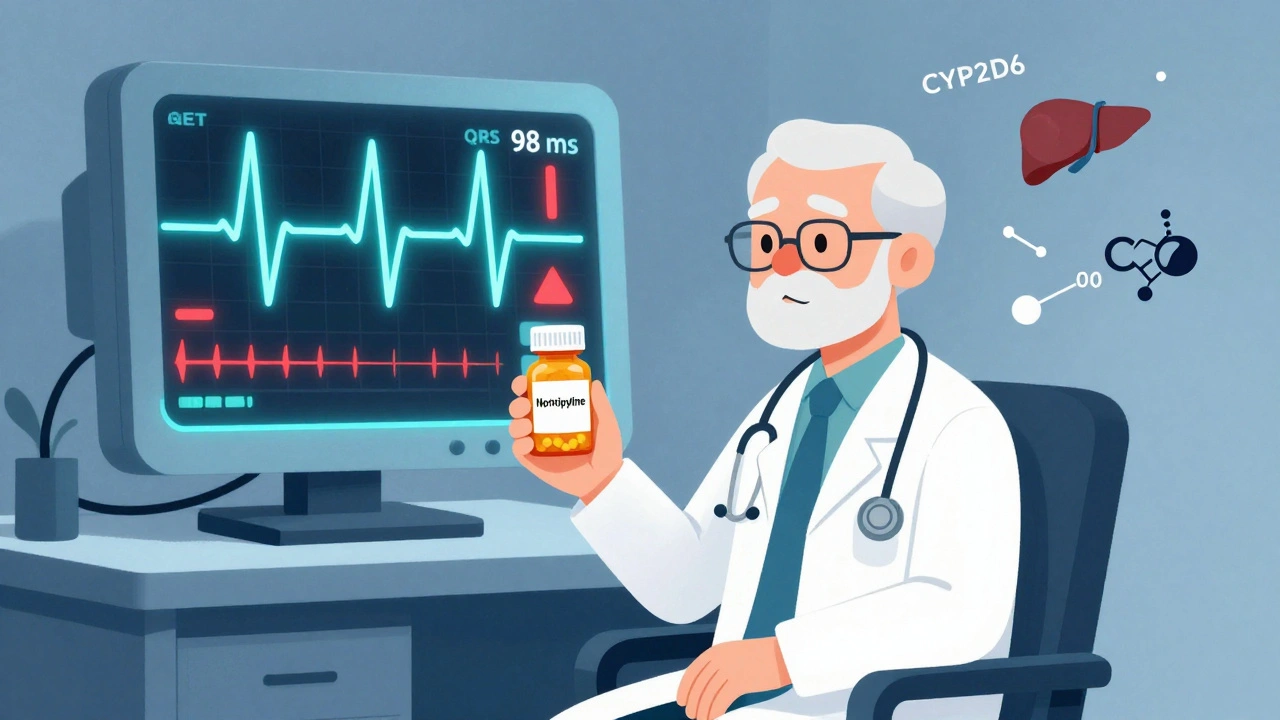
The real danger is cardiac toxicity. TCAs block sodium channels in heart muscle cells. This slows down electrical signals, widening the QRS complex on an ECG. Once it hits 100 milliseconds or more, you’re looking at a high risk of ventricular arrhythmias, including torsades de pointes. That’s a type of irregular heartbeat that can turn fatal in minutes. And here’s the kicker: you might not feel anything until it’s too late.
Studies show that TCAs cause 5 to 10 times more deaths in overdose than newer antidepressants like SSRIs. Even though they’re prescribed less now, they still account for 15-20% of fatal prescription overdoses. That’s not because people are trying to kill themselves-it’s often because their levels crept up slowly. A 70-year-old on amitriptyline for depression might also be taking an antihistamine for allergies. That drug blocks the same liver enzyme (CYP2D6) that clears amitriptyline. Suddenly, their blood level jumps from 120 ng/mL to 280 ng/mL. No warning. No symptoms. Just a quiet, deadly buildup.
What Therapeutic Drug Monitoring Actually Measures
Therapeutic drug monitoring (TDM) for TCAs isn’t just checking a number. It’s a full picture: the parent drug, its metabolites, and how your body handles them.
For amitriptyline, the safe range is 80-200 ng/mL. Nortriptyline? 50-150 ng/mL. Desipramine? 100-300 ng/mL. But these aren’t hard lines. Some people crash at 160 ng/mL. Others tolerate 220 without issue. That’s why TDM looks at more than just concentration.
It checks the metabolite-to-parent ratio (MPR). If nortriptyline levels are high compared to amitriptyline, it means your body is converting it quickly-likely because you’re an ultrarapid metabolizer. If the opposite is true, you might be a poor metabolizer. That’s often tied to your genes. About 7% of people of European descent have a CYP2D6 variant that makes them slow metabolizers. Their TCA levels can be 20 to 30 times higher than normal at the same dose.
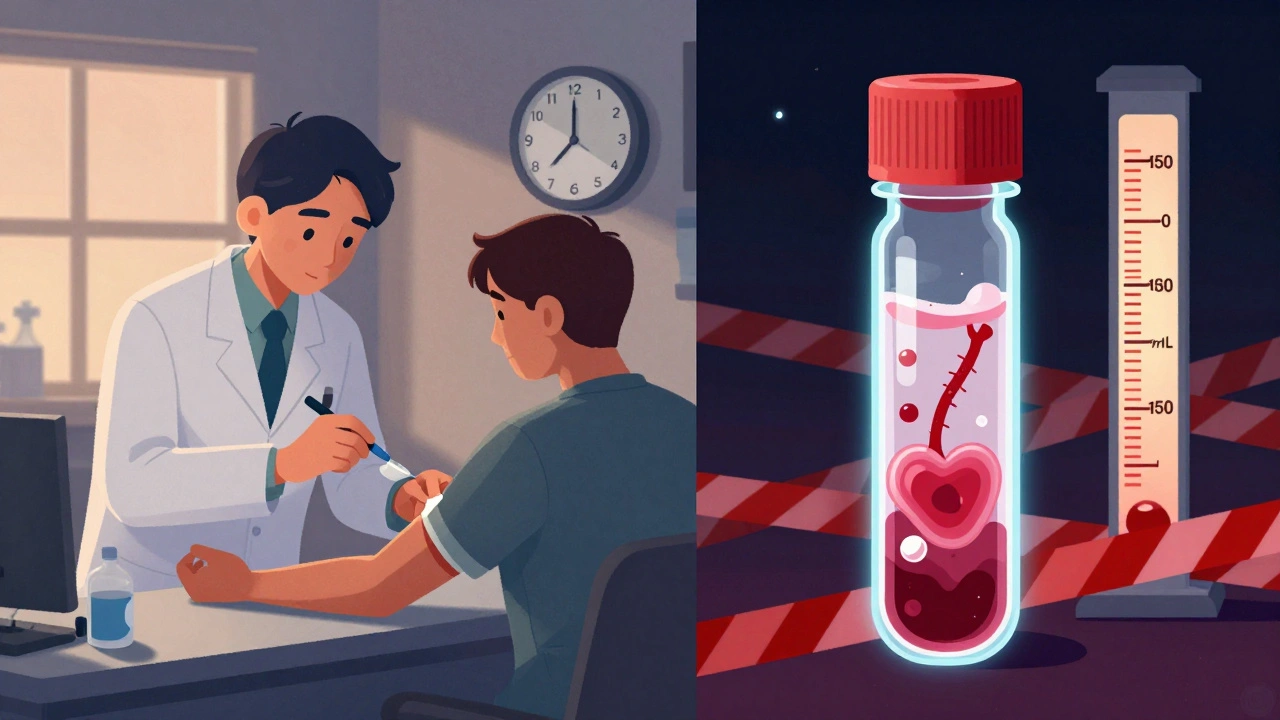
Timing matters too. Blood must be drawn right before your next dose-this is called the trough level. If you get tested too soon after taking your pill, the number looks artificially high. And you need at least 5-7 days of consistent dosing for levels to stabilize. Many doctors skip this step. That’s why 28% of TDM requests are invalid from the start.
When TDM Saves Lives
A 74-year-old man in Bristol was on 75 mg of nortriptyline for depression and chronic pain. He felt fine. No side effects. But his doctor ordered a TDM test anyway. The result: 185 ng/mL. Above the 150 ng/mL ceiling. His ECG showed a QRS of 98 ms-just under the danger line. They cut his dose to 50 mg. Two weeks later, his level dropped to 110 ng/mL. His ECG normalized. He stayed out of the hospital.
Compare that to a case in Manchester. A 68-year-old woman on 100 mg of amitriptyline collapsed at home. Her ECG showed a QRS of 140 ms. Her blood level? 190 ng/mL-technically within the "therapeutic" range. But she was a slow metabolizer. Her body couldn’t clear the drug. She needed sodium bicarbonate, intubation, and days in the ICU. Her TDM had never been done. The doctor assumed her dose was safe because it was "standard."
That’s the problem with relying on clinical judgment alone. Symptoms of TCA toxicity-drowsiness, confusion, rapid heartbeat-look like depression worsening or aging. Without a blood test, you’re guessing. TDM gives you hard data. Studies show that using TDM cuts hospitalization risk by 35% compared to adjusting doses based on symptoms alone.
The Hidden Flaws in TDM
It’s not perfect. Labs take 24-48 hours to return results. In an emergency, you can’t wait. That’s why guidelines say: if someone has a QRS >100 ms, treat immediately-don’t wait for the lab.
Another issue? Reference ranges vary. One lab says 80-200 ng/mL for amitriptyline. Another says 70-180. That 15-20% difference can lead to wrong dose changes. And 32% of TDM requests don’t even say why the test was ordered. No indication. No current dose. No timing of last dose. That’s like asking a mechanic to fix your car without telling them what’s broken.
Then there’s cost. In the U.S., one test runs $150-$250. In the UK’s NHS, it’s covered-but delays and paperwork still slow things down. And many patients stop coming in for blood draws once they feel better. One nurse practitioner on Reddit said she lost 40% of her TDM patients after the first test. They thought they were cured. They weren’t. They just needed steady monitoring.
Who Needs TDM the Most
You don’t need it for every TCA user. But you absolutely need it for:
- Patients over 65-40% of TCA users are elderly. Their livers clear drugs slower. Their brains are more sensitive to anticholinergic effects.
- People on multiple medications-especially antihistamines, SSRIs, or antifungals. These can block CYP2D6 or CYP2C19.
- Those with heart conditions or a history of arrhythmias.
- Anyone with unexplained dizziness, confusion, or ECG changes.
- People who haven’t improved after 4-6 weeks on a stable dose.
For healthy adults under 50 with no other meds and no heart issues, TDM might be less urgent. But even then, it’s still the safest path.
The Future of TCA Monitoring
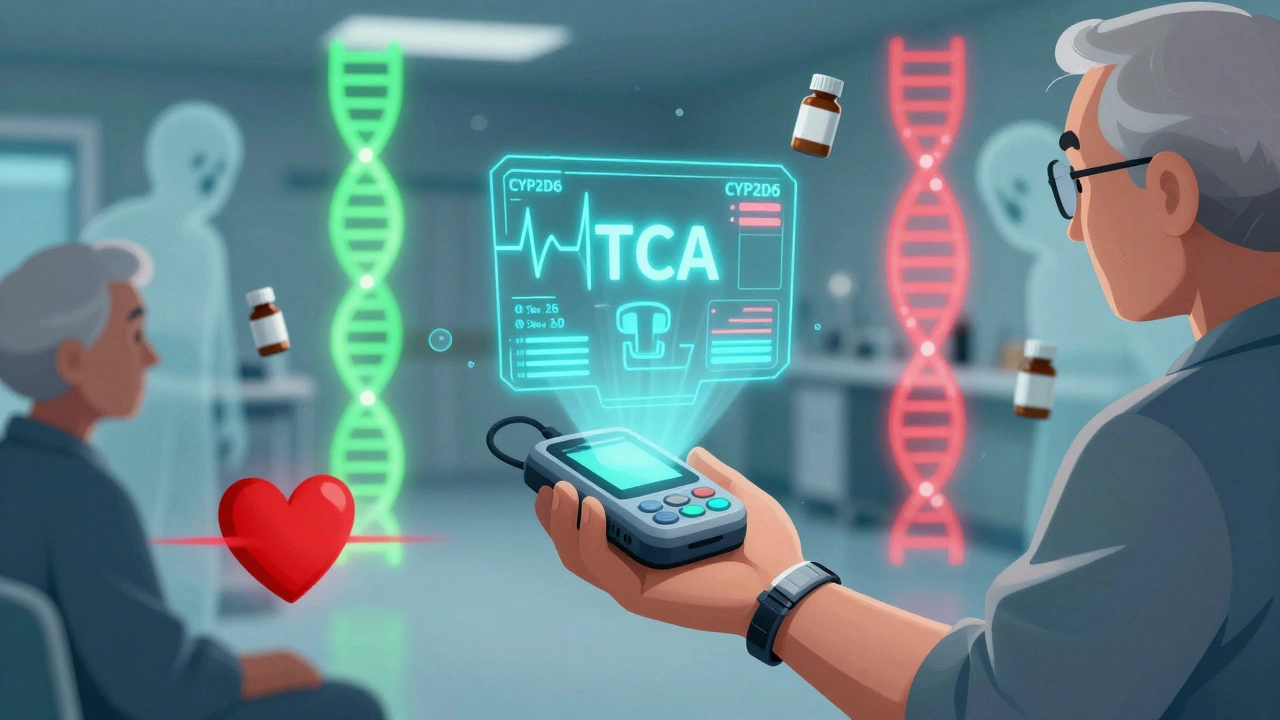
There’s new tech coming. Siemens Healthineers just launched a handheld TDM device in Europe that gives results in 20 minutes. No lab needed. No wait. The FDA also approved an AI tool called PsychX Analytics that combines TCA levels with ECG data, age, and other meds to predict toxicity risk. It’s not perfect-but it’s getting closer.
And now, more clinics are combining TDM with genetic testing. If you know you’re a slow metabolizer, you start on half the usual dose. That cuts the time to reach safe levels by 40%. In trials, patients needed fewer blood tests overall.
But the bottom line hasn’t changed. TCAs have a razor-thin safety margin. Even experts agree: if you’re prescribing them, you’re responsible for monitoring them. The American Psychiatric Association calls TDM a Level 1 recommendation-meaning the evidence is strong enough to require it.
What You Can Do Right Now
If you’re on a TCA:
- Ask if you’ve ever had a TDM test. If not, request one.
- Make sure your blood is drawn before your morning dose, not after.
- Bring a full list of all your meds-prescription, OTC, supplements-to every appointment.
- Don’t skip follow-up blood tests just because you feel fine.
- If you’re over 65 or on other meds, push for a baseline ECG before starting.
If you’re a clinician:
- Always document the reason for TDM. Is it for toxicity? Non-response? Polypharmacy?
- Include the exact dose, timing of last dose, and time of draw on the request form.
- Don’t rely on lab reference ranges alone. Correlate with ECG and symptoms.
- Consider pharmacogenetic testing for patients with poor response or side effects.
TCAs aren’t going away. They’re still the best option for treatment-resistant depression in older adults and for nerve pain. But their power comes with responsibility. Monitoring isn’t bureaucracy. It’s prevention. One test. One saved life.
How often should TCA blood levels be checked?
The first test should be done after 5-7 days of consistent dosing, once steady-state levels are reached. After that, check every 3-6 months if stable. More often if doses change, new meds are added, or side effects appear. Elderly patients or those on multiple drugs may need testing every 2-3 months.
Can I stop TDM if I feel better?
No. Feeling better doesn’t mean your drug level is safe. TCAs build up over time, and toxicity can develop slowly. Many people feel fine until their heart starts misfiring. Stopping monitoring increases your risk of sudden, life-threatening complications-even if you’ve been stable for months.
What if my TCA level is in the "therapeutic" range but I still have side effects?
Individual sensitivity varies. Some people have side effects at 100 ng/mL. Others tolerate 250 ng/mL. Your ECG, symptoms, and age matter more than the number alone. If you have dry mouth, constipation, dizziness, or a prolonged QRS on ECG, your dose may still be too high-even if the level looks "normal."
Do I need TDM if I’m on a low dose?
Yes-if you’re over 65, on other meds, or have heart issues. Even low doses can become toxic if your body can’t clear the drug. A 25 mg dose of amitriptyline in a slow metabolizer can hit 200 ng/mL. That’s the upper limit of safety. Dose doesn’t always predict level.
Are there alternatives to blood tests for monitoring TCAs?
Not yet. ECG changes are the best early warning, but they only show up after toxicity is already happening. New tools like AI platforms and handheld devices are emerging, but they still rely on blood levels. Until continuous monitoring is approved, blood tests remain the gold standard.
If you're managing TCA therapy, don't wait for a crisis to start monitoring. Proactive TDM isn't just good practice-it's the only way to make these powerful drugs safe.
11 Comments

Laura Saye
December 6 2025
It’s fascinating how pharmacokinetics operates in the shadows of clinical intuition-our bodies are not abstract variables but intricate, genetically coded ecosystems. The CYP2D6 polymorphism, for instance, doesn’t merely alter metabolism-it redefines the very ontology of therapeutic safety. A ‘standard dose’ is a colonial fiction when applied to a species as genetically heterogeneous as ours. TDM isn’t just monitoring-it’s epistemic humility in action.

Michael Dioso
December 7 2025
LMAO. You people treat TCAs like they’re nuclear waste. SSRIs have their own crap-weight gain, emotional numbness, sexual dysfunction-but nobody’s running around with ECGs and blood draws like it’s a damn horror movie. If your grandma’s on 25mg and not dead yet, chill. This is overmedicating disguised as medicine.

Juliet Morgan
December 9 2025
My mom’s on nortriptyline and she’s 71. She thought she was fine-until her doctor finally ordered the test. Level was 178. She had zero symptoms. Now she’s on 30mg. She sleeps better, no dizziness. Don’t wait till you’re in the ER. Ask for the test. Seriously. Your life isn’t a gamble.

William Chin
December 10 2025
As a board-certified psychiatrist with over two decades of clinical experience, I must emphasize that the absence of regulatory compliance in therapeutic drug monitoring constitutes a material breach of the standard of care as defined by the American Psychiatric Association’s Practice Guidelines (2023 Edition). Failure to implement TDM in elderly polypharmacy patients is not negligence-it is malpractice.

James Moore
December 12 2025
They say TCAs are dangerous-but who’s really responsible? Big Pharma pushed SSRIs because they’re more profitable, right? And now the medical-industrial complex is scared to admit that TCAs work better for chronic pain and treatment-resistant depression-so they’ve turned monitoring into a bureaucratic nightmare to scare people away. You think this is about safety? It’s about control. And the labs? They’re cashing in. $200 for a blood test? That’s a racket.

Lucy Kavanagh
December 13 2025
Did you know the NHS started tracking TCA deaths in 2018 and found 63% of them were in patients who’d been told their levels were ‘normal’? That’s not coincidence. That’s a cover-up. The government doesn’t want you to know how many people die because labs use different reference ranges. They’re hiding it. And now they’re pushing AI tools-like that PsychX thing-to make you trust machines instead of your own body. Wake up.

Stephanie Fiero
December 14 2025
my dr told me i didnt need tdm bc i was on a low dose... i got a qrs of 112 at 100ng/ml. i was fine till i wasnt. dont listen to anyone who says you dont need it. just get the test. its one needle. save your heart.

Krishan Patel
December 14 2025
It is not merely medical negligence-it is a moral failure of Western medicine to reduce the human organism to a chemical equation. The ancient healers of Ayurveda understood balance; they did not require blood draws to sense the rhythm of the body. Yet here we are, in the 21st century, reducing sentient beings to pharmacokinetic variables, trusting algorithms over intuition. The true toxicity is not in the drug-it is in the arrogance of believing we can quantify life.

sean whitfield
December 15 2025
So we need a $200 blood test to make sure a 75-year-old doesn't die from a drug that's been around since the 60s? Cool. Meanwhile, your antidepressant app just sold your data to a pharma company. Who's really running the show?

Carole Nkosi
December 16 2025
TCAs are not the problem. The system is. Doctors don’t test because they’re too busy. Labs take too long. Patients forget. It’s all broken. But if you’re still alive after 6 months on amitriptyline, you’re probably fine. Stop overthinking. Just take your pill and live.



Norene Fulwiler
December 5 2025
I had a cousin on amitriptyline for nerve pain-she felt fine until she collapsed at Thanksgiving. Turned out her antihistamine for allergies was slowing her metabolism. They didn’t test her levels until it was too late. This post? It’s a wake-up call. If you’re on TCAs, get tested. No excuses.