
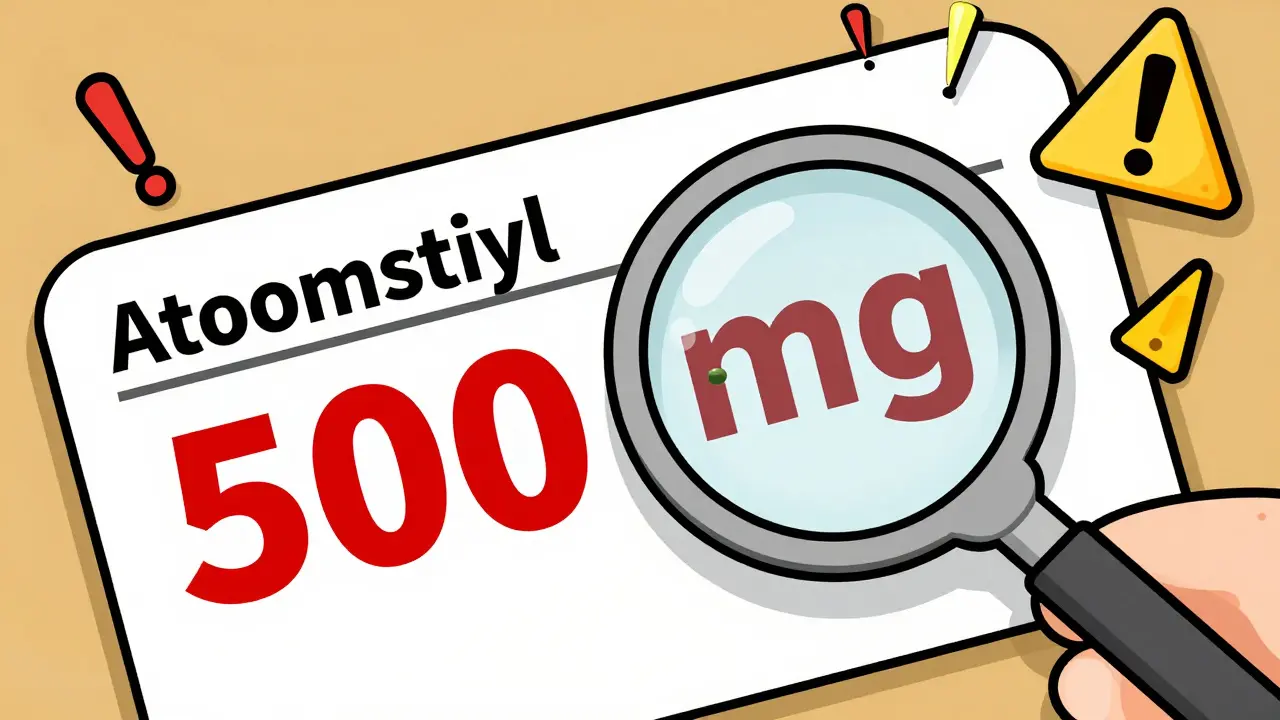
Every time you pick up a prescription, there’s a hidden safety check built into the label-medication strength and quantity. These two pieces of information aren’t just details; they’re your last line of defense against dangerous mistakes. A single misread can mean taking 10 times too much-or too little-of a drug. And it happens more often than you think.
In 2022, the American Society of Health-System Pharmacists reported over 1.3 million medication errors in the U.S. alone. About 22% of those involved wrong strength or quantity. That’s not a statistic-it’s a person who took a 500 mg pill thinking it was 50 mg. Or a child who got a double dose because the liquid label said 5 mg/mL instead of 0.5 mg/mL. These aren’t rare accidents. They’re preventable.
What Medication Strength Really Means
Strength tells you how much active drug is in each dose. It’s not just a number. It’s a unit. And mixing up units can be deadly.
For pills and capsules, strength appears as something like 500 mg or 10 mcg. That means each tablet or capsule contains that exact amount. If your doctor prescribed 500 mg, but the label says 250 mg, you’re getting half the dose. That could make your blood pressure medication useless-or cause your infection to worsen.
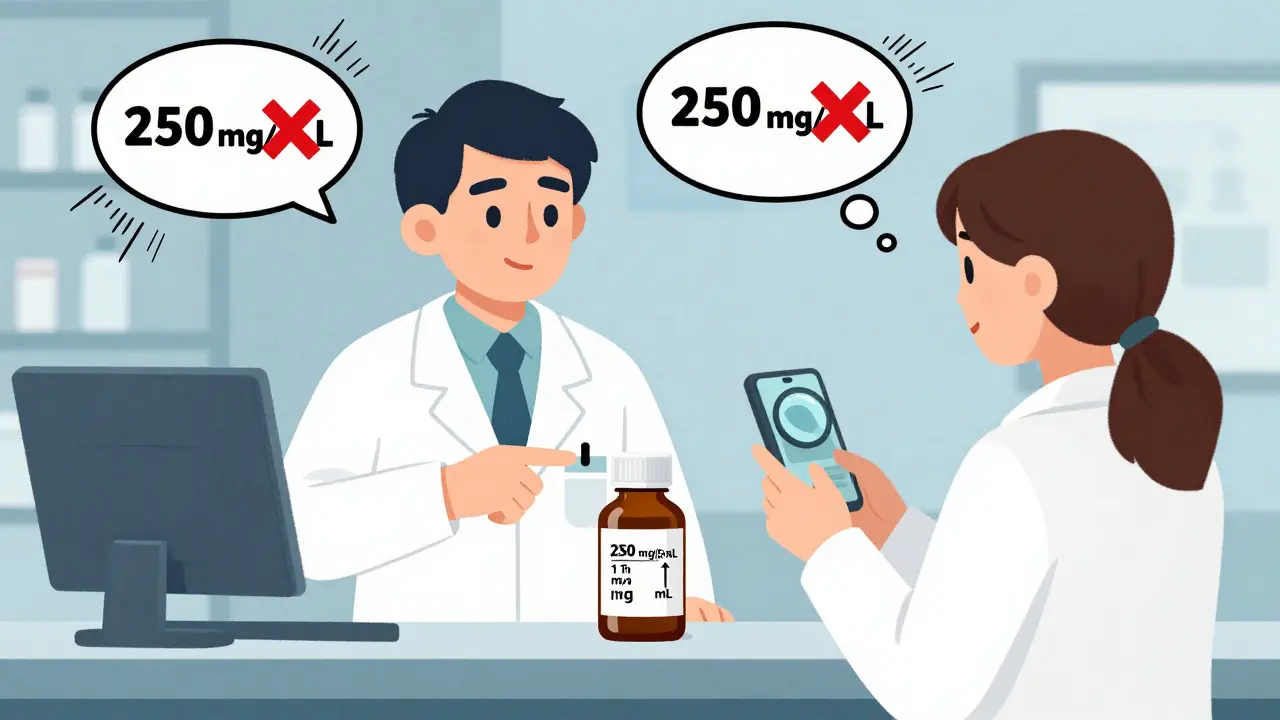
Liquids are trickier. Instead of just a number, you’ll see a ratio: 250 mg/5 mL. This means every 5 milliliters (about one teaspoon) contains 250 milligrams of the drug. If you confuse this with 250 mg/mL-a 10-fold difference-you could overdose instantly. That’s why pharmacists are trained to say: "Always read the full ratio, not just the first number."
Topical creams and ointments use percentages. 1% hydrocortisone means 1 gram of drug per 100 grams of cream. If you think it’s 10%, you’re applying 10 times more steroid than intended. That can cause skin thinning, stretch marks, or even adrenal suppression with long-term use.
What Quantity Tells You
Quantity is how much the pharmacy gave you total. It’s not how much to take each time. It’s the whole supply.
For pills: 30 tablets means 30 pills in the bottle. If your prescription says take one daily, that’s a 30-day supply. If you see 90 tablets instead, you might have been given a refill you didn’t ask for-or the wrong drug entirely.
For liquids: 120 mL means 120 milliliters total. If you’re supposed to take 5 mL twice a day, that’s 12 days’ worth. If the bottle says 60 mL, you’re missing half your supply. That’s a red flag.
Creams and ointments: 30 grams means 30 grams total. A gram is about the size of a pea. So 30 grams is roughly a tablespoon. If you’re told to use a pea-sized amount twice daily, 30 grams should last about 15 days. If it’s labeled 15 grams, you’re only getting half.
Always double-check: Does the quantity match the number of days your doctor said you’d need? If your prescription says 14 days and you got 90 pills, ask. It’s not a mistake-it’s a safety step.
Where to Find Strength and Quantity on the Label
Pharmacies don’t always put this info in the same spot. But there’s a pattern.
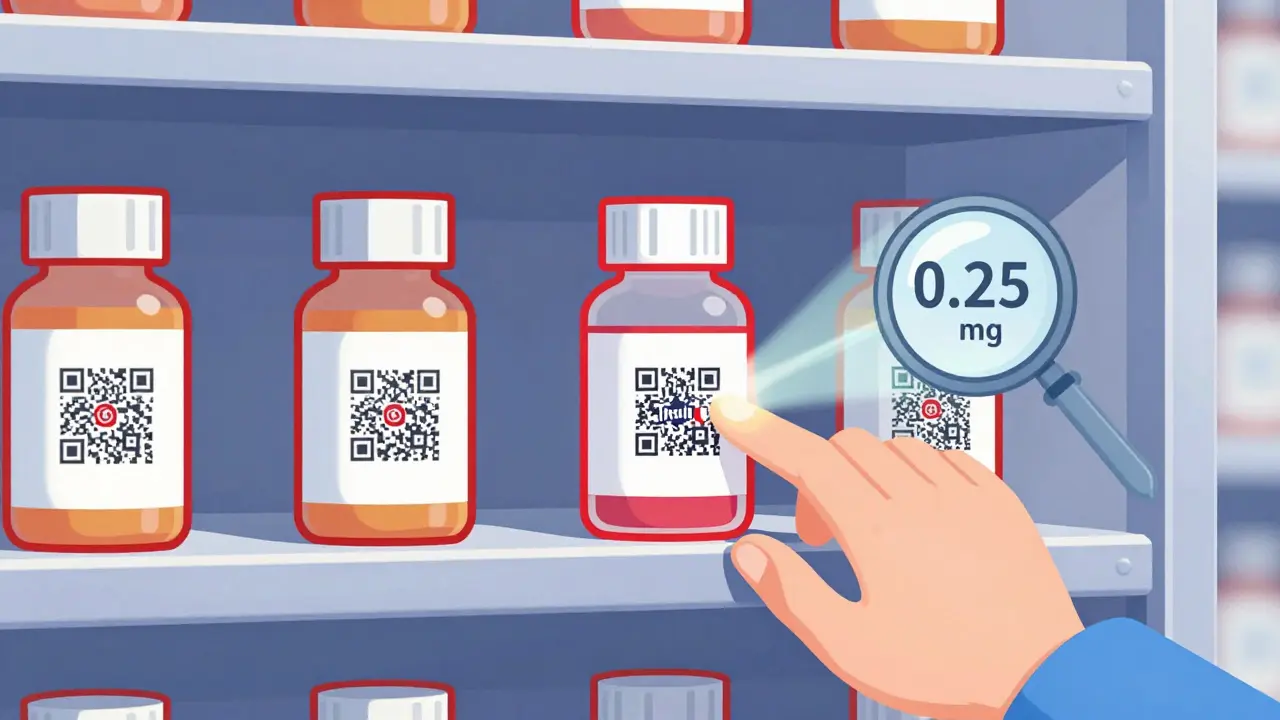
Strength is always right next to the drug name. At CVS, it’s usually directly under the medication. At Walgreens, it’s often in parentheses: Amoxicillin (500 mg). At Kaiser Permanente, you might even see a small box labeled "Strength Verified" with a QR code you can scan to confirm.
Quantity is almost always on the bottom line of the label, right above the pharmacy’s contact info. It will say something like: Dispense: 30 tablets or Quantity: 120 mL.
Here’s what to look for:
- Is the strength written in full? No abbreviations like "U" for units (could be mistaken for "0").
- Is the unit clear? "mg" not "MG", "mcg" not "ug".
- For liquids: Is the ratio written as "X mg/Y mL"? Not just "X mg"?
- Is the quantity in the correct unit? Tablets, mL, grams-not "bottles" or "containers".
Most pharmacies follow federal guidelines (FDA 21 CFR § 1306.13), so the format is consistent across chains. But presentation? That varies. That’s why you can’t assume-you have to read.
How to Verify It Yourself (4 Simple Steps)
Don’t just take the label at face value. Verify it. Here’s how:
- Locate the strength right beside the drug name. Don’t skip this step. Even if you’ve taken the drug before, strength can change. A new batch might be 10 mg instead of 5 mg.
- Check the units. Is it mg, mcg, or IU? A mistake here can mean a 1,000-fold error. 0.1 mg is not the same as 100 mg. If you’re unsure, ask the pharmacist to explain it in plain terms.
- For liquids, confirm the ratio. If it says "5 mg/5 mL", then 1 mL = 1 mg. If you’re supposed to take 2 mL, you’re getting 2 mg. If the ratio is missing, or it just says "5 mg", that’s a red flag. Ask for clarification.
- Match quantity to your prescription. If your doctor said "take 1 pill a day for 14 days," you should get 14 pills. If you got 30, ask why. It might be a refill you didn’t expect-or a mistake.
Use your phone. If the text is too small, turn on the magnifier in your camera app. Many pharmacists recommend this. In a 2023 survey, 76% of pharmacists said patients who used magnifying tools caught errors others missed.
Common Mistakes and How to Avoid Them
People make the same errors over and over. Here are the top three:
- Misreading decimals: 0.25 mg looks like 25 mg. This causes 14% of strength errors. Always say it out loud: "zero point two five milligrams." Never assume.
- Confusing total quantity with daily dose: You see "30 tablets" and think you take 30 a day. No. That’s the total supply. The daily dose is usually printed separately on the label or in the instructions.
- Not checking liquid ratios: 5 mg/mL is 10 times stronger than 0.5 mg/mL. Yet 32% of pediatric overdoses happen because caregivers misread this. Always write it down: "5 mg per 5 mL" means 1 mg per mL.
Here’s a real example from Reddit: A mom picked up her son’s amoxicillin. The label said "500 mg/5 mL." She thought it was "250 mg/5 mL" because that’s what the doctor prescribed. She gave him the full dose. He had a seizure. She caught it only because she compared it to the last bottle. She didn’t know the strength had changed. She was lucky.
You can be lucky too. But only if you check.
What to Do If Something Looks Wrong
If the strength or quantity doesn’t match what your doctor told you, don’t guess. Don’t assume it’s a typo. Don’t take it anyway.
Call the pharmacy. Say: "I need to verify the strength and quantity on this prescription. Can you confirm the drug, dose, and total amount?" They’re trained to help. They expect this question.
If they can’t explain it clearly, ask to speak to the pharmacist on duty. Pharmacists are the last safety net. They’re legally required to catch errors before you leave the counter.
And if you still feel uneasy? Take the prescription back. Ask for a new one. It’s your right. It’s your safety.
Why This Matters More Than Ever
More people are on multiple medications now. The average Medicare beneficiary takes 4.7 prescriptions daily. That’s a lot of labels to read. And with aging populations, vision and memory decline. That’s why the FDA updated its guidelines in May 2023: clearer fonts, color-coded alerts for high-risk drugs, and mandatory QR codes linking to official dosage guides.
By January 2025, all labels for drugs with narrow therapeutic indexes-like warfarin, insulin, or lithium-will have red borders around the strength. That’s not decoration. It’s a warning.
And the technology is catching up. CVS, Walgreens, and Kaiser now use AI to scan labels before dispensing. But AI doesn’t replace you. It supports you. Your eyes, your questions, your willingness to double-check-that’s what stops the error before it happens.
Medication errors don’t happen because doctors prescribe wrong. They happen because labels are misread. And you’re the one who reads them last.
So next time you pick up a prescription, pause. Look at the strength. Look at the quantity. Ask if anything’s unclear. It takes 10 seconds. It could save your life.
What if the strength on my prescription label doesn’t match what my doctor told me?
If the strength on the label doesn’t match what your doctor prescribed, do not take the medication. Call the pharmacy immediately and ask them to verify the prescription with your doctor’s office. Pharmacies are required to confirm all prescriptions before dispensing. It’s possible there was a mix-up, a typo, or a refill error. Never assume the label is correct-always verify.
Why do some labels say "mg" and others say "mcg"? Does it matter?
Yes, it matters greatly. "mg" means milligram (one-thousandth of a gram). "mcg" means microgram (one-millionth of a gram). That’s a 1,000-fold difference. Taking 5 mg instead of 5 mcg is like taking a full pill instead of a tiny fraction. This is why pharmacists must write "mcg" and never "ug" or "μg"-those can be misread. Always confirm the unit. If you’re unsure, ask the pharmacist to spell it out.
How can I tell if a liquid medication’s strength is correct?
For liquids, look for a ratio: "X mg/Y mL". For example, "250 mg/5 mL" means each 5 milliliters contains 250 milligrams of the drug. To find the dose per milliliter, divide the first number by the second: 250 ÷ 5 = 50 mg/mL. If your doctor told you to take 2 mL, you’re getting 100 mg. If the label only says "250 mg", it’s incomplete. Always insist on seeing the full ratio. Never rely on the total number alone.
Can I use my phone to read small print on prescription labels?
Yes, and many pharmacists recommend it. Use your phone’s camera with the magnifier feature (on iPhone: Settings > Accessibility > Magnifier; on Android: download a free magnifying app). This is especially helpful for older adults or those with low vision. A 2023 survey found that 76% of pharmacists said patients who used magnifying tools caught labeling errors others missed. It’s a simple tool that makes a big difference.
Are there any new changes to prescription labels I should know about?
Yes. Starting January 1, 2025, the FDA requires all labels for high-risk medications (like insulin, blood thinners, and seizure drugs) to have a red border around the strength information. Also, nearly all major pharmacies now include QR codes on labels that link to official FDA medication guides. Scanning them with your phone gives you clear dosage instructions in plain language. Some pharmacies are even testing NFC tags that let you tap your phone to hear a voice reading the label aloud.
15 Comments

Eric Knobelspiesse
February 10 2026
hmmmm interesting post but like… i dunno man. i’ve been taking metformin for 8 years and never read the label. just look at the color of the pill. blue = 500mg, white = 850mg. works every time. also, why are we even talking about mcg vs mg? if your doc prescribes it, they know what they’re doing. maybe we should trust professionals instead of turning every pill bottle into a forensic investigation? just sayin’.

Ritu Singh
February 11 2026
As a pharmacist in Mumbai with over two decades of experience, I must commend the clarity of this post. In India, where polypharmacy is rampant and literacy varies widely, these distinctions are not merely academic - they are life-or-death. I have seen mothers give their children 10 mL of syrup thinking it was 1 mL because the label read ‘5 mg/mL’ without the slash being clear. We conduct weekly community sessions on label reading. The fact that the FDA is introducing red borders for high-risk drugs is a step toward equity. But technology alone cannot replace human education. We must teach patients to read, not just scan. And we must empower them to ask - without shame - ‘Can you say that again?’

Mark Harris
February 12 2026
YESSSS this is so needed! I work in ER and last month a guy came in with a potassium level of 7.8 because he thought his ‘5 meq’ tablet was ‘50 meq’. He didn’t even know the difference. I told him to take a pic of the bottle next time and zoom in. He did. Saved his life. Also - use the magnifier app! It’s free. It’s easy. It’s literally one tap. Why wouldn’t you? Your life isn’t a gamble.

Savannah Edwards
February 13 2026
I’ve been reading labels since my mom had a stroke from misreading her blood thinner. She thought ‘5 mg’ meant ‘5 tablets’. She took 25 mg instead of 5. She was in the ICU for three weeks. Since then, I’ve made it a ritual: I read every label out loud, I write down the strength and quantity on a sticky note, and I compare it to the doctor’s note on my phone. I even have a checklist. It sounds obsessive, but I’d rather be called paranoid than be another statistic. And yes - I use the magnifier. I’m 32 and my eyes are fine, but I still do it. Because I’ve seen what happens when you assume.

Mayank Dobhal
February 14 2026
u mad bro? this is basic. if u cant read a label u prob shouldnt be on meds.

Marcus Jackson
February 16 2026
Most people don’t know what ‘mcg’ stands for. I’ve asked. Half said ‘milligram’. That’s not ignorance - it’s systemic failure. The FDA should mandate a spoken audio version on every label via QR code. Not just text. Voice. In English and Spanish. And maybe Hindi too. This isn’t about reading. It’s about accessibility.

Natasha Bhala
February 18 2026
i love this. i used to ignore labels too until my grandma almost died. now i always zoom in. i dont even trust the pharmacist anymore. i check twice. its not paranoia its self care. thanks for saying this.

Gouris Patnaik
February 19 2026
This is why India is better off with Ayurveda. Western medicine is built on confusion. Who even needs to know ‘mcg’? We’ve been using neem, turmeric, and ashwagandha for 5000 years without a single label. Your fear of dosage is a symptom of colonial mindset. Let go of the pill. Return to nature.

Ashley Hutchins
February 21 2026
So now we’re policing how people read labels? What’s next? Mandatory literacy tests before you get a prescription? This is just another way for the government to control the poor. If you’re too lazy to read, maybe you shouldn’t be taking meds at all. And why are we trusting pharmacists? They’re paid by the same companies that make the drugs. It’s all a scam.

Sarah B
February 21 2026
if you cant read a label dont take the med

Tola Adedipe
February 21 2026
I’ve been a pharmacist in Toronto for 15 years. This post is spot on. But here’s the real issue: insurance companies force us to dispense 90-day supplies even when the prescription says 30. So the quantity on the label doesn’t match the doctor’s intent. We’re caught between regulations and safety. We flag it, we call the prescriber, we explain - but patients still take it. The system is broken. The label isn’t the problem. The policy is.

Heather Burrows
February 22 2026
i mean… it’s kind of sad that we have to treat adults like children just to keep them from killing themselves. maybe we should stop prescribing so many drugs? instead of teaching people to read labels… why not just stop making them necessary?

Amit Jain
February 23 2026
OMG this is why I stopped trusting American medicine. I’m from Delhi and we don’t even have labels like this. We just get a small slip with the name and ‘take twice daily’. No units. No ratios. No QR codes. And guess what? We don’t die. We don’t have 1.3 million errors. We have common sense. You people overcomplicate everything. Just take the damn pill. If you’re scared, don’t take it. Simple.

Jesse Lord
February 23 2026
My 78-year-old dad used to ignore labels until he had a fall from low blood pressure. He thought his ‘5 mg’ blood pressure pill was ‘50 mg’ because the ‘0’ looked smudged. I printed out a cheat sheet for him: ‘mg = milligram’, ‘mcg = microgram’, ‘per 5 mL = per teaspoon’. I laminated it. He keeps it in his wallet. He says it’s the most important thing he carries. I didn’t fix his eyesight. I just gave him a tool. And now he asks questions. That’s the win.
Write a comment
Popular Posts

Patrick Jarillon
February 9 2026
Let me guess - this whole post is just Big Pharma’s way of keeping you dependent on their overpriced pills. You think reading labels is the solution? Nah. The real issue is that drug companies deliberately design labels to confuse people. Ever notice how every prescription comes with a 12-page leaflet in 6-point font? That’s not an accident. That’s intentional obfuscation. And don’t get me started on QR codes - those are just tracking devices. Your phone scans it, your data gets sold, and then your insurance hikes your premiums because ‘you’re high-risk’. This isn’t safety. It’s control.