
Medicaid covers prescription drugs for millions of Americans, but knowing what’s actually included isn’t as simple as it sounds. Just because you’re enrolled doesn’t mean every medication is automatically approved. States run their own Medicaid programs, and that means your coverage depends on where you live, what drug you need, and even how many other drugs you’ve tried first.
Everything Is Covered - Except When It’s Not
Technically, Medicaid doesn’t have to cover prescription drugs under federal law. But here’s the reality: every state does. That’s because skipping drug coverage would leave too many low-income people without access to life-saving treatments. So while it’s optional on paper, in practice, it’s mandatory in every state and D.C.
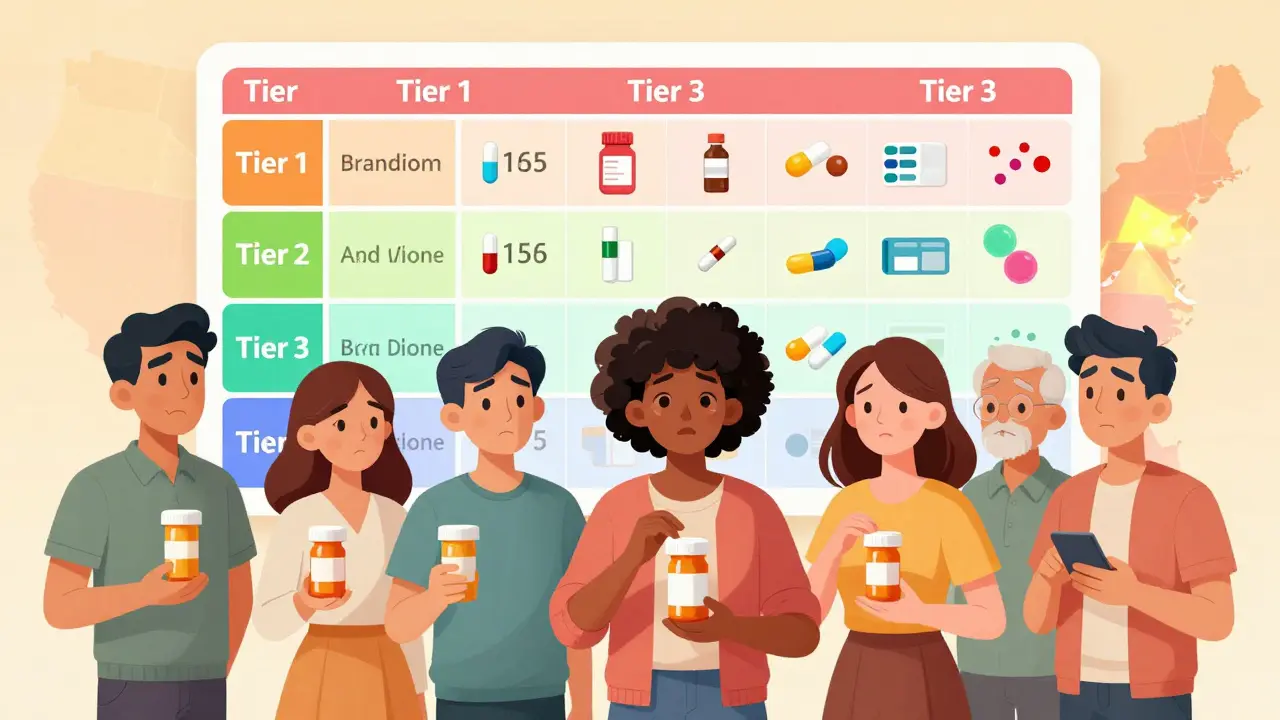
But coverage doesn’t mean free access. Medicaid uses a Preferred Drug List - also called a formulary - to decide which drugs are covered and how much you pay. These lists are split into tiers. Tier 1 is usually generic drugs with the lowest copay. Tier 2 includes brand-name drugs that cost more. Tier 3 and higher are for specialty drugs, often used for complex conditions like cancer, multiple sclerosis, or rheumatoid arthritis.
For example, if you need a generic blood pressure pill, you might pay $3. Tier 2 might cost $15. And a specialty drug for hepatitis C? That could be $50 or more - unless you qualify for extra help.
Step Therapy: Try This First
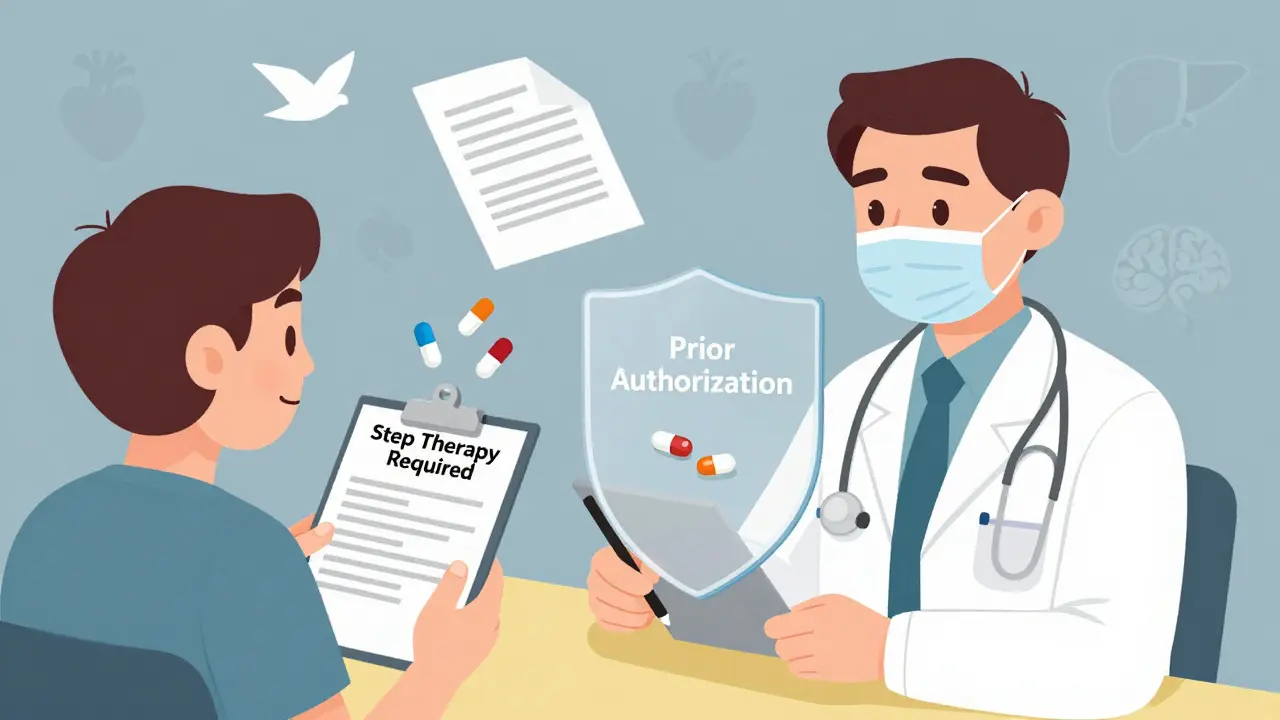
One of the biggest surprises for new Medicaid beneficiaries is step therapy. Also called “trial and failure,” this rule says you have to try at least two cheaper, preferred drugs before Medicaid will pay for the one your doctor originally prescribed.
Let’s say your doctor prescribes a brand-name antidepressant. Medicaid might require you to try two generic SSRIs first - even if you’ve already tried them before and they didn’t work. Only after those two fail can you get the original drug approved. Some states require two failures; others require just one.
North Carolina, for instance, requires two failed trials for most drug classes. Florida has similar rules. But not all states are this strict. In some, exceptions are made if your doctor proves the preferred drugs won’t work for your condition - like if you have a known allergy or severe side effect.
These rules exist to save money. According to the Medicaid and CHIP Payment and Access Commission, state formularies cut drug spending by 15-25%. North Carolina saved $127 million between 2010 and 2023 just by managing its drug list.
Prior Authorization: The Paperwork Hurdle
Even if a drug is on the formulary, it might still need prior authorization. This means your doctor has to submit paperwork - often including lab results, medical history, or proof that other treatments failed - before Medicaid will approve the prescription.
Drugs that commonly require prior authorization include:
- High-cost specialty medications
- Drugs with abuse potential (like opioids or stimulants)
- Medications with cheaper alternatives
- Drugs used for off-label purposes
Processing times vary. The Medicare Rights Center found that initial requests take about 7.2 business days. Appeals? That jumps to nearly two weeks. But here’s the good news: 78% of denials are overturned when doctors provide full clinical documentation.
Some states, like North Carolina, allow prior authorizations to last up to three years for certain conditions - like Type 1 diabetes patients using premixed insulin. That cuts down on repeated paperwork.
What’s Not Covered? The List Keeps Changing
Medicaid formularies aren’t static. They change every few months. In October 2025, North Carolina removed eight drugs from its list because they no longer qualified for federal rebates. That includes medications like Vasotec, Trulance, and Vanos Cream.
Even popular drugs can be downgraded. Epidiolex®, a treatment for rare forms of epilepsy, was moved from “preferred” to “non-preferred” in July 2025 - meaning higher costs for patients unless they go through prior authorization.
Drugs are removed for two main reasons:
- They don’t offer enough savings (no rebate from the manufacturer)
- A cheaper, equally effective alternative became available
There’s no national list. What’s covered in Texas might be denied in Ohio. Always check your state’s current formulary - and ask your pharmacist to confirm before filling a prescription.
Costs: Copays, Deductibles, and Extra Help
Most Medicaid enrollees pay little to nothing for prescriptions. But there are exceptions.
States can charge small copays - up to $3 for generics and $5 for brand-name drugs. But many states waive these for children, pregnant women, and people in nursing homes.
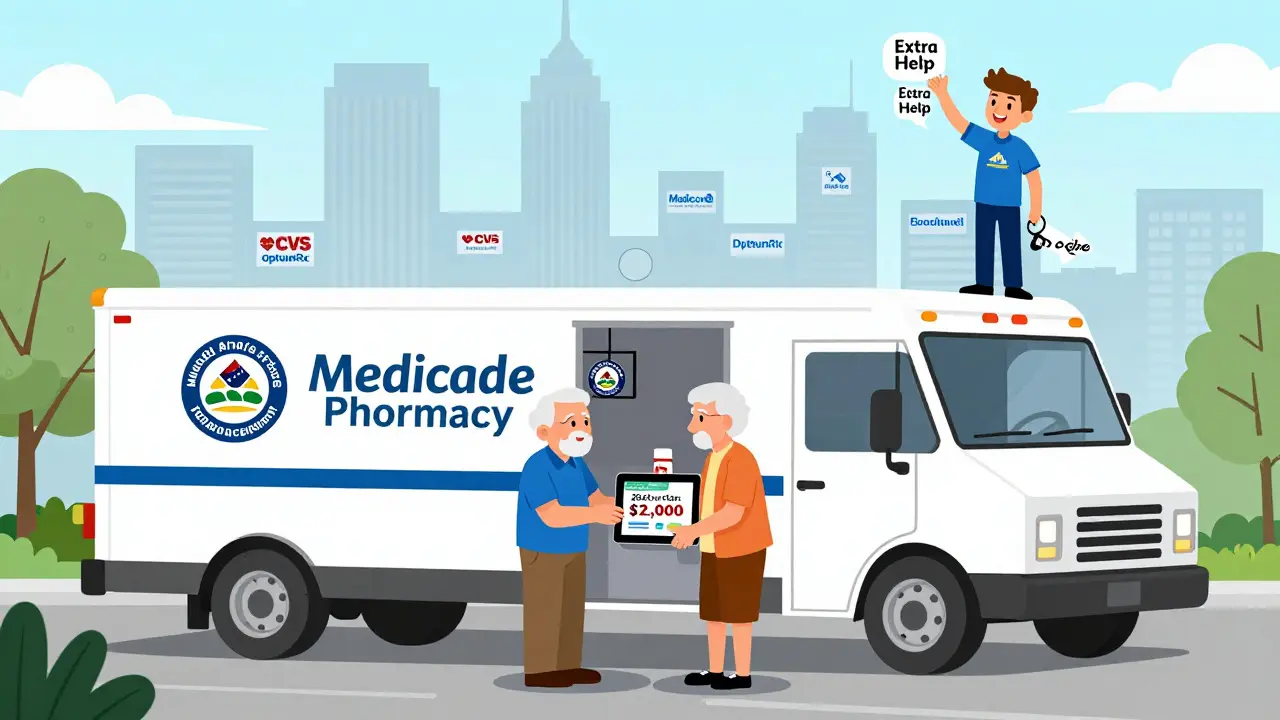
If you also have Medicare, you might qualify for Extra Help - a federal program that reduces out-of-pocket costs even further. In 2025, Extra Help means:
- $0 monthly premium
- $0 deductible
- Maximum $4.90 copay for generics
- Maximum $12.15 for brand-name drugs
- $0 cost after you hit $2,000 in annual drug spending
Here’s the catch: 1.2 million people who qualify for Extra Help don’t know it. If you’re on full Medicaid, get SSI payments, or have state help with Medicare Part B premiums, you’re likely eligible - but you have to apply.
Where to Get Your Medications
You can’t just walk into any pharmacy. Medicaid works with a network of approved pharmacies. If you go outside that network, you’ll pay full price.
Most states encourage or require mail-order for maintenance medications - things you take daily, like blood pressure or diabetes drugs. You can usually get a 90-day supply through mail-order for the same price as a 30-day retail fill.
Pharmacy benefit managers (PBMs) like CVS Caremark, Express Scripts, and OptumRx handle these networks. They negotiate prices with drugmakers and manage the formularies. If your drug gets removed from the list, it’s usually because your state’s PBM renegotiated a deal.
What’s Changing in 2026
Big changes are coming. In early 2026, the Centers for Medicare & Medicaid Services (CMS) will require states to prove their formularies don’t block medically necessary drugs. That means states can’t just remove drugs to save money - they have to show patients still have access to effective treatments.
Also, the Inflation Reduction Act’s $2,000 annual cap on out-of-pocket drug costs for Medicare Part D now applies to dual-eligible beneficiaries (those on both Medicare and Medicaid). That’s a huge win for older adults with chronic conditions who take multiple expensive drugs.
And there’s more: 22 states are testing new payment models for gene therapies - drugs that cost over $2 million per dose. These models tie payments to outcomes. If the drug doesn’t work, the state doesn’t pay the full price. It’s a new way to manage costs without denying care.
What You Should Do Right Now
If you’re on Medicaid and take prescriptions, here’s what to do:
- Find your state’s current Preferred Drug List. Search “[Your State] Medicaid Preferred Drug List 2026”.
- Check if your medication is on the list - and what tier it’s in.
- Ask your doctor if prior authorization is needed. Have them submit it early.
- Ask if step therapy applies. If you’ve already tried other drugs, tell your doctor - they can skip the trial process with proper documentation.
- Apply for Extra Help if you’re also on Medicare. It’s free and could cut your costs in half.
- Use in-network pharmacies. Call ahead to confirm.
Don’t wait until your prescription runs out. Changes happen fast. A drug that was covered last month might be gone next month. Stay informed. Talk to your pharmacist. Call your state’s Medicaid helpline. And don’t assume your doctor knows every detail - many don’t.
Need Help? You’re Not Alone
State Health Insurance Assistance Programs (SHIPs) offer free counseling. They help people understand their Medicaid drug coverage. On average, new beneficiaries need about three sessions to fully understand their benefits.
Online communities like Reddit’s r/Medicaid are full of real stories - people sharing how they got denied a drug, how they appealed, and how they finally got it approved. You’re not the first to face this. And there’s always a way through.
Medicaid was built to make sure no one has to choose between food and medicine. But navigating it takes effort. Know your rights. Ask questions. And keep pushing until you get the care you need.
Does Medicaid cover all prescription drugs?
No. Medicaid covers most prescription drugs, but each state creates its own list of approved medications called a Preferred Drug List. Some drugs are excluded because they don’t offer enough savings, have cheaper alternatives, or don’t qualify for federal rebates. Always check your state’s current formulary before filling a prescription.
Why do I have to try other drugs before Medicaid pays for mine?
This is called step therapy or trial and failure. States use it to control costs by requiring patients to try lower-cost, preferred drugs first. You typically need to fail two of them before Medicaid covers a more expensive option. Exceptions exist if your doctor proves the cheaper drugs won’t work for you - like due to allergies or past side effects.
What if my drug gets removed from the Medicaid list?
If your drug is removed, you may still get it through prior authorization if your doctor shows medical necessity. Some states allow temporary coverage while you switch to an alternative. Check your state’s formulary updates regularly - changes happen often, sometimes multiple times a year.
How much will I pay for prescriptions under Medicaid?
Most Medicaid enrollees pay little to nothing. Copays are usually $3 for generics and $5 for brand-name drugs, but many states waive these for children, pregnant women, and seniors. If you also qualify for Medicare Extra Help, your costs drop even further - to as low as $4.90 for generics and $12.15 for brands, with $0 after $2,000 in annual spending.
Can I use any pharmacy with Medicaid?
No. You must use a pharmacy in your state’s Medicaid network. Out-of-network pharmacies won’t be paid by Medicaid, and you’ll have to pay full price. Most states encourage using mail-order pharmacies for maintenance medications like blood pressure or diabetes drugs - you can often get a 90-day supply at the same cost as a 30-day retail fill.
How do I find out if I qualify for Extra Help with drug costs?
If you’re enrolled in full Medicaid, receive Supplemental Security Income (SSI), or get help paying your Medicare Part B premiums, you automatically qualify for Extra Help. You don’t need to apply separately - but many people don’t know this. Contact Medicare at 1-800-MEDICARE or visit Medicare.gov to confirm your eligibility and enroll if needed.
12 Comments

Amber Lane
January 22 2026
My mom got denied her insulin last month. They said there was a ‘cheaper alternative.’ It was a different brand that made her dizzy. She had to go to the ER. Now they’re covering it again - after the hospital billed them $12,000. Sometimes the system only listens when it costs more to say no.

Sangeeta Isaac
January 23 2026
So Medicaid’s got a formulary that changes faster than my ex’s Instagram bio. One month my seizure med’s covered, next month it’s ‘not cost-effective.’ Meanwhile, the PBM’s making bank off rebates while I’m Googling ‘how to beg for medicine’ on Reddit. #MedicaidHell

Rod Wheatley
January 25 2026
For anyone struggling with prior auth: always, ALWAYS send your doctor’s letter with lab results, prior treatment history, and a signed statement saying ‘this patient has failed all alternatives.’ I’ve had 17 approvals in 3 years - every single one overturned on appeal because I documented everything. It’s tedious, but it works. Also, call your state’s Medicaid helpline daily. They have internal codes for fast-tracking if you’re persistent.
And if you’re on Medicare too - apply for Extra Help even if you think you don’t qualify. I missed it for 4 years. Found out I was eligible because I got SSI for 3 months in 2020. $0 copays now. Life-changing.
Also - mail order for maintenance meds? 100% worth it. Got my 90-day supply of metformin for $0 copay. Retail would’ve been $15. Save your time and your cash.

Jerry Rodrigues
January 25 2026
Been on Medicaid for 8 years. Never had an issue until last year when they dropped my thyroid med. Took two appeals, a letter from my endocrinologist, and a call from my state rep to get it back. The system isn’t broken - it’s just designed to make you fight for everything.

Stephen Rock
January 26 2026
Wow the government actually cares about my blood pressure meds
next thing you know theyll start paying for my yoga mat

Andrew Rinaldi
January 26 2026
It’s interesting how we frame this as a ‘system failure’ when really it’s a reflection of how we value health in a market-driven society. The fact that we need to ‘prove’ medical necessity to get life-sustaining drugs says more about our priorities than it does about Medicaid’s design.
Maybe the real question isn’t how to fix the formulary - but why we ever let profit dictate access to medicine in the first place.

shubham rathee
January 27 2026
you know what the real problem is? the drug companies are lying to the states about how much their meds cost so they can get bigger rebates
and the states are just playing along because its easier than fighting big pharma
its all a scam

Philip Williams
January 29 2026
While the structural barriers are undeniably frustrating, it’s important to recognize that Medicaid’s formulary management is not inherently malicious - it’s a response to finite resources and rising drug prices. The goal is to ensure sustainability while preserving access. That said, the implementation often lacks compassion.
Step therapy, when applied with clinical nuance and timely appeals, can be a rational tool. But when it’s automated, rigid, and under-resourced, it becomes a barrier. The real reform needed isn’t just in policy, but in the training and staffing of utilization review teams.
Additionally, the shift toward outcome-based payments for gene therapies is a promising innovation. If we can tie reimbursement to real-world efficacy, we may finally align financial incentives with patient outcomes - not just cost containment.
What’s needed is a hybrid model: strict formularies with robust exceptions, automated prior auth with AI-driven clinical review, and mandatory patient advocacy support at every step. We can do better - but we must design with empathy, not just economics.

Alex Carletti Gouvea
January 30 2026
Why are we even spending taxpayer money on this? If you can’t afford your meds, get a better job. Medicaid is just encouraging laziness.

Ashok Sakra
February 1 2026
my cousin in india he pay 2 dollar for same drug why we pay 50
americans so spoiled

Kevin Narvaes
February 1 2026
they dont care about you they just wanna make sure you dont die in the street before tax season
and the guy who wrote this post? he works for a pbm

Ben McKibbin
January 21 2026
Let’s be real - step therapy isn’t just bureaucracy, it’s emotional sabotage. I had to fail three antidepressants before they’d approve the one that actually worked. One of them gave me tremors. Another made me cry in the grocery store for no reason. And yet, the system demanded I ‘try them first.’ This isn’t cost-saving - it’s cruelty dressed up as policy.
And don’t get me started on prior auth. My doctor spent three hours filling out forms for a drug that’s been on the market for 12 years. The approval took 11 days. I ran out of meds on day 9. I had to beg a friend for a spare pill. That’s not healthcare. That’s a game of Russian roulette with your health.