
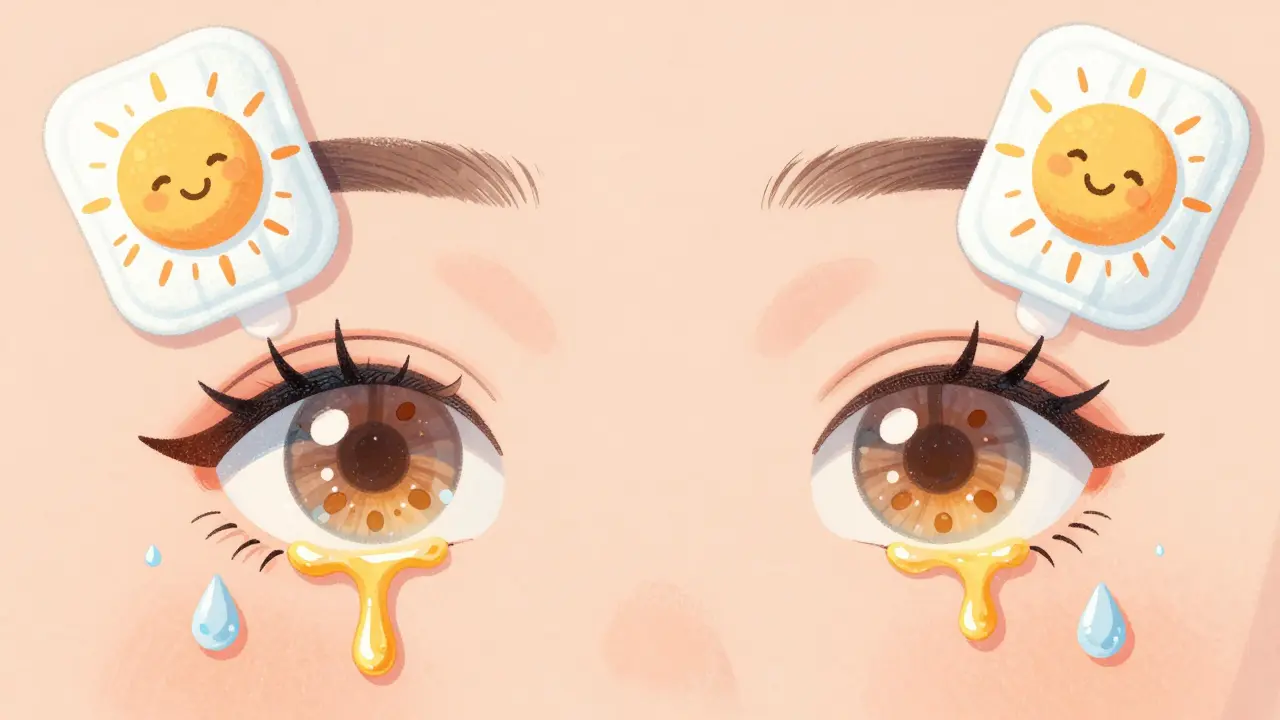
What Is Meibomian Gland Dysfunction?
Meibomian gland dysfunction, or MGD, is the most common cause of dry eyes. It happens when the tiny oil glands in your eyelids get clogged or stop working right. These glands make the oily layer of your tear film - the part that keeps your eyes from drying out too fast. When they’re blocked, your tears evaporate quickly, leaving your eyes red, gritty, burning, or blurry. It’s not just discomfort; untreated MGD can lead to corneal damage and long-term vision problems.
There are two main types: obstructive MGD, where the glands are physically blocked, and hypersecretory MGD, where the glands make too much oil - but it’s thick and poor quality. About 86% of people with dry eye disease have MGD. And it gets worse with age. By the time you’re in your 50s or 60s, there’s a very good chance you’re dealing with it - even if you don’t realize it yet.
Why Home Care Alone Isn’t Enough
Most people start with warm compresses and eyelid scrubs. That’s a good first step. But if you’ve been doing that for months and still feel like there’s sand in your eyes, you’re not alone. Studies show that without professional help, over 60% of people see symptoms come back within six months. Why? Because home care doesn’t clear deep blockages. It soothes surface inflammation, but it doesn’t unclog the glands themselves.
Think of it like trying to unclog a drain with hot water when the pipe is full of hardened grease. You might get some flow, but the real blockage stays. That’s what happens in MGD. The oil inside the glands turns waxy and sticks to the duct walls. No amount of daily scrubbing will dissolve that.
In-Office Treatments That Actually Work
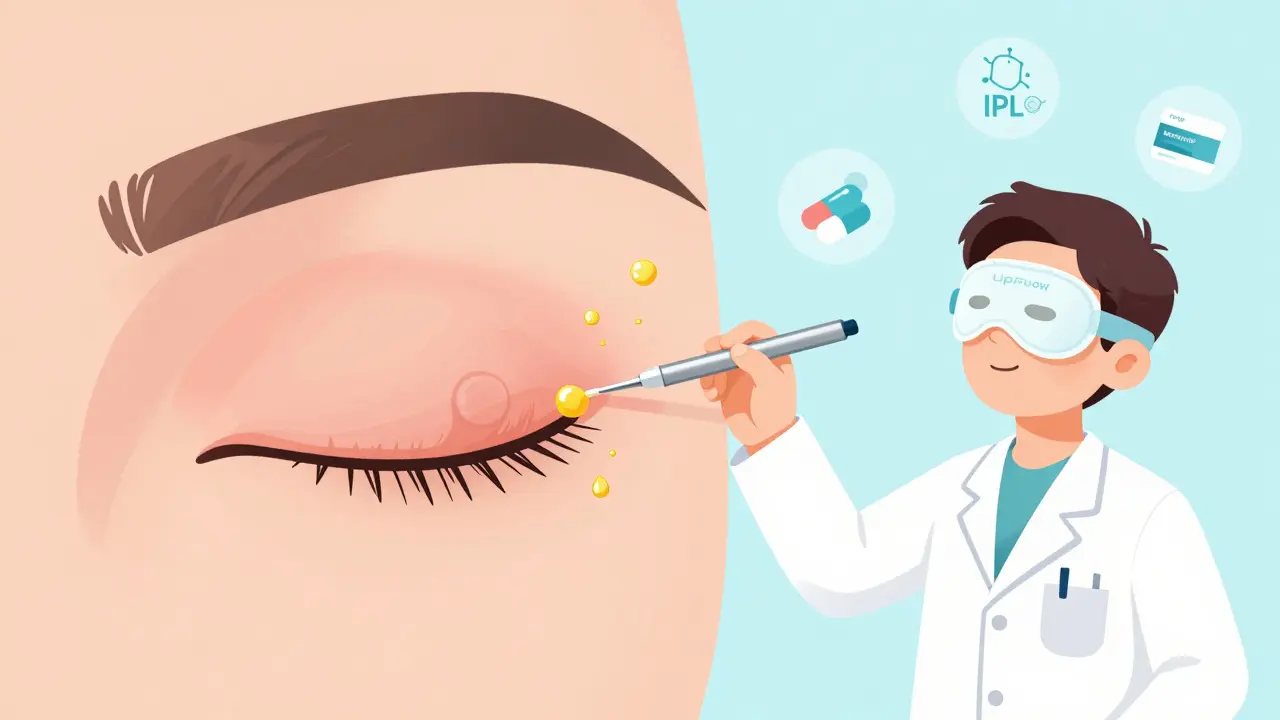
When home care isn’t cutting it, there are three proven in-office treatments: LipiFlow, IPL therapy, and meibomian gland probing.
LipiFlow uses controlled heat and gentle massage to melt and squeeze out the blocked oil. It’s a 12-minute procedure per eye, done in a doctor’s office. Clinical studies show it improves gland function by up to 68% in obstructive MGD. Patients report relief within days, and benefits often last 6 to 12 months. But it’s expensive - $1,500 to $2,500 per eye - and most insurance plans don’t cover it.
IPL (Intense Pulsed Light) targets the tiny blood vessels around the eyelids that cause inflammation. It’s not a direct gland treatment, but reducing inflammation helps the glands work better. IPL is usually done in four sessions, three weeks apart. When combined with manual gland expression, it cuts OSDI scores (a dry eye symptom scale) from 32.6 down to 18.3. About 78% of patients still feel better six months later. But IPL alone? Not enough. It must be paired with expression.
Meibomian Gland Probing (MGP) is the most direct approach. A thin probe is inserted into each gland to physically break through blockages. It’s done under local numbing drops. This isn’t new - it’s been used for over a decade - but it’s still underused. Dr. Scheffer Tseng says most thermal devices miss the real problem: fibrosis around the ducts. Probing addresses that directly. When combined with heat, studies show 85% of patients maintain improvement after a year.
Medications That Help - and Which Ones to Avoid
Antibiotics aren’t always the answer, but when used right, they can make a big difference.
Azithromycin is now the top oral choice. A five-day course (500 mg on day one, then 250 mg daily) works as well as a month-long doxycycline regimen - but with far fewer side effects. In one study, 78.6% of patients saw less redness with azithromycin versus 62.3% with doxycycline. And only 3.2% had nausea or stomach issues with azithromycin, compared to 28.6% with doxycycline. It’s short, effective, and well-tolerated.
Topical lifitegrast (5%) is an anti-inflammatory eye drop. It doesn’t unclog glands, but it reduces the inflammation that makes MGD worse. In patients with advanced MGD, corneal staining scores dropped from 12.4 to 5.7 in just 12 weeks. It’s for those who’ve tried everything else and still have burning or light sensitivity.
Don’t waste time on long-term doxycycline unless you have severe inflammation. The side effects - sun sensitivity, upset stomach, yeast infections - often outweigh the benefits.
The Home Routine That Makes All the Difference
Even after in-office treatment, your daily habits determine whether the relief lasts.
Here’s what works, based on real patient compliance data:
- Warm compress - 5 minutes, twice a day. Use a Bruder Mask heated to 40-42°C. Microwaveable masks are better than towels because they hold heat longer.
- Lid massage - After the compress, gently rub your upper and lower lids from the nose outward with a clean finger. This pushes oil out of the glands.
- Lid cleaning - Use hypochlorous acid solution (like OCuSOFT Lid Scrub) to wipe the lash line. Do this once a day. It kills bacteria and breaks down debris.
That’s 10-15 minutes total. Sounds simple? It is. But only 43% of patients stick with it after six months. And guess what? Those who don’t? Their symptoms return. Compliance isn’t optional - it’s the foundation.
Who Needs to Act Now?
Early treatment changes everything. If you’ve had symptoms for less than a year, your glands are still mostly intact. Treatment success rates are 37% higher than for those who wait five years or more. By then, glands may be permanently damaged - and no treatment can bring them back.
That’s why experts now recommend screening for MGD even before cataract surgery. If your glands are blocked, surgery can make dry eye worse. Treating MGD first cuts post-op inflammation by 40%.
If you wear contacts and they feel uncomfortable by midday, or if your eyes burn after staring at a screen, or if you wake up with crusty lashes - you might have MGD. Don’t assume it’s just “dry eyes.” It’s likely MGD.

What’s Next? The Future of MGD Care
Research is moving fast. Exosome therapy - using natural healing signals from your own cells - is showing 92% improvement in early trials. Nanomicellar cyclosporine (like Cequa) delivers medication deeper into the eye with 35% better results than older drops. Genetic studies are even pointing to IL-17 as a key player in MGD inflammation, which could lead to targeted biologic drugs in the next five years.
But here’s the truth: none of that matters if you don’t do the basics. No matter how advanced the tech gets, you’ll still need warm compresses, lid hygiene, and follow-up care. The future of MGD treatment isn’t about flashy new gadgets - it’s about consistency.
Cost, Insurance, and Real-World Barriers
Let’s be honest: the biggest hurdle isn’t finding a treatment - it’s paying for it. LipiFlow runs $1,500-$2,500 per eye. IPL costs $800-$1,200 per session. Probing is $750-$1,200. Most insurance plans won’t cover any of it. Only 15-20% of commercial insurers approve MGD procedures. Even Medicare doesn’t cover them routinely.
Some clinics offer payment plans. Some patients use HSA or FSA accounts. A few get partial coverage if they document severe symptoms and failed home therapy. But don’t expect easy reimbursement. This is still considered “elective” by many insurers, even though it prevents permanent damage.
And yes - it’s frustrating. But consider this: if you’ve been buying artificial tears every month for years, you’ve already spent hundreds. Treatment might cost more upfront, but it can stop the cycle.
Final Takeaway: MGD Is Manageable - But Not Curable
Meibomian gland dysfunction isn’t something you “fix” once and forget. It’s a chronic condition, like high blood pressure. You manage it. You don’t cure it.
But you can live comfortably. You can avoid vision damage. You can stop relying on drops that just mask the problem.
The key is three things: act early, combine treatments, and stick to daily care. Skip one of those, and you’re setting yourself up for frustration.
If you’ve been told your dry eyes are just “aging,” or “from screens,” or “stress” - ask for a meibomian gland evaluation. It’s quick, painless, and often covered by insurance if you’re seeing an eye doctor for another reason. Don’t wait until your eyes hurt every day. Start now - before the glands are gone for good.
13 Comments

Nishant Sonuley
January 18 2026
You know what's funny? Everyone's rushing to buy LipiFlow like it's the holy grail, but have you ever stopped to ask why these glands even get clogged in the first place? It's not just age or screens - it's the processed oils in our diet, the lack of omega-3s, and the fact that we've forgotten how to blink properly. We've turned our eyes into factory machines. The real treatment? Unplug. Slow down. Let your body remember how to heal.

Andrew Qu
January 19 2026
I've been doing the Bruder mask + lid massage routine for 8 months now. After years of burning eyes and fake tears, my vision finally feels clear by 3 PM. It’s not glamorous, but it works. Stick with it.

Tyler Myers
January 20 2026
Azithromycin? That’s just antibiotics with a marketing team. Big Pharma doesn't care if you heal - they care if you keep buying. They’d rather you take drops forever than fix the root cause.

Wendy Claughton
January 21 2026
I just started the routine after reading this… and I’m already noticing a difference 🥹 Thank you for sharing the truth - not the fluff. You’ve given me hope.

Naomi Keyes
January 22 2026
I must point out - and I say this with the utmost scientific rigor - that the claim that '86% of dry eye patients have MGD' is statistically misleading, as it conflates self-reported symptoms with clinical diagnosis via meibography, which has inter-operator variability exceeding 30%. Also, the LipiFlow efficacy data comes from studies funded by TearScience, which was acquired by Johnson & Johnson - a conflict of interest that should be disclosed in bold, underlined, and italicized font.

Ryan Otto
January 22 2026
The entire premise is flawed. MGD is not a disease - it's a symptom of systemic inflammation caused by glyphosate in the food supply and fluoridated water. The medical establishment ignores this because they profit from the $40 billion dry eye industry. Probing works? Of course it does - it's mechanical. But they'll never tell you that the real solution is a ketogenic diet and infrared sauna therapy. The truth is buried under layers of corporate grease - much like your meibomian glands.

Andrew Short
January 23 2026
You people are pathetic. Spending $2,000 on a machine that 'massages' your eyelids? Just use a warm spoon. It's been done for centuries. This is why America is collapsing - we pay for magic when we could just use our hands.

Stacey Marsengill
January 25 2026
I cried when I read this. Not because I’m emotional - because I’ve spent $12,000 on eye drops, lasers, and supplements that did nothing. Then I found a doctor who probed my glands. It felt like someone pulled a cactus out of my eyeball. I haven’t worn sunglasses indoors since. I’m alive again.

Robert Cassidy
January 26 2026
Let me ask you something: if MGD is so common, why aren’t we hearing about it in every other country? Why is this only a 'Western problem'? Coincidence? Or is it tied to our obsession with screen time, plastic packaging, and the decline of traditional diets? I think we’ve been manipulated into believing our eyes are broken - when really, our culture is.

Danny Gray
January 28 2026
I wonder… if we treat MGD like a mechanical failure, are we ignoring the metaphysical? The eyes are the windows of the soul - what if the blockage isn't just in the glands, but in our refusal to truly see? To look beyond the surface? To stop consuming and start perceiving? The warmth of the compress… it’s not just heat - it’s a meditation. The massage? A ritual of surrender. We fix the gland, but we never fix the gaze.

Andrew McLarren
January 30 2026
While the clinical data presented is largely sound and methodologically rigorous, I would respectfully urge all readers to consider the socio-economic implications of these treatments. The financial burden placed on patients - particularly those without insurance or with high-deductible plans - raises serious ethical concerns regarding access to care. One cannot reasonably expect consistent compliance with a regimen that requires substantial out-of-pocket expenditure, particularly when the condition is chronic and non-life-threatening in its early stages. A public health approach, rather than a purely clinical one, is urgently needed.

Emma #########
February 1 2026
I just started the warm compress and lid scrub yesterday… and my eyes don’t feel like sandpaper anymore. I’m not a believer in miracle cures - but this? This feels like the quiet kind of healing that actually lasts.
Write a comment
Popular Posts
Aysha Siera
January 18 2026
This is all corporate propaganda. The real cause of MGD is 5G radiation weakening your tear ducts. They don't want you to know.