
When you hear the word breast cancer, it’s easy to feel overwhelmed. But knowing what screening options exist and how treatment decisions are made can turn fear into control. In 2026, the rules around mammograms and treatment paths have changed - not just slightly, but meaningfully. If you’re a woman in your 40s, 50s, or beyond, or if you have a family history of breast cancer, this isn’t just information. It’s a roadmap.
When Should You Start Getting Mammograms?
The big shift happened in 2024. For years, women were told to wait until 50 to start regular mammograms. Now, every major U.S. medical group - including the American College of Obstetricians and Gynecologists (ACOG), the American Cancer Society, and the U.S. Preventive Services Task Force - agrees: start at 40. Why the change? Data showed more women in their 40s are being diagnosed with invasive breast cancer than ever before. A 2023 study found that nearly 1 in 6 new cases occurred in women under 50. Waiting until 50 meant missing critical early windows. ACOG’s updated guidelines now say: if you’re average risk, begin screening at 40. No more waiting. No more guessing. You don’t have to choose between yearly and every-other-year screening. You choose based on your comfort and your doctor’s advice. The U.S. Preventive Services Task Force recommends every two years for women 50 to 74. But ACOG and the American Society of Breast Surgeons say annual is fine - and often better - especially if you have dense breasts or a family history.2D vs. 3D Mammography: What’s the Difference?
Most clinics still use 2D mammograms. They’re cheaper, widely available, and covered by Medicare and most insurance plans. But 3D mammography - also called digital breast tomosynthesis (DBT) - is becoming the new standard. Here’s how they compare:- 2D mammogram: Takes two flat X-ray images of each breast. It’s fast. But overlapping tissue can hide small tumors or create false alarms.
- 3D mammogram: Takes dozens of thin-slice images as the machine moves around your breast. A computer puts them together into a 3D model. This lets radiologists see through layers of tissue. It’s better at spotting cancers in dense breasts - and reduces false positives by up to 40%.
Who Needs Extra Screening?
Not everyone has the same risk. If you have a BRCA1 or BRCA2 gene mutation, a strong family history, or had chest radiation before age 30, your risk jumps. For these women, screening isn’t just mammograms - it’s mammograms plus MRI. The American Cancer Society says: if your lifetime risk is 20% to 25% or higher, start annual mammograms and breast MRIs at age 30. MRI is more sensitive than mammograms, especially for young women with dense tissue. It’s not perfect - it can find things that turn out to be harmless - but for high-risk women, it saves lives. What about dense breasts alone? If your mammogram says you have dense tissue but no other risk factors, guidelines are split. The U.S. Preventive Services Task Force says there’s not enough proof to recommend extra tests like ultrasound or MRI. But the American Cancer Society says: if your breasts are heterogeneously or extremely dense, talk to your doctor about adding screening ultrasound. Some states require doctors to tell you if you have dense breasts - and what that means for your risk.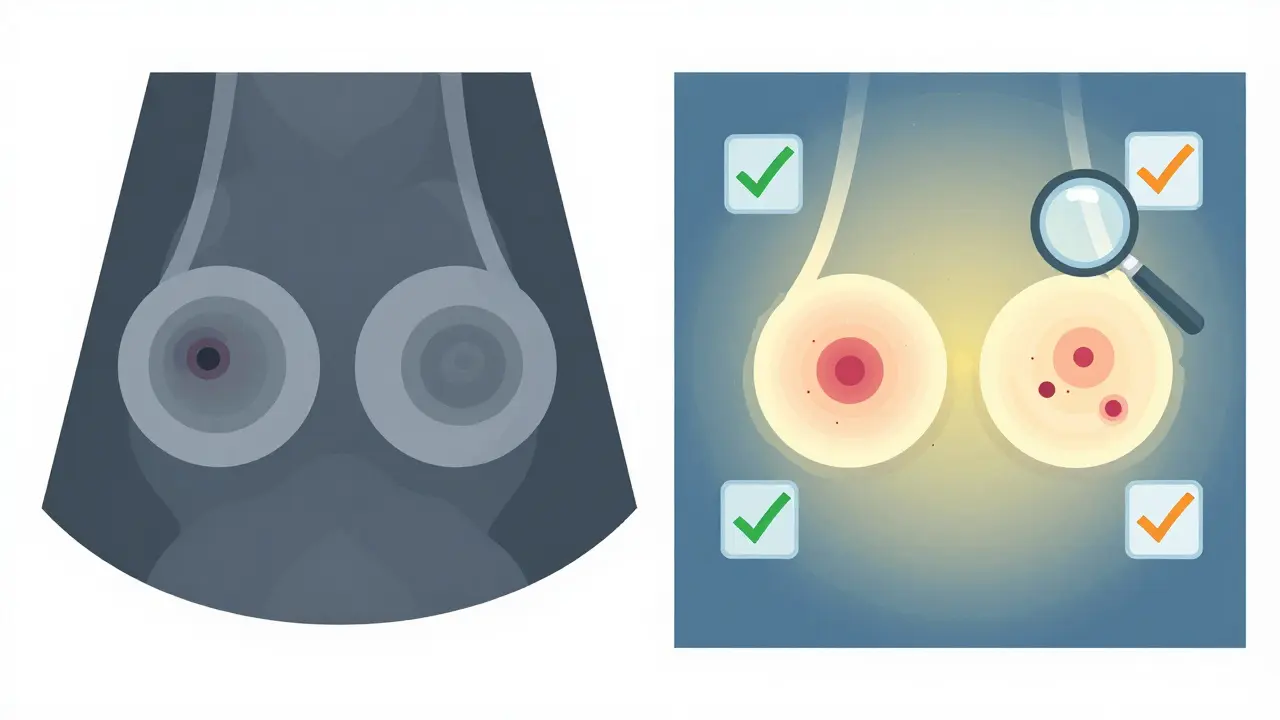
How Much Does Screening Actually Help?
Screening mammograms don’t prevent cancer. But they save lives by catching it early. A major review of nine clinical trials found that regular screening reduces breast cancer deaths by about 12% in women aged 39 to 74. That might sound small, but think of it this way: for every 1,000 women screened yearly from 40 to 74, roughly 1 to 2 deaths from breast cancer are prevented. The biggest benefit? Finding cancer before it spreads. Early-stage tumors - Stage 0 or Stage I - are often treated with just surgery and maybe radiation. No chemo. No long-term side effects. That’s the goal.What Happens After a Diagnosis?
A mammogram might find a lump. But the real work starts after a biopsy confirms cancer. Treatment isn’t one-size-fits-all. It’s built around three key things:- Stage: How big is the tumor? Has it spread to lymph nodes or elsewhere?
- Biology: Is the cancer hormone receptor-positive? HER2-positive? Or triple-negative?
- Your health: Age, menopausal status, other medical conditions, and personal goals matter.
When Does Screening Stop?
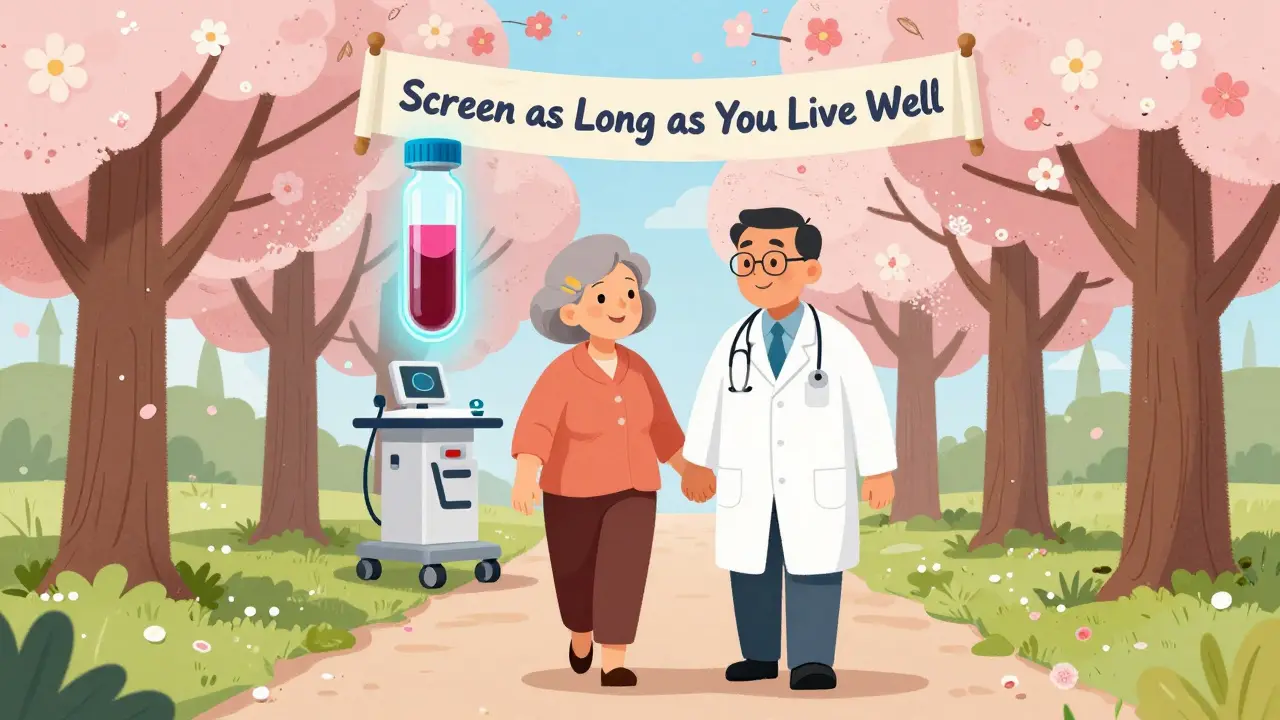
There’s no hard cutoff at 75. The American Society of Breast Surgeons says: keep screening as long as you’re in good health and your life expectancy is more than 10 years. Why? Because breast cancer risk keeps rising with age. About 30% of all cases happen in women over 70. If you’re active, healthy, and want to live well, screening makes sense. If you have serious heart disease, advanced dementia, or other life-limiting conditions, your doctor might suggest stopping. But that decision should be personal - not automatic.What’s Next for Breast Cancer Screening?
New blood tests - called liquid biopsies - are being studied to detect cancer DNA in the bloodstream. They’re not ready for routine use yet, but they could one day replace or supplement mammograms, especially for high-risk women. Artificial intelligence is also helping radiologists. Some systems can flag suspicious areas on mammograms with accuracy matching or exceeding human readers. In the UK, AI-assisted screening is already being piloted in NHS clinics. The big takeaway? Screening isn’t just a yearly appointment. It’s part of a longer conversation about your body, your risk, and your future.What to Do Now
- If you’re 40 or older and haven’t had a mammogram - schedule one.
- If you’re under 40 and have a family history of breast cancer - talk to your doctor about genetic counseling and risk assessment.
- If you’ve had a mammogram and were told you have dense breasts - ask if supplemental screening is right for you.
- If you’ve been diagnosed - don’t rush. Get a second opinion. Ask about your cancer’s subtype and treatment options.
9 Comments

Gabrielle Panchev
January 7 2026
It’s interesting how the guidelines have shifted, but not because of any groundbreaking new science-no, it’s because of pressure from advocacy groups, insurance companies, and the fact that radiologists need to justify their equipment upgrades-3D mammography is expensive, and if you’re not billing for it, your clinic’s budget takes a hit, and yes, I’ve worked in one, and no, I don’t get paid extra for pushing 3D over 2D, but the administration does, and the machines are leased, and the vendor reps are relentless, and the patients are told it’s ‘better’ even when the data says ‘marginally better for dense tissue,’ and honestly, if you’re average risk and your breasts are fatty, you’re probably fine with 2D, and yes, I’m aware that this makes me the unpopular voice in the room, but someone has to say it, and no, I won’t apologize for questioning the narrative.

Venkataramanan Viswanathan
January 9 2026
In India, we do not have widespread access to mammography, even in urban centers. Many women wait until symptoms appear. The concept of screening at 40 is still foreign to many. I have spoken to doctors in Delhi who say that for women under 45 without family history, clinical breast exams are more practical than imaging. We need culturally appropriate guidelines, not just imported American protocols. Also, cost matters. A 3D mammogram here costs more than a month’s salary for many.

Saylor Frye
January 10 2026
Let’s be real-mammograms are a 1970s technology with a 2020s price tag. The real innovation isn’t 3D imaging, it’s AI that’s being quietly deployed to reduce radiologist workload. The FDA approves these tools as ‘decision support,’ but in practice, they’re replacing humans. And yes, I’ve seen the error rates. One AI flagged a breastfeeding cyst as ‘highly suspicious.’ The radiologist overruled it. The vendor called it a ‘false negative.’

Molly McLane
January 12 2026
My mom got diagnosed at 48 after a routine mammogram. She didn’t even know she had dense breasts. The tech didn’t explain anything. I wish someone had told us about supplemental ultrasound back then. Now I make sure every woman I know asks about it. It’s not scary-it’s just smart. And if you’re scared to talk to your doctor? Bring a friend. Or text me. I’ll go with you.

Katie Schoen
January 12 2026
okay but like… why are we still talking about mammograms like they’re the only option? i mean, i get it, they’re everywhere-but what if you’re trans? or nonbinary? or just really uncomfortable with the whole thing? there’s gotta be a better way to screen people without making them feel like they’re being X-rayed at a carnival. also, 3d is kinda wild when you think about it-like, my chest got scanned from 17 different angles. i felt like a robot getting upgraded.

Beth Templeton
January 14 2026
Screening saves lives. End of story.

Tiffany Adjei - Opong
January 15 2026
Oh so now we’re all supposed to get 3D mammograms because the American Society of Breast Surgeons says so? Funny how that same society pushed for routine mammograms in the 90s and then quietly dropped the 40-year-old recommendation in 2010 only to bring it back in 2024 after a PR campaign funded by GE Healthcare. Don’t get me wrong-I’m glad we’re catching more cancers-but let’s stop pretending this is purely medical and not corporate. Also, why does no one ever mention the 20% false positive rate? That’s not ‘better,’ that’s a whole lot of anxiety, biopsies, and lost sleep for no reason.

Ryan Barr
January 17 2026
3D mammography is the gold standard. If you’re not using it, you’re practicing outdated medicine. The data is clear. The cost is justified. Any doctor who recommends 2D over 3D for a woman over 40 is either underfunded or underinformed.


Leonard Shit
January 5 2026
so i got my first mammogram at 41 and the tech said i had dense breasts like a brick wall
then they did the 3d thing and it was like watching a sci-fi movie of my own chest
turns out it was just scar tissue from a weird workout injury
still, better safe than sorry i guess